 Fundraising Fox
Ginkgo Bioworks
NYSE: DNAalso invests · investor profileYC S14YC Top CompanyTop employer of YC founders · 10Boston, US · Founded 2009 · Incorporated in Delaware · 641 employees · Public · Hiring · 88 known investors
Find your way into Ginkgo Bioworks
Sign up to see every warm intro you have to Ginkgo Bioworks
- Paths you didn't know you had: your email and LinkedIn already hold routes to the Ginkgo Bioworks team. We find them for you
- 2nd- and 3rd-degree connections: the friend-of-a-friend routes that take hours to manually find through your inbox or LinkedIn
- Answers now, not in days: momentum is everything in a raise. Skip asking around whether someone knows someone
Days of research, done the moment you sign in, with every route ranked by how warm it is.
Ginkgo Bioworks builds autonomous labs that accelerate bioengineering for applications in pharmaceutical, agricultural, and industrial biotechnology. The company serves biopharma, agritech, and industrial biotech companies seeking to engineer organisms at scale.
Also known as Ginkgo · Ginkgo Bioworks Holdings, Inc. · NYSE: DNA · The Organism Company
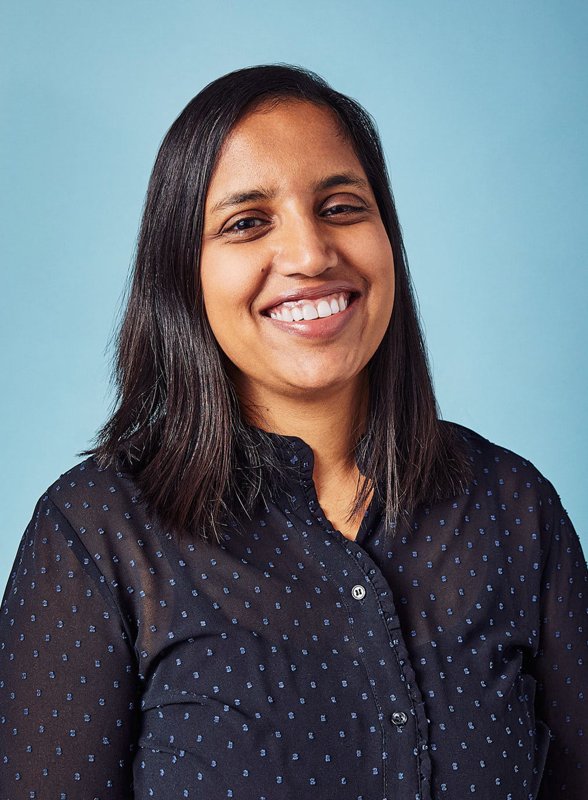
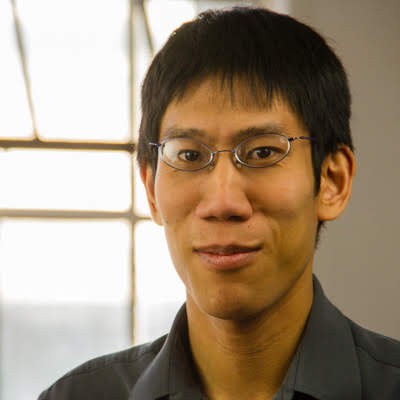
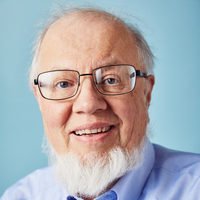
Founders & leadership· Y Combinator alumni (S14)
Board
Investors · 88

How we know: open dataset · 5k.vc investor directory · Not right? Tell us

How we know: Azure Capital Partners's portfolio page · open dataset · 5k.vc investor directory · Not right? Tell us
How we know: Blue Owl Capital's portfolio page · Not right? Tell us
How we know: Cannage Capital's portfolio page · Not right? Tell us
How we know: Cool Climate Collective's portfolio page · Not right? Tell us
How we know: the VCSheet dataset · open dataset · 5k.vc investor directory · Not right? Tell us
.jpeg)
How we know: Designer Fund's portfolio page · Not right? Tell us

How we know: Draper Associates's portfolio page · Not right? Tell us

How we know: Felicis Ventures's portfolio page · funding news · the VCSheet dataset · research · mass-ventures.com · open dataset · 5k.vc investor directory · Y Combinator's founder network · Not right? Tell us
How we know: Four Cities's portfolio page · Y Combinator's founder network · Not right? Tell us
How we know: Fundamental Ventures's portfolio page · Not right? Tell us
How we know: Hemisphere Ventures LLC's portfolio page · open dataset · 5k.vc investor directory · Not right? Tell us
How we know: iGlobe Partners's portfolio page · research · startupintros.com · open dataset · 5k.vc investor directory · Not right? Tell us

How we know: In-Q-Tel's portfolio page · Not right? Tell us
How we know: Jude Gomila's portfolio page · Not right? Tell us
How we know: Khosla Ventures's portfolio page · Not right? Tell us
How we know: research · mass-ventures.com · Not right? Tell us

How we know: the VCSheet dataset · Not right? Tell us
How we know: Prelude Ventures's portfolio page · the VCSheet dataset · Not right? Tell us

How we know: Tekmen Teknoloji Reklamcilik Yayincilik A.S.'s portfolio page · Not right? Tell us
How we know: Trans-Pacific Technology Fund's portfolio page · Not right? Tell us

How we know: the VCSheet dataset · Not right? Tell us
How we know: Viking Global's portfolio page · Y Combinator's founder network · research · mass-ventures.com · Not right? Tell us
How we know: Vital Venture Capital's portfolio page · Not right? Tell us

How we know: Y Combinator's portfolio page · the Y Combinator directory · research · mass-ventures.com · open dataset · 5k.vc investor directory · Not right? Tell us

How we know: research · startupintros.com · Not right? Tell us
How we know: research · Not right? Tell us
How we know: Y Combinator's founder network · Not right? Tell us
How we know: Y Combinator's founder network · Not right? Tell us
How we know: research · startupintros.com · Not right? Tell us

How we know: research · startupintros.com · Not right? Tell us
How we know: research · startupintros.com · Not right? Tell us
How we know: Y Combinator's founder network · Not right? Tell us


How we know: research · startupintros.com · Not right? Tell us

How we know: research · startupintros.com · Not right? Tell us
How we know: open dataset · 5k.vc investor directory · Not right? Tell us
How we know: research · startupintros.com · Not right? Tell us
How we know: open dataset · 5k.vc investor directory · Not right? Tell us

How we know: agfundernews.com · Y Combinator's founder network · Not right? Tell us
How we know: Y Combinator's founder network · Not right? Tell us
How we know: research · startupintros.com · Not right? Tell us
How we know: research · startupintros.com · Not right? Tell us

How we know: research · startupintros.com · Not right? Tell us
How we know: Y Combinator's founder network · Not right? Tell us

How we know: research · Not right? Tell us

How we know: the VCSheet dataset · research · mass-ventures.com · open dataset · 5k.vc investor directory · Not right? Tell us
How we know: research · Not right? Tell us
How we know: research · startupintros.com · Not right? Tell us
How we know: Y Combinator's founder network · Not right? Tell us
How we know: research · startupintros.com · Not right? Tell us

How we know: research · startupintros.com · Not right? Tell us
How we know: research · prnewswire.com · Y Combinator's founder network · Not right? Tell us
How we know: Y Combinator's founder network · Not right? Tell us
Also in the syndicate · 19
Funding
SEC filings, press & company announcements$326.6M disclosed across 2 of 15 rounds · 2014–2020
- $275MSeries DDec 2017 · 2 sources
Viking Global (lead), Bill Gates, Cascade Investment, General Atlantic, Y Combinator's Continuity Fund
Source ↗
▶$51.6MraisedSep 2015 · 70 investors · OtherRule 506(b)
- Jason KellyDirector, Executive Officer
- Peter BoyntonDirector
- Reshma ShettyDirector, Executive Officer
- Bartholomew CantonExecutive Officer
- Offering amount
- $51.6M
- Amount sold
- $51.6M
- First sale
- Jul 2015
- Incorporated
- Corporation, Delaware
- Federal exemptions
- 06b
Source: SEC EDGAR Form D. Amounts as filed; amended filings shown once at their latest values.
The YC application· Summer 2014 batch
Ginkgo Bioworks at YC Summer 2014 Demo Day
Y Combinator
Company profile
researched Aug 2026Ginkgo Bioworks Holdings, Inc. is an American biotechnology company headquartered in Boston, Massachusetts, founded in 2008 by five scientists from MIT: Tom Knight, Jason Kelly, Reshma Shetty, Barry Canton and Austin Che. Historically self-described as "the organism company," Ginkgo applies genetic engineering to produce microbes with industrial applications on behalf of other companies, sparing customers the cost of reproducing the early design stages of synthetic biology. Its platform has been marketed as a way to program cells much as one programs computers, with services spanning protein engineering, nucleic acid design and cell-free systems for markets including food, fragrance, pharmaceuticals, agriculture and diagnostics.
The company's current public positioning centers on autonomous laboratories: robotic systems intended to replace manual benchwork, which the company frames as the principal bottleneck in biotechnology R&D. Ginkgo says it operates an autonomous lab at its Boston headquarters, sells the ability for customers to build their own autonomous labs, and offers a "cloud lab" model in which customers run experiments virtually on the Boston system before purchasing. Customer-facing units include Ginkgo Solutions and Ginkgo Datapoints, which scope and design experiments, and a conversational interface described as "Catalyst Agent." The company states it is trusted by over 130 customers.
Ginkgo has expanded substantially through acquisition, absorbing Novogy's microbial engineering assets, FGen AG's ultra-high-throughput screening platform, assets from Bitome, Zymergen, Bayer's West Sacramento Biologics R&D site (including Joyn Bio platform assets), Altar and Circularis. Reported 2024 financials show revenue of $227 million against an operating loss of $560 million and a net loss of $547 million, with total assets of $1.38 billion, total equity of $716 million and 834 employees.
Founding story
Ginkgo Bioworks was founded in 2008 in Boston by five scientists from MIT — Tom Knight, Jason Kelly, Reshma Shetty, Barry Canton and Austin Che — around the idea that biology could be engineered with the same discipline applied to computing. Tom Knight, an MIT professor in EECS regarded as a father of synthetic biology, is quoted saying the interesting thing to program in the 21st century would be biology rather than computers. Several founders came from MIT's Synthetic Biology Working Group; Shetty was an iGEM advisor in 2006 known for engineering bacteria to smell like bananas and mint. The company's founders describe their motivation in terms of the question "What if you could grow anything?"
Business model
Ginkgo operates a platform/services model: rather than manufacturing and selling end products itself, it engineers organisms and cells to specification for corporate customers and licenses those custom engineered microbes to external clients. Revenue historically came from large multi-year R&D partnerships and government contracts, and Ginkgo has also offered cell development programs with no upfront cost to early-stage biotech startups in exchange for equity. Current offerings include the sale/deployment of autonomous lab systems for customers to operate themselves, cloud-lab access to Ginkgo's Boston autonomous lab, and project-based R&D via its Solutions and Datapoints teams. Ginkgo also created spinouts and joint ventures, including Joyn Bio (2017) and Motif Foodworks (launched with $117 million in funding).
Fee-based R&D services and platform access (project-based programs, cloud-lab usage, and sale of autonomous lab systems), licensing of custom engineered organisms to corporate clients, multi-year corporate partnership and government contract revenue, and equity stakes taken in exchange for zero-upfront-cost development programs.
Traction
Ginkgo reports more than 130 customers. Reported 2024 revenue was $227 million with an operating loss of $560 million, a net loss of $547 million, total assets of $1.38 billion, total equity of $716 million and 834 employees. Earlier commercial milestones include a $122M cannabinoid production deal with Cronos, a Roche antibiotics discovery partnership worth up to $160M, an $80M investment in Synlogic, the launch of Motif Foodworks with $117 million, and a reported $47 million Department of Energy contract. Total disclosed venture funding reached $719 million as of the 2019 Series E; one aggregator reports $803.1M across 8 rounds.
Latest developments
Ginkgo has repositioned its public messaging around autonomous labs, offering customers the ability to build their own autonomous lab, virtual access to its Boston lab, and a natural-language "Catalyst Agent" interface. A PR Newswire listing indicates Ginkgo reported first quarter 2026 financial results, completed the divestiture of its Biosecurity business and continued scaling its autonomous lab. A reported collaboration with OpenAI paired an AI reasoning model with robotic lab access.
▸Full profile — market position, technology, go-to-market, geography, history, risks & controversies
Market position
Ginkgo describes itself as pioneering autonomous labs for bioengineering across biopharma, agriculture and industrial biotech, and states it serves over 130 customers. Before going public it was described as one of the world's largest privately held biotech companies, valued at $4.2 billion in 2019, and merged with a SPAC at a $17.5 billion valuation in 2021. Its 2024 results show $227 million in revenue with large operating and net losses.
Third-party analysis and company materials cite a modular, high-throughput phenotyping platform that automates workflows from media preparation through multimodal analytics; software tooling such as digital twins used to model throughput and locate bottlenecks; remote design and execution of experiments via a cloud lab; and natural-language interaction with the automation stack ("Catalyst Agent"). Its historical differentiation was providing the early design stages of synthetic biology as a service so customers need not rebuild that capability internally. A reported collaboration with OpenAI applied an AI reasoning model with robotic lab access, described as exceeding existing biochemistry benchmarks by 40 percent.
Technology
Ginkgo's core technology is a robotic "Foundry" and, more recently, autonomous laboratories that replace manual benchwork, allowing scientists to order experimental work from robots using natural language. Capabilities cited include organism and cell engineering, protein engineering, nucleic acid design, cell-free systems, ultra-high-throughput screening (via FGen), adaptive laboratory evolution instruments (via Altar), real-time metabolite monitoring (via Bitome) and cell and gene therapy tools (via Circularis). With IARPA, Ginkgo worked on ENDAR (Engineered Nucleotide Detection and Ranking), a software tool to detect whether biological organisms have been genetically engineered, potentially providing early warning of bioweapons and other man-made biological threats.
Go-to-market
Ginkgo sells directly to enterprise and institutional R&D customers through consultative engagement (inbound contact forms, meeting bookings, and the Solutions and Datapoints teams that scope projects). Its funnel includes a "try before you buy" cloud-lab offering on the Boston autonomous lab that precedes sales of customer-owned autonomous labs. It has also used large multi-year partnerships with corporates (Cronos, Roche, Bayer, Synlogic), government contracts (a reported $47 million Department of Energy contract; IARPA work), spinout creation, and equity-for-services arrangements with early-stage startups through partnerships with Y Combinator and Petri.
Biopharma, agricultural and industrial biotech organizations, plus food, fragrance, cosmetics, nutrition, materials and diagnostics companies; government agencies; and early-stage biotech startups that access the platform in exchange for equity.
Geography
Headquartered in Boston, Massachusetts, with a purpose-built laboratory site in the Raymond L. Flynn Marine Park and roughly 200,000 sq ft in the Innovation and Design Building as of 2021, plus facilities in Cambridge, Massachusetts. Acquisitions extended its footprint to West Sacramento, California (former Bayer biologics R&D site), Switzerland (FGen AG) and France (Altar). One aggregator describes the workforce as global.
History
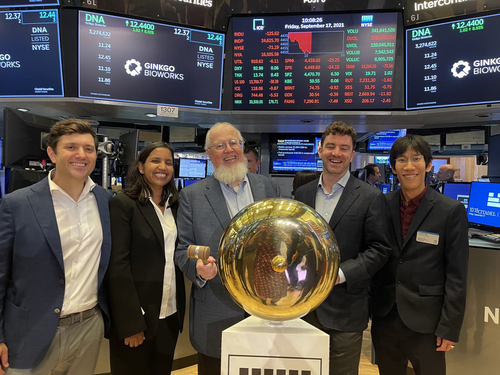
Founded in 2008 in Boston by five MIT scientists. Early public funding support came from MassVentures' START program for SBIR-funded Massachusetts companies, followed by MassVentures' first equity investment. In 2014 Ginkgo became the first biotechnology company to join the Y Combinator accelerator. Venture rounds followed from 2014 through 2020, including a $45M/$53M Series B led by Viking Global in 2015, a $100M Series C in 2016, a $280M Series D in 2017, a $290M Series E in 2019 and a $70M round in 2020. In 2019 the company was valued at $4.2 billion and raised $290 million in September and $350 million in October. In 2020 Ginkgo agreed to acquire Novogy's Microbial Engineering Platform assets and bought $25 million of property from Marcus Partners in the Raymond L. Flynn Marine Park for a 219,000 sq ft laboratory building. On 11 May 2021 Ginkgo announced a SPAC merger with Soaring Eagle at a $17.5 billion valuation; it adopted the NYSE ticker "DNA" (previously used by Genentech) and began trading on 17 September 2021. Growth through 2021 was attributed to venture funding and entry into COVID-19 testing. Baillie Gifford became the largest shareholder (15%) after purchasing 167.75 million shares on 31 March 2022. A 2022 acquisition wave included FGen AG, Bitome assets, Zymergen ($300 million, all-stock), Bayer's West Sacramento biologics R&D site, Altar and Circularis. In Q1 2026 the company reported completing the divestiture of its Biosecurity business while continuing to scale its autonomous lab.
Risks & controversies
In October 2021 a market research firm published a report alleging Ginkgo embellished its revenue through a scheme heavily reliant on related-party transactions; the report prompted an inquiry by the U.S. Department of Justice. In November 2021 shareholders sued, alleging the company misrepresented its revenue sources in statements about the SPAC merger. As of 2021 the company could not name a single significant product manufactured and sold using its organisms. In March 2023 the former Attorney General of Louisiana launched an investigation into Ginkgo's officers and directors (sourced on Wikipedia to a self-published source). The company also reports large operating and net losses (−$560M and −$547M in 2024) relative to $227M of revenue.
Compiled by commissioned research from 10 cited public sources — announcements, filings, and press listed under research sources below.
Key figures
latest reportedCompany-reported or press-reported figures, each dated to when it was claimed — not independently audited.
Images
Founder mafia
The Ginkgo Bioworks mafia →13 people who came through Ginkgo Bioworks went on to found or lead other companies.


Related companies · 10








Companies working in the same space as Ginkgo Bioworks.
Non-dilutive funding · 8 SBIR/STTR awards
Federal grants — no equity taken| Agency | Phase | Year | Amount |
|---|---|---|---|
| National Science Foundation | Phase I | 2015 | $150K |
| Defense Advanced Research Projects Agency (DARPA)Defense Advanced Research Projects Agency | Phase II | 2014 | $1.8M |
| National Science Foundation | Phase II | 2013 | $500K |
| National Institutes of Health (NIH)National Institutes of Health | Phase I | 2013 | $150K |
| National Science Foundation | Phase I | 2013 | $150K |
| Defense Advanced Research Projects Agency (DARPA)Defense Advanced Research Projects Agency | Phase I | 2012 | $150K |
| National Science Foundation | Phase I | 2011 | $150K |
| National Science Foundation | Phase I | 2009 | $100K |
Source: SBIR.gov award data (U.S. Small Business Administration). SBIR/STTR awards are competitive federal R&D grants and contracts — non-dilutive capital alongside any venture rounds above.
Acquisitions · 2
Early investors' stakes continue via these dealsModulus Therapeutics was a Seattle biotech spun out of the Allen Institute for AI that used machine learning to engineer immune cells, initially NK cells for cancer, later shifting toward autoimmune cell therapies.
Proof Diagnostics was a Cambridge, MA biotech startup co-founded by Feng Zhang and others that developed a portable CRISPR-based rapid testing platform for COVID-19 and other infectious diseases, while also building a proprietary library of gene-editing enzymes.
Timeline · 26
launches, deals, and filingsGinkgo reported first quarter 2026 financial results for the quarter ended March 31, 2026, completed the divestiture of its Biosecurity business, and reported continued scaling of its autonomous lab.
Reported government contract with the US Department of Energy.
$47M source ↗
Reported collaboration in which an AI reasoning model with access to robotic labs outperformed existing biochemistry benchmarks by 40 percent.
The former Attorney General of Louisiana launched an investigation into Ginkgo's officers and directors.
Ginkgo acquired France-based adaptive laboratory evolution instruments developer Altar and California-based Circularis to strengthen cell and gene therapy capabilities.
Ginkgo partnered with the Intelligence Advanced Research Projects Activity to build ENDAR (Engineered Nucleotide Detection and Ranking), a software tool to detect genetically engineered organisms as early warning of biological threats.
Ginkgo agreed to acquire Bayer's Biologics Research & Development site in West Sacramento and entered a multi-year platform collaboration with Bayer; the deal included integration of R&D platform assets from Joyn Bio.
$300M source ↗
Ginkgo acquired assets from real-time metabolite monitoring company Bitome.
Baillie Gifford purchased 167.75 million shares, becoming the largest shareholder with a 15% stake.
Agreement to acquire bioengineering company FGen AG and its ultra-high-throughput screening platform.
Ginkgo was sued in a shareholder lawsuit alleging it misrepresented its revenue sources in statements regarding the SPAC merger.
A market research firm published a report accusing Ginkgo of embellishing revenue via related-party transactions; the report prompted a US Department of Justice inquiry.
Ginkgo Bioworks completed its SPAC merger and began trading on the New York Stock Exchange; the ticker DNA was previously used by Genentech.
Ginkgo announced a merger with SPAC Soaring Eagle at a $17.5 billion valuation.
$17.5B source ↗
Ginkgo acquired property worth $25 million from Marcus Partners in the Raymond L. Flynn Marine Park for construction of a 219,000 square foot laboratory building.
$25M source ↗
Series E round with participation from existing major investors and new investors including funds and accounts advised by T. Rowe Price Associates, bringing total funding to $719 million.
$290M source ↗
Ginkgo made an $80 million investment in Synlogic to accelerate development of living medicines.
$80M source ↗
A $122 million deal with Cronos to produce cultured cannabinoids.
$122M source ↗
Partnership with Roche worth up to $160 million to discover novel antibiotics.
$160M source ↗
Partnerships giving early-stage startups access to Ginkgo's platform and mentorship in exchange for equity.
Ginkgo launched its second spinout, Motif Foodworks, focused on alternative proteins, with $117 million in funding.
$117M source ↗
Ginkgo launched Joyn Bio, a joint venture with Leaps by Bayer, to apply biotechnology to agriculture.
Oversubscribed Series B round led by Viking Global with prior investors OS Fund, Y Combinator and Felicis Ventures; proceeds earmarked for expansion into pharmaceuticals, cosmetics and probiotics and construction of Bioworks 2 foundry.
$45M source ↗
Ginkgo became the first biotech company admitted to the Y Combinator startup accelerator program.
Dated company events from announcements, filings, and press; legal rows summarize public dockets and regulator releases.
Legal entities · 1
corporate structure▸Research sources · 10
primary sources listed
- Ginkgo Bioworksginkgo.bio · web
- Ginkgo Bioworksginkgobioworks.com · web
10 public sources were cited for this profile; the first-party ones are listed here.
Frequently asked questions
- What does Ginkgo Bioworks do?
- Publicly traded (NYSE: DNA) Boston biotech building autonomous labs and cell-programming services for biopharma, agriculture and industrial biotech.
- Who founded Ginkgo Bioworks?
- Ginkgo Bioworks was founded by Jason Kelly, Reshma Shetty, Barry Canton, Austin Che, Tom Knight, Bartholomew Canton in 2009.
- Who are Ginkgo Bioworks's investors?
- Ginkgo Bioworks's investors include 11.2 Capital, Allen Institute for AI (AI2) Incubator, Azure Capital Partners, B3 Holding, Blue Owl Capital, Cannage Capital, Cool Climate Collective, DCVC (Data Collective) and 61 more.
- How much funding has Ginkgo Bioworks raised?
- Ginkgo Bioworks has disclosed $326.6M raised across 2 of its 15 known rounds.
- Is Ginkgo Bioworks publicly traded?
- Yes — Ginkgo Bioworks trades on NYSE under the ticker DNA.
- Where is Ginkgo Bioworks headquartered?
- Ginkgo Bioworks is headquartered in Boston, US.