 Fundraising Fox
Anduril
Unicorn · $61BFounded 2017 · 9,436 employees on LinkedIn · 113 known investors
Find your way into Anduril
Sign up to see every warm intro you have to Anduril
- Paths you didn't know you had: your email and LinkedIn already hold routes to the Anduril team. We find them for you
- 2nd- and 3rd-degree connections: the friend-of-a-friend routes that take hours to manually find through your inbox or LinkedIn
- Answers now, not in days: momentum is everything in a raise. Skip asking around whether someone knows someone
Days of research, done the moment you sign in, with every route ranked by how warm it is.
Anduril builds autonomous systems and software for defense and military applications, including attack aviation, unmanned aircraft, and underwater vehicles, unified by an autonomy platform. It also operates its own defense manufacturing facility.
Also known as Anduril Industries · Anduril Industries, Inc.
Founders & leadership
Anduril was founded in 2017 by Palmer Luckey, Brian Schimpf, and Trae Stephens.



Investors · 113
How we know: open dataset · 5k.vc investor directory · Not right? Tell us
How we know: 1435 Capital's portfolio page · Not right? Tell us
How we know: 1Flourish Capital's portfolio page · Not right? Tell us

How we know: 8VC's portfolio page · the VCSheet dataset · open dataset · 5k.vc investor directory · Not right? Tell us
How we know: Aliya Capital Partners's portfolio page · Not right? Tell us


How we know: a16z's portfolio · a partner's Signal profile · startupfortune.com · open dataset · 5k.vc investor directory · Not right? Tell us

How we know: the VCSheet dataset · Not right? Tell us
How we know: Anti's portfolio page · open dataset · 5k.vc investor directory · Not right? Tell us

How we know: Balerion Space Ventures's portfolio page · Not right? Tell us
How we know: Beaconsfield Capital's portfolio page · Not right? Tell us
How we know: Booz Allen Ventures's portfolio page · Not right? Tell us

How we know: Brave Capital's portfolio page · Not right? Tell us

How we know: the VCSheet dataset · Not right? Tell us
How we know: BVVC's portfolio page · Not right? Tell us

How we know: Champion Hill Ventures's portfolio page · a partner's Signal profile · the VCSheet dataset · open dataset · 5k.vc investor directory · Not right? Tell us

How we know: Coatue Management's portfolio page · open dataset · 5k.vc investor directory · Not right? Tell us
How we know: Collective Liquidity's portfolio page · Not right? Tell us

How we know: Contrary's portfolio page · the VCSheet dataset · open dataset · 5k.vc investor directory · Not right? Tell us

How we know: Coral Capital's portfolio page · open dataset · 5k.vc investor directory · Not right? Tell us

How we know: Cortado Ventures's portfolio page · Not right? Tell us

How we know: Cosmic Venture Partners's portfolio page · open dataset · 5k.vc investor directory · Not right? Tell us

How we know: Craft Ventures's portfolio page · deep research dossier: david-sacks · open dataset · 5k.vc investor directory · Not right? Tell us
How we know: Dragon Capital's portfolio page · Not right? Tell us

How we know: Elad Gil's portfolio page · press coverage · Not right? Tell us
How we know: Elementum Ventures's portfolio page · open dataset · 5k.vc investor directory · Not right? Tell us

How we know: the VCSheet dataset · Not right? Tell us

How we know: Embedded Ventures's portfolio page · open dataset · 5k.vc investor directory · Not right? Tell us
How we know: EQUIAM's portfolio page · Not right? Tell us
How we know: Ethos VC's portfolio page · open dataset · 5k.vc investor directory · Not right? Tell us

How we know: Factorial Funds's portfolio page · Not right? Tell us

How we know: Felicis Ventures's portfolio page · Not right? Tell us

How we know: FJ Labs's portfolio page · the VCSheet dataset · Not right? Tell us

How we know: Floodgate's portfolio page · Not right? Tell us

How we know: Flyover Capital's portfolio page · Not right? Tell us

How we know: Founders Fund's portfolio page · Wikidata · startupfortune.com · open dataset · 5k.vc investor directory · Not right? Tell us

How we know: Friends Family Capital's portfolio page · Not right? Tell us
__Twitter.png)

How we know: Galdana Ventures's portfolio page · Not right? Tell us
.png)
How we know: General Catalyst's portfolio page · open dataset · 5k.vc investor directory · Not right? Tell us

How we know: Greycroft's portfolio page · the VCSheet dataset · open dataset · 5k.vc investor directory · Not right? Tell us

How we know: Haystack's portfolio page · Not right? Tell us

How we know: Human Capital's portfolio page · the VCSheet dataset · open dataset · 5k.vc investor directory · Not right? Tell us


How we know: ICONIQ's portfolio page · startupfortune.com · Not right? Tell us

How we know: In-Q-Tel's portfolio page · open dataset · 5k.vc investor directory · Not right? Tell us
How we know: Inflection Ventures's portfolio page · Not right? Tell us
How we know: IronArc Ventures's portfolio page · Not right? Tell us

How we know: Jovono's portfolio page · Not right? Tell us

How we know: K5 Global's portfolio page · the VCSheet dataset · Not right? Tell us
How we know: Khosla Ventures's portfolio page · Not right? Tell us

How we know: Kyber Knight Capital's portfolio page · Not right? Tell us

How we know: Lightspeed Venture Partners's portfolio page · open dataset · 5k.vc investor directory · Not right? Tell us
How we know: the VCSheet dataset · open dataset · 5k.vc investor directory · Not right? Tell us
How we know: Long Journey Ventures's portfolio page · the VCSheet dataset · Not right? Tell us

How we know: Lux Capital's portfolio page · press coverage · open dataset · 5k.vc investor directory · Not right? Tell us
How we know: Manta Ray Ventures's portfolio page · Not right? Tell us
How we know: MarketX Ventures's portfolio page · Not right? Tell us

How we know: the VCSheet dataset · Not right? Tell us

How we know: Palumni VC's portfolio page · Not right? Tell us
How we know: Perot Jain's portfolio page · Not right? Tell us

How we know: Practical Venture Capital's portfolio page · Not right? Tell us

How we know: Primary Venture Partners's portfolio page · Not right? Tell us

How we know: Red Beard Ventures's portfolio page · the VCSheet dataset · Not right? Tell us

How we know: Revolution's portfolio page · open dataset · 5k.vc investor directory · Not right? Tell us

How we know: Saga Ventures's portfolio page · the VCSheet dataset · Not right? Tell us

How we know: SciFi VC's portfolio page · deep research dossier: max-levchin-scifi-vc · Not right? Tell us
How we know: Sero Capital, LLC's portfolio page · Not right? Tell us
How we know: Silent Capital's portfolio page · Not right? Tell us

How we know: the VCSheet dataset · Not right? Tell us

How we know: Sozo Ventures's portfolio page · Not right? Tell us
How we know: Sparq Capital (SFO)'s portfolio page · Not right? Tell us
How we know: Summit Peak Investments's portfolio page · Not right? Tell us
How we know: SV Angel's portfolio page · open dataset · 5k.vc investor directory · Not right? Tell us

How we know: the VCSheet dataset · open dataset · 5k.vc investor directory · Not right? Tell us
How we know: Valor Equity Partners's portfolio page · the VCSheet dataset · open dataset · 5k.vc investor directory · Not right? Tell us

How we know: the VCSheet dataset · Not right? Tell us
How we know: Washington Harbour Partners's portfolio page · Not right? Tell us
How we know: Wormhole Capital's portfolio page · Not right? Tell us
How we know: XYZ Venture Capital's portfolio page · the VCSheet dataset · open dataset · 5k.vc investor directory · Not right? Tell us

How we know: the VCSheet dataset · open dataset · 5k.vc investor directory · Not right? Tell us

How we know: press coverage · Not right? Tell us

How we know: open dataset · 5k.vc investor directory · Not right? Tell us
How we know: open dataset · 5k.vc investor directory · Not right? Tell us
How we know: deep research dossier: balaji-srinivasan · Not right? Tell us
How we know: the VCSheet dataset · Not right? Tell us

How we know: open dataset · 5k.vc investor directory · Not right? Tell us
How we know: the VCSheet dataset · Not right? Tell us
How we know: open dataset · 5k.vc investor directory · Not right? Tell us
How we know: open dataset · 5k.vc investor directory · Not right? Tell us
How we know: open dataset · 5k.vc investor directory · Not right? Tell us

How we know: press coverage · Not right? Tell us
How we know: a partner's Signal profile · Not right? Tell us
How we know: press coverage · Not right? Tell us
How we know: the VCSheet dataset · Not right? Tell us

How we know: the VCSheet dataset · Not right? Tell us

How we know: the VCSheet dataset · Not right? Tell us

Funding
SEC filings, press & company announcements$5B disclosed across 1 of 2 rounds · 2026
- $5BSeries HJul 2026
Thrive Capital (lead), 1789 Capital, Andreessen Horowitz, Founders Fund, ICONIQ
Source ↗
Source: company announcements and press reports — follow each round's link for the claim.
Company profile
researched Aug 2026Anduril Industries, Inc. is an American military technology company headquartered in Costa Mesa, California, that develops advanced autonomous systems for the U.S. Department of Defense and allied governments. Its product portfolio includes unmanned aerial systems and counter-UAS, semi-portable autonomous surveillance systems such as its Sentry towers, undersea vehicles, autonomous fighter aircraft, space sensors, and networked command-and-control software. Named products cited in the sources include the Lattice software platform, Standard Range and Long Range Sentry Towers, the Altius-600 UAS, the backpack-portable Bolt and Bolt-M aerial systems, the Ghost Shark autonomous underwater vehicle deployed by the Australian Navy, Dive AUVs, and the "Fury" autonomous fighter jet.
The company positions itself against the traditional defense prime model, arguing that expensive legacy platforms and slow procurement have left the U.S. industrial base unable to compete with peer rivals, particularly China. Its stated approach is to combine low-cost hardware with sophisticated software—an approach Palmer Luckey carried over from Oculus—and to mass-produce networked, autonomous assets using American components, while also advocating for policy and procurement reform. As of November 2025 the company operated 15 business lines and expected to end the year with 7,000 employees; Wikipedia reports 7,000 employees in 2026 and Contrary Research lists 7,651 as of April 2026.
Anduril has expanded from border surveillance into air, undersea, space and command-and-control domains, and in 2025-2026 into missile defense via the U.S. "Golden Dome" initiative. It is also building hyperscale manufacturing capacity through its Arsenal program, beginning with Arsenal-1 near Columbus, Ohio, described by Business Insider as a 5 million-square-foot factory.
Founding story
The company originated at a June 2014 Founders Fund retreat on Sonora Island, British Columbia, where Palmer Luckey—creator of the Oculus Rift, which he sold to Facebook in 2014 for $2 billion—met Trae Stephens, who had recently left Palantir to join Founders Fund. The two shared an interest in building venture-backed companies that would work closely with the U.S. government, a space then occupied mainly by Palantir and SpaceX. Stephens, who joined the 2016 Defense transition team and later the Defense Innovation Board, recruited employees alongside Luckey, who left Facebook in March 2017 after alleging he was fired over pro-Trump political contributions (Meta denies this). They recruited from Palantir and Oculus and planned to combine low-cost hardware with sophisticated software. Anduril was incorporated on April 20, 2017 and seeded by Founders Fund, with Brian Singerman leading the seed round. Palantir director Brian Schimpf, a Cornell graduate who had spent ten years at Palantir, joined after being pitched and became the fifth co-founder and CEO; Matt Grimm (COO) and Joe Chen were the other co-founders, and Trae Stephens serves as chairman.
Business model
Anduril designs, manufactures and sells autonomous hardware systems together with its Lattice software platform to government defense and security customers, primarily under contracts with the U.S. Department of Defense and allied ministries of defense, as well as domestic agencies such as Customs and Border Protection. Reported contracts range from small awards (e.g., $18.6 million with the U.S. Navy for Dive AUVs, $25.3 million with the U.S. Space Force) to participation in large programs such as the U.S. Air Force's Advanced Battle Management System (worth up to $950 million across more than 50 selected companies) and the U.S. Army's $22 billion augmented reality headset program. The company invests heavily in R&D relative to competitors and pursues vertically integrated, mass-manufacturable products built with American components rather than bespoke legacy platforms.
Revenue comes from government defense contracts for hardware systems and software, including multi-year procurement and deployment agreements. Reported revenue was approximately $100 million (estimated) in 2020, and $2.2 billion in 2025—more than double the prior year—per statements from CEO Brian Schimpf; Wikipedia's infobox lists $2 billion for 2025.
Traction
Anduril reported $2.2 billion in 2025 revenue, more than double 2024, and operated 15 business lines with about 7,000 employees at the end of 2025. It holds contracts with the U.S. Department of Defense, Air Force, and Army, the Dutch Ministry of Defence, NATO, the U.K. Ministry of Defence, and Poland, among others. Specific awards cited include a five-year $25 million CBP sentry tower contract and a further $36 million CBP award in 2020, an $18.6 million U.S. Navy Dive AUV contract, a $25.3 million U.S. Space Force contract, and selection among more than 50 firms for the Air Force's ABMS program worth up to $950 million. Its Altius-600 UAS has been supplied to Ukraine by the U.S. and U.K., and the Australian Navy is deploying Ghost Shark. Cumulative capital raised exceeds $11 billion.
Latest developments
In March 2026 Anduril acquired ExoAnalytic Solutions, a missile- and satellite-tracking firm, its first acquisition for its space business. In May 2026 it closed a $5 billion Series H at a $61 billion valuation led by returning investors Thrive Capital and Andreessen Horowitz, and announced participation in a space-based "Golden Dome" missile defense contract, a Dutch Ministry of Defence contract win, and a U.S. Army battle-manager software contract using Lattice. In July 2026 Reuters reported that Anduril was in talks to raise a new round at approximately a $100 billion valuation, possibly in two tranches closing within the year; Anduril responded that no decisions had been made about future financing. The Pentagon has funded Anduril's efforts to expand domestic solid rocket motor manufacturing capacity.
▸Full profile — market position, technology, go-to-market, geography, history, risks & controversies
Market position
Anduril is described as the leading venture-backed defense technology company, benefiting from a broad revival in defense tech funding (over $12 billion in venture funding to the sector in the first half of 2026, versus nearly $10 billion in all of 2025). Business Insider characterizes it as not yet at the level of SpaceX or Palantir in government business but far ahead of the newer wave of smaller defense startups. Sources note the Department of Defense is avoiding sole reliance on any one startup—for example, the Air Force selected Shield AI software to work with Anduril's "Fury" autonomous fighter jet rather than awarding both hardware and software to one vendor.
Sources describe Anduril's differentiation as combining low-cost, mass-producible hardware with a common autonomy and command-and-control software layer (Lattice), heavy R&D spending relative to competitors, use of American-sourced components, and a startup-style development cycle applied to defense procurement. Contrary Research frames the ambition as doing for defense production what SpaceX did for launch economics. Business Insider notes Anduril has beaten incumbent primes including Lockheed Martin, Boeing and Northrop Grumman for at least one Air Force contract, though it is not yet at the scale of SpaceX or Palantir in government business.
Technology
Anduril's core technology is Lattice, an AI-powered software platform that fuses sensor data and acts as a command-and-control layer through which a human operator can direct autonomous devices. It underpins hardware including Sentry surveillance towers, unmanned aerial and counter-UAS systems (Altius-600, Bolt, Bolt-M), autonomous underwater vehicles (Ghost Shark, Dive AUVs), the Fury autonomous fighter jet, and space sensors. Lattice has also been applied to battle-manager software analyzing data from joint missile defense systems and to the U.S. Space Force's surveillance network, and integrated into the Army's IVAS augmented-reality headset program with Microsoft.
Go-to-market
Anduril sells directly to government defense and security agencies, often beginning with self-funded prototypes and small pilot deployments that expand into larger production contracts—as with the CBP border tower pilots that grew into multi-year awards. CEO Brian Schimpf has described much of the company's effort as "pulling the customer along" by demonstrating capabilities ahead of what is currently on the market. The company also partners with larger technology firms (Microsoft on the Army IVAS program, Google Cloud for CBP AI work, Meta on soldier wearables, Apex on satellite hardware) and teams with other contractors on large programs such as Golden Dome.
The U.S. Department of Defense (renamed Department of War per one source) and its services (Air Force, Army, Navy, Marine Corps, Space Force), the Department of Homeland Security and Customs and Border Protection, and allied governments including the U.K. Ministry of Defence, Royal Navy and Royal Marines, the Dutch Ministry of Defence, NATO, Poland, and the Australian Navy.
Geography
Headquartered in Costa Mesa, California, with U.S. operations including Sentry towers along the U.S.-Mexico border in the San Diego and Texas sectors, pilot sites in Montana and Vermont, and a hyperscale manufacturing facility (Arsenal-1) under construction near Columbus, Ohio. Internationally, Anduril has supplied or contracted with the UK Royal Navy and Royal Marines, the U.K. Ministry of Defence, the Dutch Ministry of Defence, NATO, Poland, and the Australian Navy (Ghost Shark), and has installed systems at Marine Corps bases in Japan. Contrary Research describes an ambition to help allies including Australia, Korea and Taiwan.
History
Anduril was incorporated on April 20, 2017 and seeded by Founders Fund, with Brian Singerman leading the seed round. Its first commercial traction came from border security: in June 2017 executives pitched the Department of Homeland Security's California office, and the San Diego CBP sector eventually paid Anduril to test a border system; Lattice surveillance towers were informally tested on a Texas rancher's land in June 2018, and additional towers were installed in San Diego, Texas, Montana and Vermont over 2019-2020. In June 2019 the UK Royal Navy purchased Lattice and Anduril signed a contract with the Royal Marines; advocacy group Mijente reported a $13.5 million Marine Corps contract that year. Funding scaled from $120 million in September 2019 (valuation over $1 billion) to $200 million in July 2020 ($2 billion valuation), a $1.5 billion Series F in 2024 at roughly $30 billion, a $2.5 billion Series G in June 2025 at $30.5 billion, and a $5 billion Series H in May 2026 at $61 billion.
In January 2025 Anduril announced its Arsenal hyperscale manufacturing program, with Arsenal-1 under construction near Columbus, Ohio in concert with Ohio State University. In March 2026 it made its first space-business acquisition, buying missile- and satellite-tracking firm ExoAnalytic Solutions. By July 2026 Reuters reported the company was in talks for a new round at roughly a $100 billion valuation, which Anduril did not confirm.
Risks & controversies
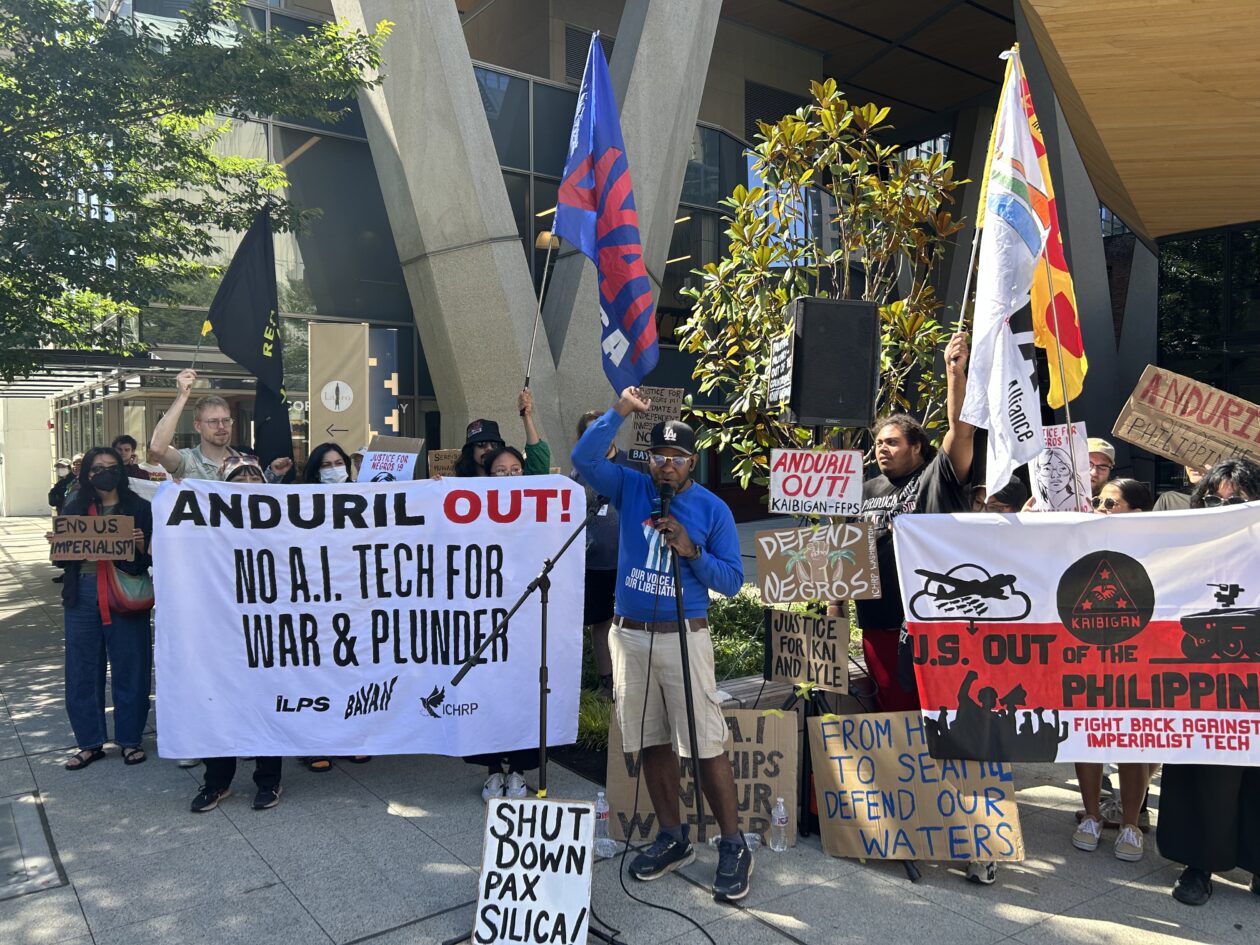
Sources note reputational and political friction around the company's origins and customers: Palmer Luckey left Facebook in March 2017 alleging he was fired over pro-Trump political contributions, which Meta denies. Advocacy group Mijente publicized Anduril's $13.5 million Marine Corps contract and the company's border surveillance work, and its Sentry towers along the U.S.-Mexico border have drawn scrutiny. Concerns about AI in warfare are referenced, with Luckey arguing the technology will improve battlefield decision-making. Commercially, the Department of Defense has signaled it will not lock itself into a single rising-star vendor, splitting hardware and software awards. Contrary Research highlights broad industry risk from U.S. reliance on Chinese supply chains for weapons components and rare earths.
Compiled by commissioned research from 7 cited public sources — announcements, filings, and press listed under research sources below.
Key figures
latest reportedCompany-reported or press-reported figures, each dated to when it was claimed — not independently audited.
Founder mafia
The Anduril mafia →25 people who came through Anduril went on to found or lead other companies.





Related companies · 3
Companies working in the same space as Anduril.
Non-dilutive funding · 5 SBIR/STTR awards
Federal grants — no equity taken| Agency | Phase | Year | Amount |
|---|---|---|---|
| U.S. Air ForceAir Force | Phase II | 2020 | $12M |
| U.S. Air ForceAir Force | Phase II | 2020 | $701.8K |
| U.S. Air ForceAir Force | Phase I | 2020 | $50K |
| U.S. Air ForceAir Force | Phase I | 2019 | $50K |
| U.S. Air ForceAir Force | Phase I | 2019 | $50K |
Source: SBIR.gov award data (U.S. Small Business Administration). SBIR/STTR awards are competitive federal R&D grants and contracts — non-dilutive capital alongside any venture rounds above.
Timeline · 15
launches, deals, and filingsReuters reported, per anonymous sources, that Anduril was in talks for a new round that could value it at about $100 billion, potentially structured in two tranches closing within the year. Anduril said no decisions had been made about future financing.
Anduril announced a contract win from the Dutch Ministry of Defence and a U.S. Army contract for battle manager software using its Lattice platform to analyze data from joint missile defense systems.
Anduril announced it was part of a contract with other companies to develop a space-based 'Golden Dome' missile defense system for the continental United States.
Anduril acquired missile tracking and space intelligence firm ExoAnalytic Solutions, its first acquisition for its space business, to use ExoAnalytic's telescope network and missile defense tracking data to improve ground and satellite capabilities.
Anduril announced a series of 'Arsenal' hyperscale manufacturing projects for autonomous weapons systems; the first, Arsenal-1, is under construction near Columbus, Ohio, in concert with Ohio State University. Business Insider describes Arsenal-1 as a 5 million-square-foot factory funded in part by the 2024 Series F.
Luckey and Zuckerberg announced a partnership on a U.S. military defense contract to develop wearable tools for soldiers, such as headsets using AI and sensors to enhance vision.
Anduril announced a partnership with satellite hardware producer Apex to develop space systems for the U.S. and allies.
Anduril and Microsoft introduced Lattice to the U.S. Army's Integrated Visual Augmentation System (IVAS) program; the partnership was expanded in 2025. Anduril is helping the U.S. Army build its $22 billion augmented reality headset program.
Google began integrating Google Cloud technology with Anduril technology to support AI implementations by CBP's Innovation Team.
Anduril received another $36 million from CBP for surveillance towers; CBP planned to install 200 towers by 2022.
$36M source ↗
U.S. Customs and Border Protection and Anduril entered a five-year, $25 million contract to deploy sentry towers.
$25M source ↗
Anduril was one of more than 50 companies selected by the U.S. Air Force to help develop the Advanced Battle Management System (ABMS) under a contract worth up to $950 million.
$950M source ↗
The UK Royal Navy purchased Lattice as part of a modernization initiative; Anduril also signed a contract with the Royal Marines.
Advocacy group Mijente reported a $13.5 million Marine Corps contract to install Anduril systems at military bases in Japan and the United States.
$13.5M source ↗
Anduril executives pitched low-cost border security to the Department of Homeland Security's California office; the San Diego Customs and Border Protection office eventually paid Anduril to test a new border system.
Dated company events from announcements, filings, and press; legal rows summarize public dockets and regulator releases.
In the news

▸Research sources · 7
primary sources listed
- Anduril Industries - Wikipediaen.wikipedia.org · web
7 public sources were cited for this profile; the first-party ones are listed here.
Frequently asked questions
- What does Anduril do?
- Defense technology company building autonomous air, undersea and space systems unified by its Lattice command-and-control software.
- Who founded Anduril?
- Anduril was founded by Palmer Luckey, Brian Schimpf, Trae Stephens in 2017.
- Who are Anduril's investors?
- Anduril's investors include 137 Ventures, 1435 Capital, 1Flourish Capital, 8VC, Aliya Capital Partners, Altra Venture, Andreessen Horowitz, Anorak Ventures and 105 more.
- How much funding has Anduril raised?
- Anduril has disclosed $5B raised across 1 of its 2 known rounds.