 Fundraising Fox
Aurora Solar
San Francisco, US · Founded 2013 · 300 employees on LinkedIn · 12 known investors
Find your way into Aurora Solar
Sign up to find every way you can get introduced to Aurora Solar
- Your email: who you already know at Aurora Solar, and who your contacts know
- 2nd- and 3rd-degree connections: people you know who worked, studied or invested with the Aurora Solar team
- Your LinkedIn: the connections who can make the intro for you
We rank every route by how warm it is, so you raise on warm intros instead of cold emails.
Aurora Solar makes a cloud-based platform for designing, selling, and delivering solar energy projects, including 3D modeling with shade and tilt analysis, proposal generation, and lead capture tools. It serves solar installers and sales teams to speed up system design and improve proposal accuracy.
Also known as Aurora · Aurora Solar Inc.
Founders & leadership
Aurora Solar was founded in 2013 by Christopher Hopper and Samuel Adeyemo.

Board

Investors · 12

How we know: press coverage · the VCSheet dataset · research · aurorasolar.com · Not right? Tell us

How we know: Energize Capital's portfolio page · funding news · prnewswire.com · Not right? Tell us

How we know: Fifth Wall's portfolio page · funding news · press coverage · the VCSheet dataset · research · aurorasolar.com · Not right? Tell us

How we know: GROOVE CAPITAL's portfolio page · Not right? Tell us

How we know: ICONIQ's portfolio page · press coverage · research · aurorasolar.com · Not right? Tell us

How we know: Lux Capital's portfolio page · press coverage · research · aurorasolar.com · Not right? Tell us

How we know: board seat on SEC Form D · Not right? Tell us
How we know: funding news · press coverage · Not right? Tell us

How we know: the VCSheet dataset · Not right? Tell us

Also in the syndicate · 1
Reported raises · per SEC filings
Form D private placements$398.5M disclosed across 4 of 9 rounds · 2016–2022
▶$200MraisedMar 2022 · 10 investors · Other TechnologyRule 506(b)
- Christopher HopperExecutive Officer, Director
- Tyler LancasterDirector
- Samuel AdeyemoExecutive Officer, Director
- Shvetank JainDirector
- Doug PepperDirector
- Offering amount
- $200M
- Amount sold
- $200M
- First sale
- Feb 2022
- Incorporated
- Corporation, Delaware
- Federal exemptions
- 06b
▶$125MraisedMay 2021 · 7 investors · Other TechnologyRule 506(b)
- Tyler LancasterDirector
- Samuel AdeyemoExecutive Officer, Director
- Shvetank JainDirector
- Doug PepperDirector
- Christopher HopperExecutive Officer, Director
- Offering amount
- $125M
- Amount sold
- $125M
- First sale
- May 2021
- Incorporated
- Corporation, Delaware
- Federal exemptions
- 06b
▶$50MraisedNov 2020 · 8 investors · Other TechnologyRule 506(b)
- Christopher HopperExecutive Officer, Director
- Samuel AdeyemoExecutive Officer, Director
- Shvetank JainDirector
- Tyler LancasterDirector
- Doug PepperDirector
- Offering amount
- $50M
- Amount sold
- $50M
- First sale
- Nov 2020
- Incorporated
- Corporation, Delaware
- Federal exemptions
- 06b
▶$23.5MraisedApr 2019 · 5 investors · Other TechnologyRule 506(b)
- Samuel AdeyemoExecutive Officer, Director
- Shvetank JainDirector
- Amy FranceticDirector
- Christopher HopperExecutive Officer, Director
- Offering amount
- $23.5M
- Amount sold
- $23.5M
- First sale
- Jan 2019
- Incorporated
- Corporation, Delaware
- Federal exemptions
- 06b
Source: SEC EDGAR Form D. Amounts as filed; amended filings shown once at their latest values.
Company profile
researched Aug 2026Aurora Solar provides a cloud software platform used by solar sales organizations and installers to run the residential solar and storage project lifecycle: lead capture, remote system design, proposal generation, financing, contracting, and handoff to installation. The design side lets users produce site-specific system layouts without a truck roll, using HD map imagery (EagleView and Google HD included, Nearmap as an add-on), 3D roof and tree modeling, roof measurements, irradiance analysis, performance simulation, ground mounts, LIDAR-assisted modeling, bankable shade reports, and a component database. Automation features include automated panel placement (AutoDesigner), automated stringing and fire pathway placement, AI-assisted obstruction detection, and Aurora AI site models that generate 3D roof models including obstructions in under 15 seconds.
On the sales side, the platform produces tablet-friendly, customizable and branded proposals from an address and an electric bill, with dynamic panel placement, interactive irradiance and sun path tools, utility rate data (custom rates or Genability and Aurora rates), configurable pricing methods (price-per-watt, per component, or flat fee), adders, discounts and incentives, energy bill comparisons, web and PDF proposals, proposal activity tracking, contract manager and e-signature. Battery storage modeling covers backup, self-consumption, and energy arbitrage. Enterprise capabilities include advanced user roles, teams, partner/dealer management, SSO, partner apps, a Sync API, webhooks, and a Design API. Aurora also sells services layered on the software: on-demand site models (standard within three hours, expedited within 30 minutes), plan sets (solar-only under 24 hours, solar-plus-storage under 48 hours), and engineering stamps.
The platform includes integrated financing options from third-party providers such as GoodLeap, Dividend, and Mosaic, and the company references integrations built with financing partners including EnFin, Lightreach, and Sungage. Training and enablement are delivered through on-demand documentation, a help center, and Aurora Academy courses.
Founding story
The company traces its origin to 2013, when co-founders Christopher Hopper and Samuel Adeyemo, then graduate students, spent seven months designing a solar energy system by assembling multiple disparate tools, while installation took only two weeks. That mismatch prompted them to build software making PV system design as straightforward as installation. Aurora Solar was founded in August 2013 while the founders were students at the Stanford Graduate School of Business.
Business model
Business-to-business software subscription sold per user, with usage-based and service add-ons. Published plans are Basic ($159/user/month billed monthly, $135/user/month billed annually) and Premium ($259/user/month monthly, $220/user/month annually), each with one user and 50 projects per month, plus a custom-priced Enterprise tier with unlimited users, APIs and integrations, advanced permissions, dealer configurations, and volume-based discounts on credit purchases. Basic and Premium can be paid by credit card with no minimum commitment on monthly plans and a one-year commitment on annual plans; Enterprise can be invoiced. Additional revenue comes from paid add-ons such as on-demand site models (from $9.99), expedited models, plan sets, engineering stamps, premium support, training, technical consultation, proposal template customization, and the Design API.
Recurring per-seat subscription fees across Basic, Premium, and custom Enterprise tiers, supplemented by credit-based and per-project service purchases (site models, plan sets, engineering stamps) and paid support/professional services add-ons.
Traction
Aurora states that 90% of top residential US solar companies use its platform and that more than five million solar projects had been designed in the software as of April 2021. Customer testimonials report proposal times falling from one to two hours to under 20 minutes, design time reductions of about 70%, savings of 30+ minutes per design, a 14x proposal time reduction at Infinity Energy, and close rate improvements (one customer citing a rise from 30% to 65%).
Latest developments
The company promotes a 2026 Aurora Solar Snapshot annual report covering homeowners, solar professionals and, newly, solar sales professionals adapting to current market conditions. Current product packaging emphasizes Aurora AI site models, AutoDesigner automation, battery storage modeling, contract manager and e-signature, and enterprise APIs, along with financing integrations with providers including EnFin, Lightreach, and Sungage.
▸Full profile — market position, technology, go-to-market, geography, history, risks & controversies
Market position
Aurora describes itself as the world's number one solar design software and states that 90% of top residential US solar companies use the platform. Customer testimonials on its site position it against Solo, OpenSolar, and Solargraf, citing design accuracy, shading accuracy, and scalability as differentiators. A separate company, Aurora Solar Technologies Inc. (TSX.V: ACU) of North Vancouver, operates in PV manufacturing process control and is unrelated to this company.
Positioning centers on design accuracy without site visits, particularly shade and irradiance modeling validated by NREL and offered as bankable shade reports, combined with permit-quality proposals generated from just an address and an electric bill. Aurora couples this technical depth with AI automation (rapid 3D site model generation, automated design, stringing and fire pathways) and an end-to-end scope spanning lead capture, design, proposal, integrated third-party financing, e-signature and contract management, plus optional expert services such as plan sets and engineering stamps. Customers quoted by the company cite reduced proposal turnaround and higher close rates relative to competing tools.
Technology
Remote solar design technology combining HD aerial imagery, LIDAR-assisted modeling, 3D roof and tree modeling, irradiance and shading analysis, and a performance simulation engine validated by NREL, with shade reports positioned as bankable. Machine learning and computer vision underpin Aurora AI site models that produce 3D roof models with obstructions in under 15 seconds, AI-assisted obstruction detection, AutoDesigner automated panel placement against energy targets, automated stringing and fire pathway placement, and Lead Capture AI, which auto-generates a preliminary design for website visitors. The company states AI-generated 3D solar designs can be created in under 30 seconds. A database of more than 25,000 US authorities having jurisdiction supports permit-oriented design, and Sync, Design, and webhook APIs support integration with external systems.
Go-to-market
Self-serve online sign-up for Basic and Premium plans purchased by credit card, with additional licenses purchasable in-app, alongside a sales-led motion for Enterprise deals via demo scheduling and contact-sales. Marketing assets include the annual Aurora Solar Snapshot report, customer case studies and testimonials, Aurora Academy training content, and co-marketed integrations with financing providers such as EnFin, Lightreach, and Sungage.
Residential solar sales organizations, installers, dealers, and enterprise solar providers, ranging from individual solar professionals on the Basic plan to scaled teams and multi-dealer enterprises; content is segmented into 'For Sales' and 'For Installers.' End homeowners interact with the software indirectly through proposals and instant 3D solar estimates.
Geography
Primarily United States-focused: HD imagery, a database of 25,000+ US jurisdictions, US utility rate data, California Title 24 compliance approval, and adoption claims referencing top US residential solar companies. The company also refers to solar providers around the world using the platform.
History
Founded in August 2013, Aurora had its performance simulation engine validated by the National Renewable Energy Laboratory in July 2015 and its remote shading accuracy validated by NREL in December 2015. In November 2016 it received a $400,000 award from the U.S. Department of Energy's SunShot Incubator Program (Technology to Market, Incubator 10). It raised a $20 million Series A led by Energize Ventures in February 2019. In March 2020 it became the first assessment tool approved by the California Energy Commission for demonstrating compliance with the California Title 24 solar mandate, and in September 2020 released battery storage backup and recommendation functionality. A $50 million Series B led by ICONIQ followed in November 2020. The company surpassed five million solar projects designed in its software in April 2021, announced a $250 million Series C led by Coatue in May 2021, and a $200 million Series D co-led by Coatue and Energize in February 2022, alongside the release of Lead Capture AI and Sales Mode AI.
Risks & controversies
Sources do not describe litigation, regulatory actions, or controversies. Notable considerations from the material: heavy exposure to the US residential solar market, which the company itself characterizes as facing 'new realities'; competition from Solo, OpenSolar, and Solargraf; dependence on third-party data and financing partners (EagleView, Google HD, Nearmap, Genability, GoodLeap, Dividend, Mosaic); and potential confusion with the unrelated public company Aurora Solar Technologies Inc.
Compiled by commissioned research from 6 cited public sources — announcements, filings, and press listed under research sources below.
Key figures
latest reportedCompany-reported or press-reported figures, each dated to when it was claimed — not independently audited.
Founder mafia
2 people who came through Aurora Solar went on to found or lead other companies.


Timeline · 12
launches, deals, and filingsRound co-led by existing investors Coatue and Energize Ventures with participation from Fifth Wall, ICONIQ, and new investors Lux Capital and Emerson Collective.
$200M source ↗
Lead Capture AI automatically designs a preliminary solar system for homeowners visiting an installer's website; Sales Mode AI lets sales reps quote, sell, and close deals in real time on a tablet, with integrated financing and e-signature.
$250M source ↗
$50M source ↗
Aurora became the first assessment tool approved by the California Energy Commission to demonstrate compliance with the California Title 24 solar mandate.
$20M source ↗
Aurora received $400,000 from the U.S. Department of Energy's SunShot Incubator Program, Technology to Market, Incubator 10.
$400K source ↗
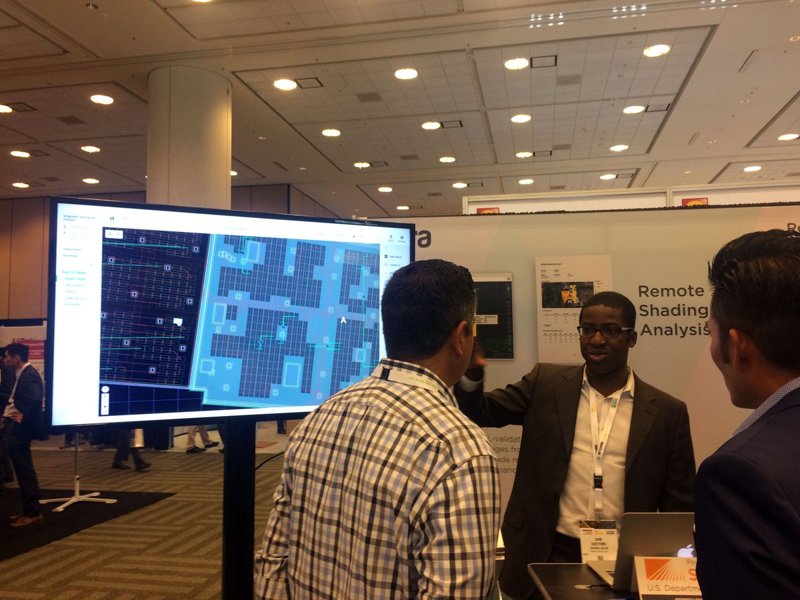
Aurora Solar's remote shading accuracy was validated by the National Renewable Energy Laboratory.
Aurora Solar's performance simulation engine was validated by the National Renewable Energy Laboratory.
Christopher Hopper and Samuel Adeyemo founded Aurora Solar while students at the Stanford Graduate School of Business.
Dated company events from announcements, filings, and press; legal rows summarize public dockets and regulator releases.
In the news
▸Research sources · 6
primary sources listed
- Aurora Solaraurorasolar.com · web
6 public sources were cited for this profile; the first-party ones are listed here.
Frequently asked questions
- What does Aurora Solar do?
- Aurora Solar sells a SaaS platform for designing, selling, financing, and delivering residential solar and storage projects.
- Who founded Aurora Solar?
- Aurora Solar was founded by Christopher Hopper, Samuel Adeyemo in 2013.
- Who are Aurora Solar's investors?
- Aurora Solar's investors include AngelDAO, Coatue Management, Energize Capital, Fifth Wall, GROOVE CAPITAL, ICONIQ, Lux Capital, Buoyant Ventures Management, Llc and 3 more.
- How much funding has Aurora Solar raised?
- Aurora Solar has disclosed $398.5M raised across 4 of its 9 known rounds.
- Where is Aurora Solar headquartered?
- Aurora Solar is headquartered in San Francisco, US.