 Fundraising Fox
Zenity
New York City, US · Founded 2021 · 267 employees on LinkedIn · 20 known investors
Find your way into Zenity
Sign up to see every warm intro you have to Zenity
- Paths you didn't know you had: your email and LinkedIn already hold routes to the Zenity team. We find them for you
- 2nd- and 3rd-degree connections: the friend-of-a-friend routes that take hours to manually find through your inbox or LinkedIn
- Answers now, not in days: momentum is everything in a raise. Skip asking around whether someone knows someone
Days of research, done the moment you sign in, with every route ranked by how warm it is.
Zenity provides a security and governance platform for AI agents, giving enterprises visibility into agents across SaaS, cloud, custom stacks, and endpoints and enforcing policies on agent actions before, during, and after decisions. It targets enterprise security teams that need to discover, inventory, and control autonomous AI agents built or embedded in tools like Salesforce Agentforce and Copilot Studio.
Also known as Zenity Labs · Zenity Ltd.
Founders & leadership
Zenity was founded in 2021 by Michael Bargury and Ben Kliger.


Investors · 20

How we know: Intel Capital's portfolio page · the company's own site · a partner's Signal profile · research · zenity.io · Not right? Tell us
How we know: Third Point Ventures's portfolio page · the company's own site · research · zenity.io · Not right? Tell us

How we know: UpWest's portfolio page · the company's own site · the VCSheet dataset · research · zenity.io · Not right? Tell us
How we know: the company's own site · research · zenity.io · open dataset · 5k.vc investor directory · Not right? Tell us

How we know: the company's own site · research · zenity.io · Not right? Tell us

How we know: Felicis Ventures's portfolio page · Not right? Tell us
How we know: M12 (Microsoft's Venture Fund)'s portfolio page · open dataset · 5k.vc investor directory · Not right? Tell us

How we know: funding news · fortune.com · research · calcalistech.com · open dataset · 5k.vc investor directory · Not right? Tell us
How we know: visionfund.com · Not right? Tell us
How we know: Vertex Ventures Israel's portfolio page · Not right? Tell us

How we know: funding news · research · calcalistech.com · Not right? Tell us
How we know: fortune.com · Not right? Tell us
How we know: funding news · research · calcalistech.com · Not right? Tell us

How we know: funding news · research · calcalistech.com · Not right? Tell us
How we know: fortune.com · Not right? Tell us

Also in the syndicate · 3
Funding
SEC filings, press & company announcements$250M disclosed across 2 of 6 rounds · 2021–2026
- $125MraisedAug 2026 · 3 sources
Norwest (lead), Hitachi, LG, SoftBank
Source ↗ - $125MSeries CAug 2026 · 3 sources
Norwest Venture Partners (lead), DTCP, Hitachi Ventures, Intel Capital, LG Technology Ventures, Qumra Capital, SoftBank Vision Fund 2, Third Point Ventures, Vertex Ventures
Source ↗
Source: company announcements and press reports — follow each round's link for the claim.
Company profile
researched Aug 2026Zenity is a Tel Aviv-based cybersecurity company that sells an AI agent security and governance platform to enterprises. The platform is organized in three layers: Surface, which builds a live inventory of agents across SaaS, cloud, custom and endpoint deployments and evaluates configuration, permissions and exploitable attack paths (AI observability, AI security posture management, and AI exposure management); Enforce, which applies policy at the moment an agent decides on an action, permitting, steering or blocking it; and Protect, which handles detection, investigation and response, with threat mapping to OWASP and MITRE ATLAS (sources 0, 3).
The company frames agent risk in three categories: external manipulation (for example prompt injection hidden in a document, email or webpage), internal over-provisioning (over-shared files, broadened permissions, unvetted data sources), and autonomous deviation, where an agent improvises and reaches credentials or systems it was not granted. Zenity argues that existing categories of tooling — DSPM, IAM, EDR/XDR, AppSec/DLP, CNAPP/CSPM — each address part of the problem but were designed for human actors and lack visibility into how agents reason, chain actions and invoke tools (sources 0, 3). Coverage extends to agentic SaaS environments such as Salesforce Agentforce and Copilot Studio, homegrown agents on AWS Bedrock, AgentCore, Foundry and Google Vertex AI, and personal or coding agents, plus enterprise assistants including Microsoft Copilot, ChatGPT Enterprise, Gemini, Claude, Codex and Cursor (sources 3, 5, 7).
Zenity began in the low-code/no-code security and governance space, launching its platform in April 2021 and reaching general availability in January 2022, then extended to enterprise copilots from November 2023 and to autonomous AI agents thereafter (source 2). It also runs Zenity Labs, an in-house research group publishing vulnerability research, threat intelligence and tooling on agentic AI systems (sources 2, 4).
Founding story
Zenity was founded in 2021 by Ben Kliger (CEO) and Michael Bargury (CTO), both veterans of Israel's Unit 8200 who had previously worked together at Microsoft leading development of cloud and operational technology security products (source 5).
Business model
Zenity sells an enterprise security and governance platform, engaged through demo requests and risk assessments on its website, to security teams at large organizations; the company states it generates tens of millions of dollars in annual revenue (sources 0, 3, 5).
Enterprise software sales; the company states it generates tens of millions of dollars in annual revenue, has tripled revenue in each of the past two years, and expects to triple again in the current year (source 5).
Traction
More than 230 employees worldwide; customers described as Fortune 500 and Global 2000 enterprises; tens of millions of dollars in annual revenue with revenue tripled in each of the prior two years; approximately $180–185M raised in total. Anonymized customer results published on the company website include a Fortune 200 consulting firm reporting a 90% reduction in security violations and 95% of high-risk violations automatically remediated, a Fortune 20 technology company reporting 90% of existing vulnerabilities remediated within four months using two FTEs, and a Fortune 50 financial services firm reporting 80% risk reduction across a tenant with over 150,000 resources (sources 0, 5, 6, 7).
Latest developments
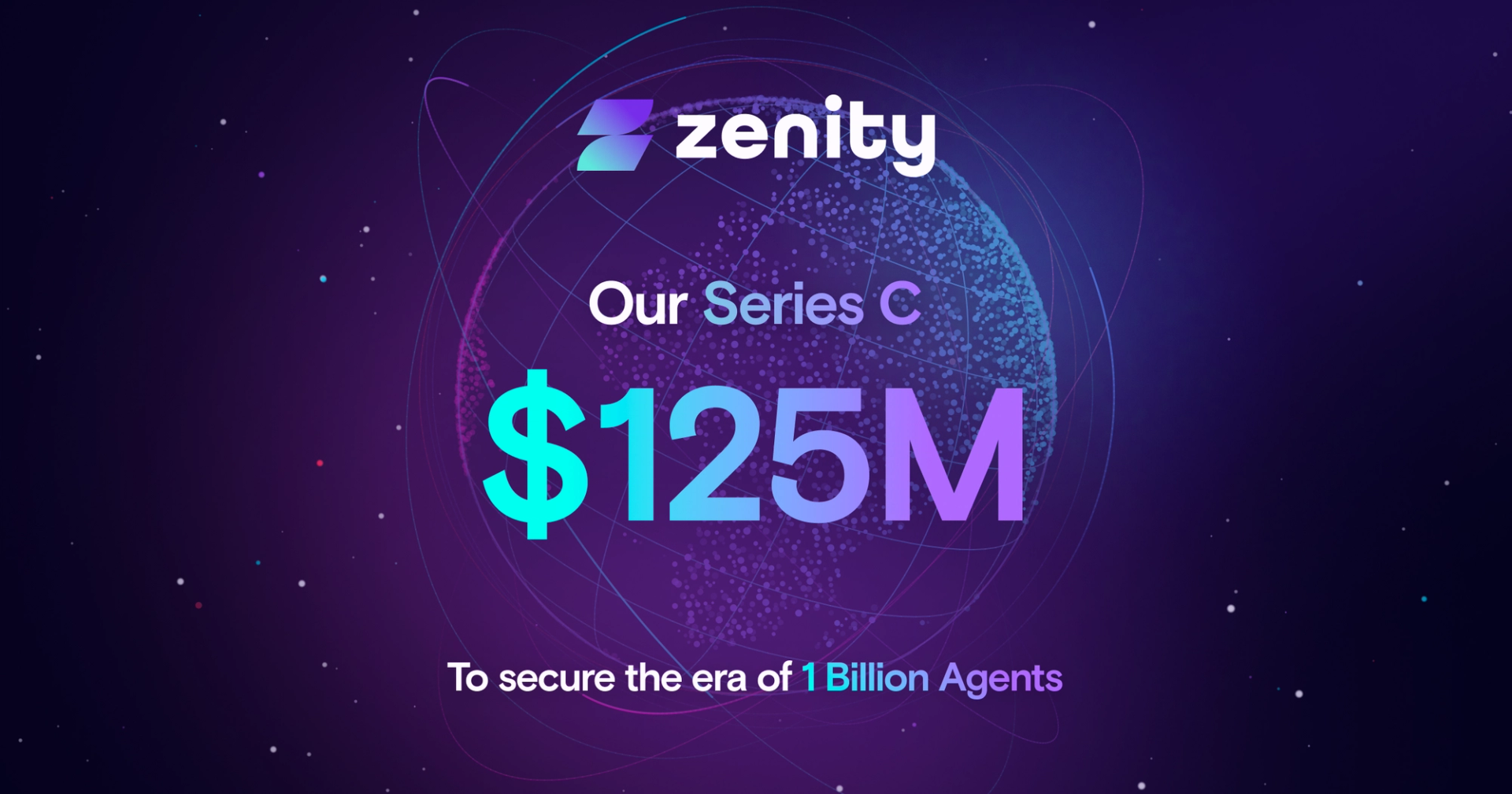
On 3 August 2026 Zenity announced a $125M Series C led by Norwest Venture Partners with Qumra Capital, SoftBank Vision Fund 2, Hitachi Ventures and LG Technology Ventures joining, alongside existing investors DTCP, Vertex Ventures, Third Point Ventures and Intel Capital. Reported total funding was approximately $185M per Calcalist and $180M per SecurityWeek. The round is almost entirely primary capital with a secondary component of roughly $10 million allowing some employees and founders to sell shares. Proceeds are earmarked for platform development, expansion of Zenity Labs, and international growth, especially in Europe and Asia-Pacific. The CEO declined to disclose post-money valuation, profitability, or IPO plans (sources 5, 6, 7).
▸Full profile — market position, technology, go-to-market, geography, history, risks & controversies
Market position
Gartner described Zenity as "the company to beat in AI agent governance," and the company was named a Representative Vendor in the 2025 Gartner Market Guide for AI TRiSM and a 2025 Gartner Cool Vendor in Agentic AI TRiSM. Norwest partner Assaf Harel characterized Zenity as having an early-mover advantage in end-to-end AI agent security with a large and growing footprint among Fortune 1000 customers. The CEO acknowledges the market is competitive with newer entrants (sources 0, 2, 5, 7).
Zenity positions the agent's decision — the point where context and intent converge — as its unit of security, in contrast to model- or prompt-focused AI security tools and to human-centric DSPM, IAM, EDR and network products. Management cites the ability to act while agents are actually running, broad coverage across SaaS, cloud, custom and endpoint agent deployments, several years of platform development ahead of newer entrants, and the Zenity Labs research team feeding vulnerability findings back into the product (sources 0, 3, 5).
Technology
The platform analyzes how AI agents are embedded in an organization, what systems and data they touch, and the business purpose they serve, then monitors them in real time. Rather than relying solely on prompt inspection or post-incident analysis, it evaluates the intent behind an action before execution and deterministically allows, modifies or blocks it, aiming to distinguish legitimate work from manipulated, compromised or rogue behavior. Capabilities span agent inventory and observability, AI security posture management against policy pre-deployment, exposure management that validates and scores exploitable attack paths and generates fixes applied via runtime boundaries, and detection and response mapped to OWASP and MITRE ATLAS (sources 0, 3, 5, 7).
Go-to-market
Direct enterprise sales supported by demo and risk-assessment requests, a partners and alliances function, and content marketing anchored by Zenity Labs research, industry analyst recognition, and its AI Agent Security Summit events (sources 0, 2, 4, 5).
Enterprise security teams at large organizations, including Fortune 500 and Global 2000 companies, with a stated focus on regulated sectors such as financial services, telecommunications, healthcare, pharmaceuticals, manufacturing, technology and energy (sources 5, 6).
Geography
Headquartered in Tel Aviv, where research and development is based, with go-to-market, sales, marketing and operations run from New York. Of more than 230 employees worldwide, roughly 150 are in Israel. The company reports a growing customer list in Japan, Korea and Singapore and is using its Series C to expand across Europe, Asia-Pacific and the U.S. (sources 5, 6, 7).
History
Zenity launched a security and governance platform for low-code/no-code development in April 2021 and exited stealth in November 2021 with a $5M seed round led by Vertex Ventures and UpWest. General availability followed in January 2022, and the company won a Global InfoSec Award for best low-code/no-code security product in June 2022. It disclosed the #ZAPESCAPE research in September 2022, and CTO Michael Bargury presented "All You Need is Guest" at Black Hat in August 2023. A $16.5M Series A led by Intel Capital came in September 2023, followed in November 2023 by support for securing enterprise AI copilots, May 2024 support for Microsoft Copilot for M365, a July 2024 strategic investment from Microsoft's M12, and an August 2024 Zenity Labs disclosure of "remote copilot execution" for Copilot for M365. A $38M Series B co-led by Third Point Ventures and DTCP closed in October 2024. In 2025 Zenity was named a Representative Vendor in the Gartner Market Guide for AI TRiSM (February), hosted the first AI Agent Security Summit (March), published the AgentFlayer 0-click agent compromise research (August), was named a Gartner Cool Vendor in Agentic AI TRiSM (September), and won "Agentic AI Security Solution of the Year" at the CyberSecurity Breakthrough Awards while hosting a San Francisco edition of its summit (October). In August 2026 it raised a $125M Series C (source 2, 5, 6, 7).
Risks & controversies
The CEO declined to disclose the company's post-money valuation or profitability. Growth and revenue figures, together with customer outcome statistics on the company website, are self-reported and not independently verified. Management describes the AI agent security market as competitive with new entrants (sources 0, 5, 6).
Compiled by commissioned research from 8 cited public sources — announcements, filings, and press listed under research sources below.
Key figures
latest reportedCompany-reported or press-reported figures, each dated to when it was claimed — not independently audited.
Timeline · 20
launches, deals, and filingsRound led by Norwest with Qumra Capital, SoftBank Vision Fund 2, Hitachi Ventures and LG Technology Ventures joining, plus existing investors DTCP, Vertex Ventures, Third Point Ventures and Intel Capital; almost entirely primary with roughly $10M secondary.
$125M source ↗
Series C proceeds allocated to product innovation, Zenity Labs expansion, and geographic growth.
Event drew hundreds of security experts and researchers.
$38M source ↗
$16.5M source ↗
Seed round led by Vertex Ventures and UpWest announced alongside stealth exit.
$5M source ↗
Dated company events from announcements, filings, and press; legal rows summarize public dockets and regulator releases.
In the news
▸Research sources · 8
primary sources listed
- Zenityzenity.io · web
8 public sources were cited for this profile; the first-party ones are listed here.
Frequently asked questions
- What does Zenity do?
- Israeli cybersecurity company providing a platform to discover, govern, and secure enterprise AI agents at runtime.
- Who founded Zenity?
- Zenity was founded by Michael Bargury, Ben Kliger in 2021.
- Who are Zenity's investors?
- Zenity's investors include Intel Capital, Third Point Ventures, UpWest, DTCP, Vertex Ventures, Felicis Ventures, Gefen Capital, M12 (Microsoft's Venture Fund) and 9 more.
- How much funding has Zenity raised?
- Zenity has disclosed $250M raised across 2 of its 6 known rounds.
- Where is Zenity headquartered?
- Zenity is headquartered in New York City, US.