 Fundraising Fox
Vecna Robotics
Cambridge, US · Founded 2018 · Delaware corporation · 110 employees on LinkedIn · 22 known investors
Find your way into Vecna Robotics
Sign up to see every warm intro you have to Vecna Robotics
- Paths you didn't know you had: your email and LinkedIn already hold routes to the Vecna Robotics team. We find them for you
- 2nd- and 3rd-degree connections: the friend-of-a-friend routes that take hours to manually find through your inbox or LinkedIn
- Answers now, not in days: momentum is everything in a raise. Skip asking around whether someone knows someone
Days of research, done the moment you sign in, with every route ranked by how warm it is.
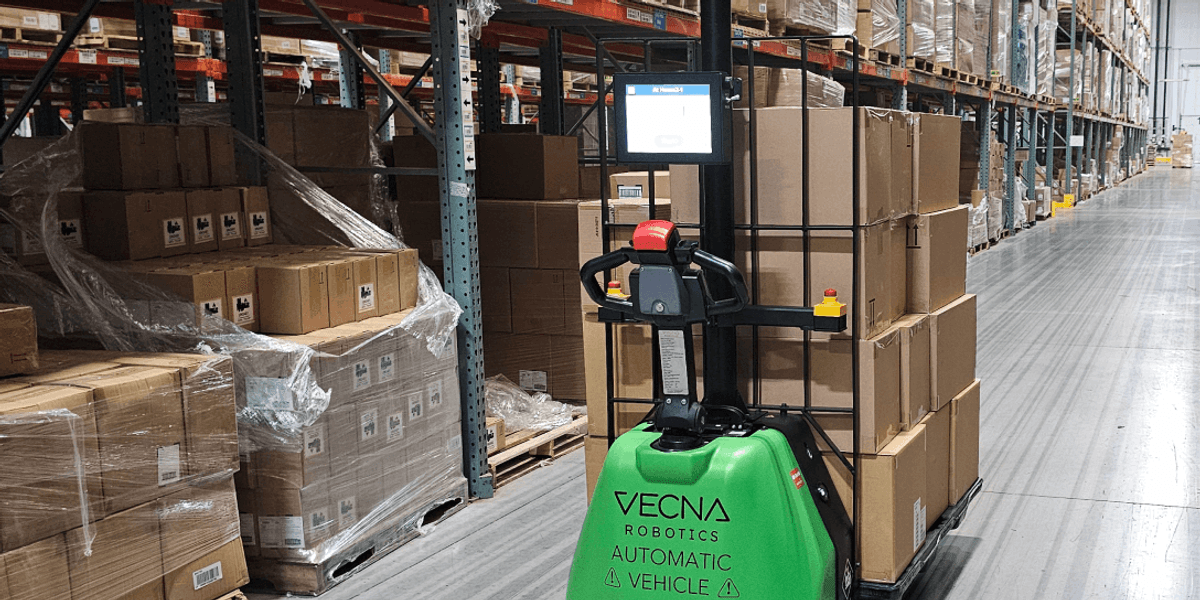
Vecna Robotics provides autonomous mobile robot (AMR) systems and orchestration software for material handling tasks such as case picking, cross-docking, and warehouse workflows. Its Pivotal Command Center offers 24/7 remote fleet monitoring and teleoperation for logistics and warehouse operators.
Also known as Vecna Robotics, Inc.
Founders & leadership

Board


Investors · 22

How we know: a partner's Signal profile · press coverage · research · startupintros.com · open dataset · 5k.vc investor directory · Not right? Tell us

How we know: Drive Capital's portfolio page · dcvelocity.com · research · en.wikipedia.org · Not right? Tell us
How we know: Fontinalis Partners's portfolio page · dcvelocity.com · the VCSheet dataset · open dataset · 5k.vc investor directory · Not right? Tell us

How we know: the VCSheet dataset · open dataset · 5k.vc investor directory · Not right? Tell us

How we know: Tectonic Ventures's portfolio page · dcvelocity.com · the VCSheet dataset · open dataset · 5k.vc investor directory · Not right? Tell us

How we know: Unless's portfolio page · dcvelocity.com · the VCSheet dataset · research · startupintros.com · Not right? Tell us
How we know: research · startupintros.com · Not right? Tell us

How we know: research · startupintros.com · Not right? Tell us
How we know: dcvelocity.com · research · startupintros.com · open dataset · 5k.vc investor directory · Not right? Tell us

How we know: research · startupintros.com · Not right? Tell us

How we know: a partner's Signal profile · funding news · dcvelocity.com · research · startupintros.com · Not right? Tell us
Also in the syndicate · 9
Funding
SEC filings, press & company announcements$134M disclosed across 4 of 9 rounds · 2018–2026
- $31Mseries DSep 2026 · 2 sources
Unless (lead), Drive Capital, Highland Capital Partners, Tectonic Ventures, Tiger Global
Source ↗ - $14.5MraisedNov 2024 · 3 sourcesSource ↗
- Undisclosed amountSeries CJun 2024Source ↗
▶$75MraisedApr 2022 · 14 investors · Other TechnologyRule 506(b)
- Craig MalloyExecutive Officer, Director
- Bob DavisDirector
- Trevor ZimmermanDirector
- Daniel TheobaldExecutive Officer, Director
- Daniela RusDirector
- Michael BearmanExecutive Officer
- Nick SolaroDirector
- Offering amount
- $75M
- Amount sold
- $75M
- First sale
- Dec 2021
- Incorporated
- Corporation, Delaware, 2018
- Federal exemptions
- 06b
▶$13.5MraisedAug 2018 · 6 investors · Other TechnologyRule 506(b)
- Daniel PattExecutive Officer, Director
- Daniel TheobaldExecutive Officer, Director
- Michael BearmanExecutive Officer
- Nick SolaroDirector
- Offering amount
- $13.5M
- Amount sold
- $13.5M
- First sale
- Aug 2018
- Incorporated
- Corporation, Delaware, 2018
- Federal exemptions
- 06b
Source: SEC EDGAR Form D. Amounts as filed; amended filings shown once at their latest values.
Company profile
researched Aug 2026Vecna Robotics, Inc. is an American robotics and technology company headquartered at 425 Waverley Oaks Road in Waltham, Massachusetts. Incorporated in 2018 as a spin-off from Vecna Technologies, it develops autonomous mobile robots (AMRs) and orchestration software for automated material handling, hybrid fulfillment and workflow optimization in warehousing, distribution and manufacturing settings.
Its current product line comprises the Vecna AFL autonomous forklift (3,000 lb capacity, 60-inch lift height, 6.7 mph at maximum load), the Vecna ATG autonomous tugger (10,000 lb capacity, 4.5 mph at maximum load), and the Vecna CPJ co-bot pallet jack (3,300 lb capacity, 2.8 mph at maximum load), together with CaseFlow, a hybrid case-picking offering that dynamically orchestrates human workers and CPJ robots and adapts to congestion and shifting demand. Earlier catalog entries documented in secondary sources include the RC20 and RC500 conveyors, RL350 lifter, RL3600 pallet truck, RT4500 tugger and the Tote Retrieval System. Targeted workflows include case picking, putaway, cross-docking, line-side delivery, end-of-line, work-in-progress and point-to-point movement.
The company states that it designs and manufactures its robots in the United States. It publishes claimed operating benchmarks of $10/hour or less per robot, deployment in four weeks or less, positive ROI in under one year, and 99% uptime backed by 24/7 monitoring. It has received a MassTLC Tech Top 50 recognition, a Diversity & Inclusion partner award, and an RBR 50 Innovation Award, and has participated in the MassRobotics interoperability standards effort.
Founding story
Vecna Robotics traces to Vecna Technologies, founded in 1998 by a group of MIT scientists — including Daniel Theobald — on a $5,000 investment from the founders; that company self-funded into a profitable manufacturer, researcher and software firm serving healthcare, logistics and remote presence markets, amassing more than a hundred issued and pending patents and employing more than 200 people. The 'Vecna' name is reported to derive from the Czech word věčný/věčná, meaning 'eternal.' The robotics group's government-funded work, notably the BEAR battlefield rescue robot, produced autonomy software that was later abstracted from that hardware and applied to industrial logistics vehicles. In 2018 Vecna Technologies spun off 60 employees and the robotics business to found Vecna Robotics, with Daniel Theobald and Dan Patt named as founders.
Business model
Vecna Robotics sells and deploys autonomous material handling vehicles bundled with its Pivotal orchestration software and a 24/7 remote Command Center service. Products are offered both as outright purchases and under a Robotics-as-a-Service (RaaS) monthly subscription; a company director of validation stated that RaaS is popular while some customers buy the equipment outright. The company markets a performance guarantee tied to customer-defined metrics and positions its pricing around a stated cost of $10/hour or less per robot.
Revenue comes from robot hardware sales and from Robotics-as-a-Service subscriptions priced on a per-month basis, with the company advertising an effective rate of $10 per robot-hour or less; recurring software (Pivotal) and 24/7 Command Center monitoring and teleoperation services are bundled with deployments. The company reported triple-digit revenue growth and more than a 100% increase in deployments in the year preceding its Series C close.
Traction
The company reports customers including GEODIS, FedEx, Caterpillar and Shape Corp., and says these customers have realized as much as 70% performance improvements in ground-to-ground warehouse workflows such as case picking, packaging and cross-docking. It cited triple-digit revenue growth and an over 100% increase in deployments in the year before its Series C close, and stated that its Series C nearly doubled its valuation versus its Series B. Earlier coverage described thousands of Vecna robots deployed worldwide, including six RT4500 tuggers at a FedEx hub and RL3600 pallet trucks at Milton CAT.
Latest developments
Vecna Robotics announced the close of its Series C round at $100 million, including $40 million in new equity and debt funding, which the company said nearly doubled its valuation relative to its Series B. Tiger Global Management, Proficio Capital Partners and IMPULSE participated. CEO Craig Malloy described the raise as providing a balance sheet to fund growth with existing customers, product performance improvements and new automation technology. Concurrently, the company appointed Michael Helmbrecht as chief operating officer, and said it had tightened its product focus to self-driving forklifts, pallet jacks and tuggers. It stated that the capital would support new platforms offering greater deployment flexibility and reach into additional workflows. An aggregator profile additionally lists a $14.5 million round dated November 13, 2024.
▸Full profile — market position, technology, go-to-market, geography, history, risks & controversies
Market position
Vecna competes in the autonomous mobile robot and automated material handling market, which secondary sources describe as crowded with numerous startups, incumbents modifying existing products, and many entrants from China. Industry forecasts cited in 2018 suggested autonomous forklifts and tugs would become the standard from 2022–2023 and eventually represent a large share of annual mobile material handling equipment. Vecna cites a $165 billion pallet-moving autonomy market and identifies third-party logistics providers and automotive as its fastest-growing demand segments. Reported customers and collaborators include GEODIS, FedEx, Caterpillar (Milton CAT) and Shape Corp.
Vecna positions its Pivotal software architecture as the connecting layer between customer systems, human workers and robot fleets, converting operational demand into coordinated action and continuously optimizing performance. The Pivotal Command Center pairs remote human operators with software to monitor fleets, resolve issues in real time and teleoperate edge cases, supporting a stated 99% uptime. Other stated differentiators are hybrid human-robot orchestration in case picking via CaseFlow, U.S. design and manufacture, a customer-defined performance guarantee, and internal reliability testing: the company operates a 'bowling alley' test facility where AMRs run around the clock on repeated pickups, drop-offs and robot-to-conveyor handshakes under replicated customer-site conditions. The company has also developed sensing at height and tolerance for variance from existing maps.
Technology
The company's autonomy stack originated as a general-purpose 'Autonomy Kit' robot brain, abstracted from the BEAR humanoid robot's hardware, capable of converting varied equipment — forklifts, tuggers, floor cleaners, construction equipment and picking systems — into mobile robots that operate safely alongside people using laser-based sensors, cameras and vision systems. Fleets are directed by a centralized controller for optimization, traffic control and service. The current Pivotal orchestration engine coordinates robots, workers and enterprise systems on a cloud-based, AI-driven platform, with the Pivotal Command Center providing round-the-clock remote monitoring and teleoperation of edge cases. The company has developed sensing at height and map-variance tolerance and participates in MassRobotics interoperability standards work.
Go-to-market
The company sells direct to enterprise operators through a business development team reached via a web contact form, promising follow-up within one business day, and supports the sales process with a 'Return on Robotics' savings calculator, webinars and case studies. It publishes customer testimonials from Shape Corp., GEODIS and a large retailer, and works with partners such as forklift maker Big Joe on hardware and with GEODIS on joint development of a case-picking solution.
Warehouse, distribution center and manufacturing operators seeking to automate pallet and case movement amid labor shortages, particularly third-party logistics providers and automotive companies. Named customers and reference accounts include GEODIS, FedEx, Caterpillar/Milton CAT and Shape Corp.
Geography
Headquarters are at 425 Waverley Oaks Road, Waltham, Massachusetts, United States; the company was earlier based in Cambridge, Massachusetts and supported efforts to build the Massachusetts Robotics Cluster. Robots are designed and manufactured in the USA, and remote monitoring support is described as U.S.-based. Documented customer deployments include Milton CAT's Milford, Massachusetts distribution center and a FedEx shipping hub in Kernersville, North Carolina; a 2018 account stated that thousands of Vecna robots were deployed worldwide across manufacturing facilities, shipping companies, 3PLs and retailers.
History
The business originated as the robotics division of Vecna Technologies, a company founded in 1998 by MIT engineering alumni including Daniel Theobald, which focused primarily on healthcare software while its robotics group conducted research for the U.S. Navy, U.S. Air Force and NASA. In the mid-2000s the division received U.S. Army, DARPA and other government funding to develop the Battlefield Extraction-Assist Robot (BEAR), whose autonomy software was later abstracted from the hardware and reused for logistics robots. A robotic courier, the QC Bot, was piloted in hospitals in April 2012, and additional logistics robots became generally available to industrial customers in April 2017, at which point Vecna Robotics was established as a wholly owned subsidiary to enable outside investment. In December 2017 the firm won the DHL & Dell Robotics Innovation Challenge for its Tote Retrieval System.
Daniel Patt, previously deputy director of DARPA's Strategic Technology Office, joined as CEO in January 2018, and the company spun out from Vecna Technologies later that year with 60 transferred employees, reincorporating in Delaware. SEC filings cited by Wikipedia record a $13.5 million round beginning August 14, 2018, led by Drive Capital, the first outside equity investment in the standalone company. A further $50 million was announced in January 2020 alongside Theobald's return as CEO; Craig Malloy was named CEO in June 2021; a Tiger Global-led Series C was announced in January 2022; and the co-bot pallet jack, developed with forklift maker Big Joe, was released in March 2022. The Series C round was later closed at $100 million total. Wikipedia lists Karl Iagnemma as CEO in its infobox.
Risks & controversies
Public sources indicate frequent leadership turnover at the chief executive level — Daniel Patt (2018), Daniel Theobald (2020), Craig Malloy (2021) and Karl Iagnemma listed in Wikipedia's infobox — and note that robotics investment dipped in the year before the Series C close. Available third-party data is also inconsistent: one aggregator reports $169.5M raised across four rounds and an implausible headcount figure of '10000+', while the company itself cited $128.5 million total capital raised as of January 2022 and a $100 million Series C. Investor lists for individual rounds also differ between sources.
Compiled by commissioned research from 8 cited public sources — announcements, filings, and press listed under research sources below.
Key figures
latest reportedCompany-reported or press-reported figures, each dated to when it was claimed — not independently audited.
Founder mafia
2 people who came through Vecna Robotics went on to found or lead other companies.

Related companies · 5





Companies working in the same space as Vecna Robotics.
Timeline · 10
launches, deals, and filingsAnnounced alongside the Series C close, Michael Helmbrecht joined as chief operating officer overseeing operations, manufacturing, IT, product, and customer success. He previously held executive roles at Dell, Lifesize, and RingCentral.
GEODIS stated it has been working with Vecna Robotics on development of a case-picking solution that nearly doubles performance, and expected the Series C capital to accelerate its launch.
Vecna Robotics released what it described as the industry's first co-bot pallet jack, developed in partnership with forklift maker Big Joe.
The company announced Craig Malloy, former founder and CEO of Lifesize, as CEO.
Alongside the announcement of $50M in investment in January 2020, Theobald took over as CEO.
As of October 2018, RL3600 Pallet Trucks were deployed at Milton CAT's Milford, Massachusetts distribution center to speed fulfillment and address retrieval of slow-selling items stored at long walking distances.
A fleet of six RT4500 Tuggers at the FedEx industrial shipping hub in Kernersville, North Carolina was profiled in The New York Times; the tuggers pull carts of bulky goods that do not fit on conveyor belts.
Daniel Patt, former deputy director of DARPA's Strategic Technology Office, joined Vecna Robotics as CEO.
Vecna Robotics was incorporated in 2018 as a spin-off from Vecna Technologies; 60 existing employees transferred into the new company. Vecna Robotics had previously been established as a wholly owned subsidiary in 2017 to allow it to seek outside investment and specialize in autonomous mobile solutions.
The firm won the DHL & Dell Robotics Innovation Challenge in December 2017 for the Tote Retrieval System, an automated guided vehicle capable of warehouse navigation and mobile piece-picking from conventional shelves.
Dated company events from announcements, filings, and press; legal rows summarize public dockets and regulator releases.
Legal entities · 1
corporate structureIn the news
 Vecna Robotics raises $31 million as demand soars for U.S.-built robots - Infraloginfralog.in · Sep 2026
 Vecna Robotics raises $31 million as demand soars for U.S.-built robots | DC Velocitydcvelocity.com · Sep 2026
▸Research sources · 8
primary sources listed
- Vecna Roboticsvecnarobotics.com · web
8 public sources were cited for this profile; the first-party ones are listed here.
Frequently asked questions
- What does Vecna Robotics do?
- Waltham, MA-based maker of autonomous forklifts, tuggers and pallet jacks with Pivotal orchestration software for warehouse material handling.
- Who are Vecna Robotics's investors?
- Vecna Robotics's investors include Blackhorn Ventures, Drive Capital, Fontinalis Partners, Tau Ventures, Tectonic Ventures, Unless, Axilor Ventures, Flybridge Capital Partners and 5 more.
- How much funding has Vecna Robotics raised?
- Vecna Robotics has disclosed $134M raised across 4 of its 9 known rounds.
- Where is Vecna Robotics headquartered?
- Vecna Robotics is headquartered in Cambridge, US.