 Fundraising Fox
Psyonic
Champaign, US · Founded 2015 · Illinois corporation · 42 employees on LinkedIn · 8 known investors
Find your way into Psyonic
Sign up to see every warm intro you have to Psyonic
- Paths you didn't know you had: your email and LinkedIn already hold routes to the Psyonic team. We find them for you
- 2nd- and 3rd-degree connections: the friend-of-a-friend routes that take hours to manually find through your inbox or LinkedIn
- Answers now, not in days: momentum is everything in a raise. Skip asking around whether someone knows someone
Days of research, done the moment you sign in, with every route ranked by how warm it is.
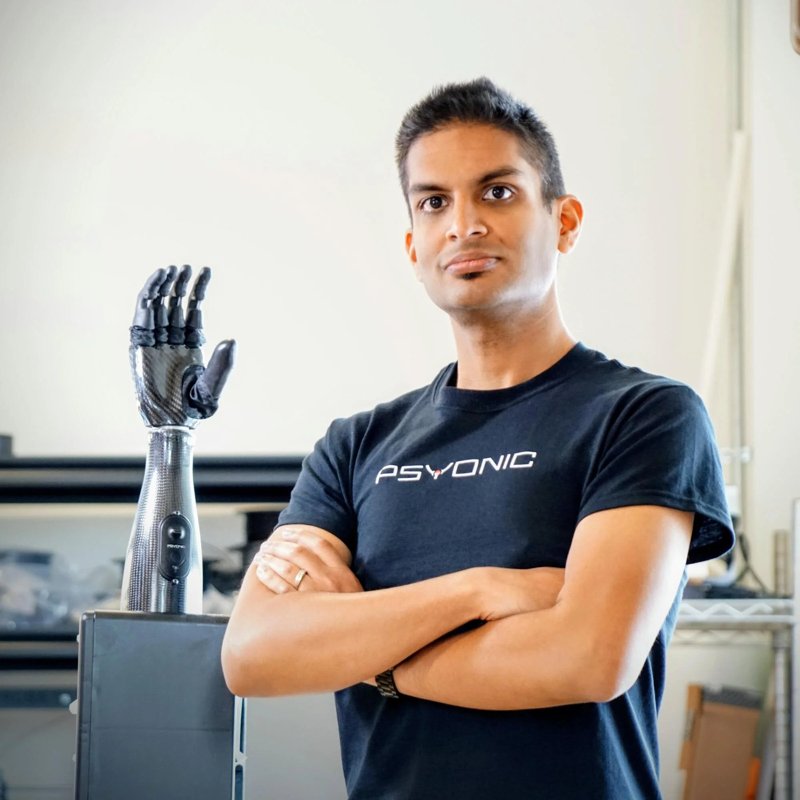
PSYONIC develops the Ability Hand, a touch-sensing bionic hand with sensory feedback and motor control for prosthetic users and robotics applications. The company positions the device as faster than other bionic hands and priced to be covered by Medicare and most private insurers.
Also known as PSYONIC · Psyonic Inc.
Founders & leadership
Psyonic was founded in 2015 by Patrick Slade and Dr. Aadeel Akhtar.
Investors · 8

How we know: av.vc · Not right? Tell us

How we know: IrishAngels's portfolio page · the VCSheet dataset · Not right? Tell us

Also in the syndicate · 3
Reported raises · per SEC filings
Form D private placements$725K disclosed across 2 of 6 rounds · 2018–2024
▶$625KraisedJan 2020 · 14 investors · BiotechnologyRule 506(b)
- Aadeel AkhtarExecutive Officer
- Offering amount
- $1M
- Amount sold
- $625K
- Minimum investment
- $25K
- First sale
- Oct 2018
- Incorporated
- Corporation, Illinois, 2015
- Federal exemptions
- 06b
▶$100KraisedJan 2019 · 2 investors · Other Technology
- Aadeel AkhtarExecutive Officer
- Amount sold
- $100K
- Minimum investment
- $50K
- First sale
- Oct 2018
- Incorporated
- Corporation, Illinois, 2015
- Federal exemptions
- 04
Source: SEC EDGAR Form D. Amounts as filed; amended filings shown once at their latest values.
Valuation · disclosed
Disclosed eventsSource: SEC prospectus filings, and round valuations the company or its investors disclosed — follow each entry's link for the claim.
Company profile
researched Aug 2026PSYONIC is a bionic technology company whose product, the Ability Hand, is a multi-articulated prosthetic hand with integrated touch sensing. The hand detects pressure during grip and relays vibration feedback to the user's arm, and it uses patented motor control and sensory feedback. It weighs 490 grams, is rated IP64 for spill and splash resistance, charges over USB-C in roughly an hour for an estimated 6-8 hours of use, and its fingers are designed to absorb blunt-force impact. The company offers 32 grip patterns, of which 19 were pre-defined and available at the time of publication, and the hand is cross-compatible with most third-party control systems including EMG pattern recognition, EMG direct control, linear transducers and force-sensitive resistors. The company states the hand closes in about 200 milliseconds and is over twice as fast as other bionic hands on the market.
A second line of business targets robotics and industrial automation. The same hardware is offered with torque, velocity and position control across six brushless DC motors, streaming of six encoder values and 30 touch-sensor values over BLE, I2C, UART or RS485, and an open API plus datasheet and spec sheet for integration with existing robotics platforms. The company also states it is exploring a bionic leg, artificial tendons, additional sensory-feedback methods, and software for biointegrated technologies.
PSYONIC says the Ability Hand is made in the United States and that the design was specifically targeted for Medicare coverage, on the basis that Medicare-covered prosthetic devices are generally covered by most private insurers; the Research Park profile states it is covered by US insurers with no out-of-pocket cost to users and describes it as the only multi-grip bionic hand made in the USA.
Founding story
PSYONIC was founded in 2015 by Aadeel Akhtar, who holds a PhD in Neuroscience and an MS in Electrical & Computer Engineering from the University of Illinois at Urbana-Champaign (2016), plus a BS in Biology (2007) and MS in Computer Science (2008) from Loyola University Chicago. Akhtar has said he was inspired to build advanced, affordable prosthetic devices after visiting Pakistan at age seven and meeting a child his age with a limb difference.
Business model
PSYONIC sells the Ability Hand as hardware to two customer groups: prosthetic users, where the device is priced and designed for reimbursement under Medicare and, by extension, most private insurance; and robotics and research buyers, who purchase the hand as an end effector with an open API. The company reports revenue of $1,655,166 in its most recent fiscal year against $652,789 the prior year, with net income of $75,758 versus a prior-year loss of $441,251.
Product sales of the Ability Hand, with prosthetic-side revenue tied to insurance reimbursement (Medicare and private insurers) and a robotics/research channel selling the hand for integration into automation and brain-machine-interface systems.
Traction
The Ability Hand launched nationally in 2021 and is used by people with upper-limb differences across the United States as well as by robotics researchers; NASA, Meta and Apptronik are cited as clients. Revenue grew from $652,789 to $1,655,166 year over year, with the company reporting net income of $75,758 in the most recent fiscal year. The StartEngine crowdfunding round attracted more than 1,600 investors and closed with $3.1 million raised. The hand has been featured on CBS's 60 Minutes being controlled via a brain implant, and reviewed by Marques Brownlee.
Latest developments
A Regulation Crowdfunding offering on StartEngine priced at $2.43 per share against a stated $65.07 million valuation, with a funding goal range of $10,000 to $2.74 million for Class B Common Non-Voting shares, had a deadline of April 30, 2024; the company announced the round had passed $2.4 million before closing, and a subsequent company post reported $3.1 million raised at close. PSYONIC has also expanded its robotics offering for high-cycle industrial environments and is exploring a bionic leg, artificial tendons, new sensory-feedback methods, and supporting software.
▸Full profile — market position, technology, go-to-market, geography, history, risks & controversies
Market position
PSYONIC positions the Ability Hand as the fastest and only multi-touch-sensing bionic hand on the market, at a cost it describes as a quarter to a half of comparable hands. The company cites a bionic limb market expected to reach almost $3 billion within eight years and a humanoid robotics industry expected to reach about $6 billion.
Claimed 2x speed advantage over other bionic hands, multi-point touch sensing with vibrotactile feedback, impact-resistant fingers, IP64 water resistance, US manufacturing, Medicare-eligible pricing, and an open API allowing use as a robotic end effector rather than only as a prosthesis.
Technology
Patented motor control and sensory feedback: integrated pressure sensors in the fingers trigger vibration feedback to the residual limb. All five fingers flex and extend and the thumb rotates both electrically and manually. Six brushless DC motors support torque, velocity and position control; 30 touch-sensor values and six encoder values stream over BLE, I2C, UART or RS485 through an open API. The hand closes in roughly 200 ms, weighs 490 g, is IP64 rated, and supports 32 grip patterns (19 pre-defined at time of publication).
Go-to-market
Direct sales and clinical distribution through prosthetists for the human prosthetics line; a "book a call" enterprise sales motion with published datasheet, spec sheet and open API documentation for robotics buyers. The company has also used equity crowdfunding on StartEngine both to raise capital and to reach a retail investor base of more than 1,600 investors, and has leaned on media exposure (CBS 60 Minutes, CNBC, Popular Mechanics, a Marques Brownlee review, ABC's Shark Tank) for visibility.
People with upper-limb differences in the United States, prosthetists, and organizations in humanoid robotics, manufacturing, brain-machine interfaces and academic research. Named clients include NASA, Meta and Apptronik.
Geography
Founded and initially based in Champaign, Illinois, at the University of Illinois Research Park's EnterpriseWorks incubator (2015-2022); headquarters moved to San Diego, California in 2022. The Ability Hand is manufactured in the United States and sold to users throughout the country.
History
The company was founded in 2015 at the University of Illinois and was a tenant of the EnterpriseWorks incubator at Illinois Research Park from 2015 to 2022. It won the Cozad New Venture Competition in 2015, and Akhtar won the $20,000 Illinois Innovation Prize in 2016. PSYONIC launched a new advanced prosthetic device at AOPA in 2019, was awarded $1 million by the National Science Foundation, and appeared on ABC's Shark Tank. The Ability Hand launched nationally in 2021. In 2022 the company moved its headquarters to San Diego, California. A Regulation Crowdfunding equity round on StartEngine ran into 2024, raising $3.1 million by its close.
Risks & controversies
The StartEngine offering carries standard equity-crowdfunding disclosures that the investment is speculative, illiquid and involves a high degree of risk including possible loss of the entire investment. The company's disclosed financials show long-term debt of $1,615,902 in the most recent fiscal year, up from $1,427,500, against $438,919 in cash and cash equivalents. Reimbursement dependence on Medicare and private insurer coverage is central to the product's affordability claim.
Compiled by commissioned research from 8 cited public sources — announcements, filings, and press listed under research sources below.
Key figures
latest reportedCompany-reported or press-reported figures, each dated to when it was claimed — not independently audited.
Related companies · 2
.jpg)
Companies working in the same space as Psyonic.
Non-dilutive funding · 4 SBIR/STTR awards
Federal grants — no equity taken| Agency | Phase | Year | Amount |
|---|---|---|---|
| National Science Foundation | Phase II | 2022 | $1M |
| National Science Foundation | Phase II | 2020 | $739.3K |
| National Science Foundation | Phase I | 2019 | $225K |
| National Science Foundation | Phase I | 2018 | $225K |
Source: SBIR.gov award data (U.S. Small Business Administration). SBIR/STTR awards are competitive federal R&D grants and contracts — non-dilutive capital alongside any venture rounds above.
Timeline · 11
launches, deals, and filingsPSYONIC announced it would soon close its Regulation Crowdfunding round on StartEngine, having raised more than $2.4 million from over 1,600 investors, with a minimum investment just under $250.
$2.4M source ↗
A company news post reports the StartEngine equity crowdfunding campaign closed with $3.1 million raised. The 2024 offering was priced at $2.43 per share at a stated $65.07 million valuation for Class B Common Non-Voting shares, with a deadline of April 30, 2024.
$3.1M source ↗
PSYONIC relocated its headquarters from Champaign, Illinois to San Diego, California, ending its 2015-2022 tenure at the EnterpriseWorks incubator in Illinois Research Park.
The Ability Hand launched nationally in 2021 and is used by people with upper-limb differences throughout the United States.
Awarded for pioneering prosthetic technology, accessibility, and leadership as founder of PSYONIC.
$20K source ↗
Founder Dr. Aadeel Akhtar was named one of MIT Technology Review's top 35 Innovators Under 35 and included in Newsweek's America's Top 50 Disruptors.
Listed among PSYONIC's news and milestones during its tenure at Illinois Research Park.
$1M source ↗
Dated company events from announcements, filings, and press; legal rows summarize public dockets and regulator releases.
Legal entities · 1
corporate structureIn the news
▸Research sources · 8
primary sources listed
- PSYONICpsyonic.io · web
8 public sources were cited for this profile; the first-party ones are listed here.
Frequently asked questions
- What does Psyonic do?
- PSYONIC makes the Ability Hand, a multi-touch-sensing bionic hand for people with limb differences and for robotics.
- Who founded Psyonic?
- Psyonic was founded by Patrick Slade, Dr. Aadeel Akhtar in 2015.
- Who are Psyonic's investors?
- Psyonic's investors include Alumni Ventures, Illinois Ventures, IrishAngels, K Street Capital, Daymond John.
- How much funding has Psyonic raised?
- Psyonic has disclosed $725K raised across 2 of its 6 known rounds.
- Where is Psyonic headquartered?
- Psyonic is headquartered in Champaign, US.