 Fundraising Fox
Dream Security
Unicorn · $3BFounded 2023 · 357 employees on LinkedIn · 22 known investors
Find your way into Dream Security
Sign up to see every warm intro you have to Dream Security
- Paths you didn't know you had: your email and LinkedIn already hold routes to the Dream Security team. We find them for you
- 2nd- and 3rd-degree connections: the friend-of-a-friend routes that take hours to manually find through your inbox or LinkedIn
- Answers now, not in days: momentum is everything in a raise. Skip asking around whether someone knows someone
Days of research, done the moment you sign in, with every route ranked by how warm it is.
Dream builds sovereign technology systems that let national governments manage critical assets and infrastructure within their own borders and control. It works directly with heads of state, ministries, and national cyber authorities, with expertise spanning AI, cybersecurity, and sovereign infrastructure.
Also known as Dream · Dream Group · DREAM SECURITY LTD
Founders & leadership
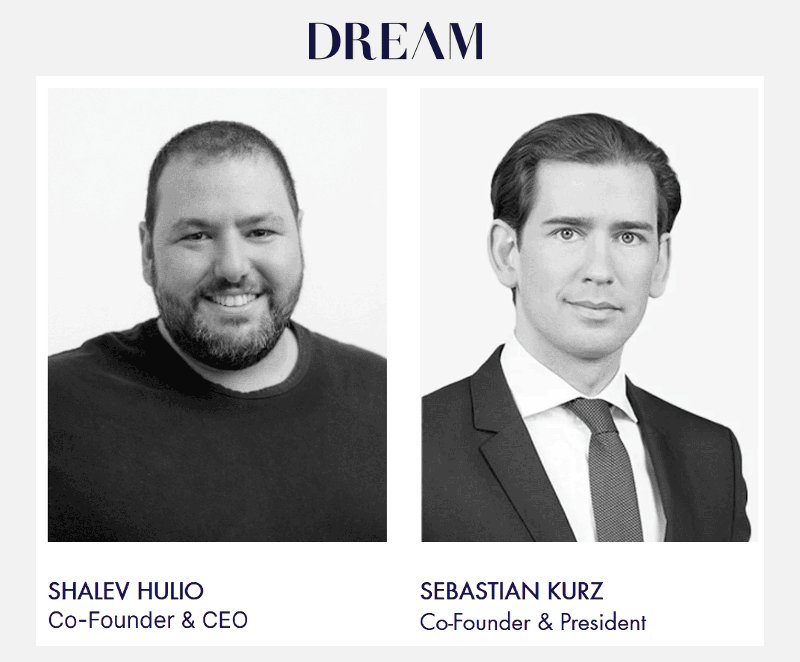
Dream Security was founded in 2023 by Shalev Hulio and Sebastian Kurz.
Investors · 22
How we know: 7GC & Co's portfolio page · funding news · Not right? Tell us

How we know: Bain Capital Ventures's portfolio page · Not right? Tell us


How we know: research · startupim.com · Not right? Tell us

How we know: research · startupim.com · Not right? Tell us


How we know: research · startupim.com · Not right? Tell us

How we know: funding news · research · startupim.com · Not right? Tell us
Also in the syndicate · 8
Funding
SEC filings, press & company announcements$260M disclosed across 1 of 9 rounds · 2022–2026
- $260MraisedJun 2026 · 4 sourcesSource ↗
Source: company announcements and press reports — follow each round's link for the claim.
Valuation · disclosed
Disclosed eventsSource: SEC prospectus filings, and round valuations the company or its investors disclosed — follow each entry's link for the claim.
Company profile
researched Aug 2026Dream Security (operating as "Dream", legal name DREAM SECURITY LTD) is an Israeli company that builds an integrated "national capability layer" combining sovereign AI and cyber defense for nation states, governments, national cyber authorities and critical infrastructure operators. Its stack is organized around three products: Atlas, a national AI platform intended to turn government data into analysis, interfaces and decisions across domains such as national intelligence, finance, health and supply chain; Sphere, a system that gives a unified view of fragmented national attack surfaces and identifies, investigates and thwarts state-actor cyberattacks against government stacks, critical infrastructure and national CERTs; and Hero, an agentic security product that autonomously discovers vulnerabilities and attack routes, performs malware reverse engineering and forensic investigation, and triages and validates fixes.
The company positions its deployments as fully on-premises and air-gapped inside a customer nation's borders, with no telemetry and no foreign control, and says customer governments train and run the models in their own clouds and data centers, so Dream itself does not access government data. Its sovereign language models are described as being in the 8-80 billion parameter range, deliberately smaller than commercial frontier models but focused on government content domains, including an earlier security-operations-specific Cyber Language Model. Dream also runs an internal threat research group (Dream Research Labs / DREAM Lab), which in August 2026 published an analysis of a multi-agent AI intrusion framework that compromised government systems in Asia.
Earlier public descriptions frame the company mainly as an AI cybersecurity vendor using machine learning, behavioral analytics and real-time threat intelligence for predictive detection and response across endpoints, enterprises and infrastructure; the sovereign-AI data analysis offering was added later and puts Dream in competition with Palantir in that segment.
Founding story
Sources give differing founding dates: Tau Capital and Trending Topics state the company was founded in January 2023, while a startup database lists founding in October 2022 with Israeli registrar incorporation on 2022-07-06. It was co-founded by Shalev Hulio (CEO, previously co-founder and CEO of NSO Group, maker of Pegasus spyware), former Austrian Chancellor Sebastian Kurz (President), and Gil Dolev (CTO, described as an AI expert).
Business model
Dream sells directly to national governments, ministries, national cyber authorities and critical infrastructure operators (utilities, energy, water, nuclear, smart-city platforms), typically through large government contracts. Products are deployed within customer borders on customer-controlled infrastructure, so the customer operates inference and hosting; one profile categorizes the business model as a mix of B2B/B2C, subscription SaaS and government contracts. Revenue visibility is described through order backlog and ARR rather than product-line disclosure.
Recurring, contract-based revenue from government and national institution customers. The company reported a $130 million order backlog at the start of 2025 and said it had accumulated $300 million in orders since beginning commercial operations in late 2024; ARR was estimated at $100-150 million in September 2025 and reported as having recently crossed $100 million in June 2026.
Traction
Reported deployments include threat detection and secure communications across multiple UAE government ministries, live protection of national infrastructure including utilities and smart-city platforms, and collaboration with regional law enforcement and defense agencies. The company says it serves public-sector clients across Europe, the Middle East and Southeast Asia, monitors millions of data points per second, and had accumulated $300 million in orders as of June 2026. Headcount grew from 4 in November 2022 to a reported 235-350 by August 2026.
Latest developments
In June 2026 Dream closed a $260M Series C at a $3 billion valuation led by Bicycle Capital and Group 11, with proceeds earmarked for global expansion including a planned Munich office. The company expanded beyond cybersecurity into sovereign AI data analysis with Atlas, and into autonomous vulnerability research and remediation with Hero. Management framed a June 12 US export-control directive barring foreign-national access to Anthropic's Fable 5 and Mythos 5 models as validation of its sovereignty thesis. In August 2026 Dream Research Labs published a report on an autonomous multi-agent AI attack framework, attributed by linguistic analysis to a Chinese-language operator, that compromised government entities in Asia. Sebastian Kurz named an IPO as a longer-term option.
▸Full profile — market position, technology, go-to-market, geography, history, risks & controversies
Market position
Positioned as a nation-focused vendor that consolidates capabilities other cybersecurity companies sell as separate products, distinguished by targeting national customers rather than a product niche. With the addition of AI data analysis tooling it competes directly with Palantir, and its Hero vulnerability-remediation product enters a segment occupied by companies including Zafran, Psychoginto, Pantera, Simulate and SafeBreach. It reached unicorn status in February 2025 and a $3 billion valuation in June 2026.
Full sovereignty claims — on-premises, air-gapped deployment with no telemetry, no foreign hyperscaler dependency and customer ownership of every layer; a turnkey sovereign AI stack intended to remove the capital, time and talent barriers to building national AI; per-vertical custom model architectures adapted to a nation's context; and a customer base limited to government and national entities, which the company says reduces its operational burden since it is not responsible for model inference.
Technology
Proprietary AI models and a data ecosystem combining machine learning, behavioral analytics and real-time threat intelligence, with automated network mapping and prioritization of unknown threats. Sovereign language models of 8-80 billion parameters are trained for government verticals (cyber, intelligence, health, finance, law) and are customized per nation's context. Deployment is on-premises and air-gapped with offline ingestion of data in any format. Dream holds 250 kilowatts of capacity at MegaDC's data center in Modi'in with hundreds of Blackwell 200 GPUs, and one profile records 38 EPO patents.
Go-to-market
Direct engagement with heads of state, ministries and senior officials responsible for national strategy, rather than product-niche enterprise sales. The company also publishes threat research and public commentary from its founders on sovereign AI to support the sales narrative, and uses inbound contact forms on its site for expert-team engagement.
Heads of state, ministries (including finance, justice and interior), national cyber authorities and CERTs, law enforcement and defense agencies, and operators of critical national infrastructure such as nuclear, gas, oil, water, electricity and smart-city systems.
Geography
Headquartered in Tel Aviv-Yafo, Israel (registered address Begin Road 152, Tel Aviv-Yafo), with a European headquarters in Vienna and an office in Abu Dhabi; a Munich office was announced as planned for later in 2026. Customers are public-sector organizations in Europe, the Middle East and Southeast Asia, including multiple UAE government ministries. Compute capacity is held in a MegaDC data center in Modi'in, Israel.
History
The company raised a $20M seed led by Group 11 in October 2022 and a $54M seed extension in 2023, followed by a $35M Series A in November 2023 co-led by Aleph and Group 11. Commercial operations began in late 2024. In February 2025 a $100M Series B led by Bain Capital valued the company at $1.1 billion, bringing Enrique Salem and Shlomo Yanai onto the board. In August/September 2025 a $45M secondary led by 7GC was completed at a $1.3 billion valuation, allowing veteran employees to sell shares. In June 2026 a $260M Series C led by Bicycle Capital and Group 11 valued Dream at $3 billion, alongside product expansion from cyber defense into sovereign AI with the Atlas and Hero launches.
Risks & controversies
CEO Shalev Hulio previously co-founded and led NSO Group, the spyware company that drew international attention over its Pegasus product; press coverage consistently frames Dream in relation to that background. Financial figures such as ARR are described as estimates rather than disclosed numbers, and sources conflict on founding date, headcount and total funding (one profile lists $514M total while the same page's Q&A says $460M). The Israeli registrar record shows two active charges/liens. Concentration in government customers and geopolitically sensitive markets, and direct competition with Palantir and well-funded vulnerability-management vendors, are structural exposures implied by the sources.
Compiled by commissioned research from 8 cited public sources — announcements, filings, and press listed under research sources below.
Key figures
latest reportedCompany-reported or press-reported figures, each dated to when it was claimed — not independently audited.
Timeline · 8
launches, deals, and filingsDream Research Labs published findings on an autonomous multi-agent AI intrusion framework built on Hermes and OpenClaw agents that compromised government entities in Asia over roughly four days in July 2026; some details were initially shared with the Financial Times.
Co-founder Sebastian Kurz said the company intends to open an office in Munich later in 2026, funded by the Series C, as part of global expansion including Germany.
Series C led by Bicycle Capital and Group 11, valuing the company at $3 billion.
$260M source ↗
Atlas, a national AI platform providing sovereign language models for state use across intelligence, health, finance and law, positioned as a response to US restrictions on foreign access to commercial frontier models.
Hero autonomously identifies vulnerabilities and attack routes attributed to state actors, assesses risk and recommends or applies fixes.
Secondary share sale by senior and veteran employees, led by 7GC; completed at a $1.3B valuation with no proceeds to the company.
$45M source ↗
Round led by Bain Capital that made the company a unicorn.
$100M source ↗
As part of the Series B, Bain Capital partner and former Symantec CEO Enrique Salem and former Teva CEO Shlomo Yanai joined Dream's board of directors.
Dated company events from announcements, filings, and press; legal rows summarize public dockets and regulator releases.
▸Research sources · 8
primary sources listed
- Dream Securitydreamgroup.com · web
8 public sources were cited for this profile; the first-party ones are listed here.
Frequently asked questions
- What does Dream Security do?
- Israeli company selling sovereign AI and national cyber-defense platforms deployed on-premises for governments and critical infrastructure.
- Who founded Dream Security?
- Dream Security was founded by Shalev Hulio, Sebastian Kurz in 2023.
- Who are Dream Security's investors?
- Dream Security's investors include 7GC & Co, Bain Capital Ventures, Criticality, GiTV, Inc., Invariantes Fund, Sparkwave Capital, XT Venture Capital, Aleph and 6 more.
- How much funding has Dream Security raised?
- Dream Security has disclosed $260M raised across 1 of its 9 known rounds.