 Fundraising Fox
Adaptyv
YC S21Lausanne, CH · Founded 2021 · 25 employees · Hiring · 20 known investors
Find your way into Adaptyv
11,047 people in our graph can introduce you to the Adaptyv team.
Sign up to see every warm intro you have to Adaptyv
- Paths you didn't know you had: your email and LinkedIn already hold routes to the Adaptyv team. We find them
- 2nd- and 3rd-degree connections: the friend-of-a-friend routes you can't see from your own inbox or LinkedIn
- Answers now, not in days: momentum is everything in a raise. Skip asking around whether someone knows someone
Days of research, done the moment you sign in, with every route ranked by how warm it is.
Adaptyv Bio develops technologies for protein engineering that enable the design and testing of new proteins for applications in medicine, industrial enzymes, and functional materials. The company serves protein engineers and researchers developing therapeutic and industrial biological products.
Also known as Adaptyv Biosystems · Adaptyv Bio · Adaptyv Biosystems Sàrl
Founders & leadership· Y Combinator alumni (S21)



Investors · 20


How we know: research · adaptyvbio.com · highlandeurope.com · open dataset · 5k.vc investor directory · Not right? Tell us
How we know: Rheingau Founders's portfolio page · open dataset · 5k.vc investor directory · Not right? Tell us
How we know: S2S Ventures's portfolio page · Y Combinator's founder network · Not right? Tell us

How we know: Unruly Capital's portfolio page · Not right? Tell us

How we know: the Y Combinator directory · research · adaptyvbio.com · open dataset · 5k.vc investor directory · Not right? Tell us

How we know: the VCSheet dataset · Not right? Tell us
How we know: Y Combinator's founder network · Not right? Tell us

How we know: the VCSheet dataset · open dataset · 5k.vc investor directory · Not right? Tell us

How we know: press coverage · research · startupticker.ch · Not right? Tell us

How we know: Y Combinator's founder network · Not right? Tell us
How we know: Y Combinator's founder network · Not right? Tell us

How we know: press coverage · research · startupticker.ch · Not right? Tell us
How we know: Y Combinator's founder network · Not right? Tell us

How we know: Y Combinator's founder network · Not right? Tell us
Also in the syndicate · 3
Funding
SEC filings, press & company announcements- Undisclosed amountSeries AAug 2026 · 3 sourcesSource ↗
- Undisclosed amountseed fundingOct 2025
ACE Ventures (lead), ByFounders, Founderful, LongGame Ventures
Source ↗ - Undisclosed amountseed roundSep 2025Source ↗
Source: company announcements and press reports — follow each round's link for the claim.
Company profile
researched Aug 2026Adaptyv Bio (legal entity Adaptyv Biosystems Sàrl) operates an automated, AI-native wet laboratory for experimental validation of designed proteins. Customers submit protein sequences digitally through a web platform or an API, the company's automated lab performs the assays, and results are returned as a structured data package, with a stated turnaround of about three weeks from sequence design to experimental data. The workflow synthesises DNA in-house, expresses proteins cell-free, and measures binding using SPR (and BLI) with built-in quality control.
The service catalogue covers protein expression analysis, binding/affinity characterisation, and thermostability characterisation, offered at screening or full-affinity resolution against targets from Adaptyv's own library or targets shipped by the customer. Alongside experiment ordering, the platform provides experiment management, progress notifications, results analysis, raw-data export and tracking of design-round performance across time, positioning the lab as the "test" step in a design–build–test–learn loop for generative protein design.
The company also publishes community and benchmarking work: protein design competitions (EGFR, TREM2, Nipah), the BenchBB "Bench-tested Binder Benchmark", the Proteinbase repository of experimental protein design data including negative results, and case studies validating externally developed models such as Microsoft Research's EvoDiff, BindCraft, ProtRL and Pro-1.
Founding story
The founders positioned the company around the bottleneck that AI can generate thousands of candidate protein designs in silico while experimental validation remains slow, costly and technically complex; CEO Julian Englert has described the company as building the link between computational design and real-world validation, noting that biology AI models are only as good as the experimental data they are trained on.
Business model
Fee-for-service laboratory validation sold per protein, with published price points starting at $49 per protein for expression, $99 per protein for binding or thermostability, and from $149 per protein for configurations including two replicates; orders are configured by number of proteins (24–768), assay resolution and target source, and placed via a self-serve web platform or API.
Per-protein service revenue from expression, binding and thermostability assays, with pricing scaling by protein count and assay resolution and additional cost for targets supplied from Adaptyv's library; revenue was reported to have grown roughly 10x between the 2024 seed round and 2026.
Traction
Reported metrics include over 10,000 proteins tested in 2025 and hundreds of experiments run during the beta period, more than 30 companies using the service in 2025 rising to over 100 customers by 2026, more than 10 preprints published in 2025 using Adaptyv data, roughly 10x revenue growth since the seed round, a team that more than doubled in six months during 2025 and tripled by 2026, and a competition platform that attracted 680 participants and 10,000 protein designs to a single competition. In an international competition the company reported raising protein success rates from 2.5% to 13% in two months. In the Anthropic benchmark, 95% of 1,320 designs expressed and 354 bound their target, an average hit rate of 26.8%, with only one target yielding no binders. A TREM2 hackathon with muni produced 141 designs from 16 teams, of which 100 went to the wet lab and 37 bound, with the best human binder at 1.11 nM and the best agent binder at 3.64 nM.
Latest developments
In August 2026 Adaptyv announced a $40 million (€34.35 million) Series A led by Highland Europe with existing investors ACE Ventures, ByFounders and Y Combinator participating, to roughly triple lab capacity by the end of 2026, open a London lab and office in Q4 2026, expand in Lausanne, and grow the team from 25 to roughly 60 in production, automation and software. It also plans to move beyond binding measurements into developability and full biophysical characterisation, next-generation modalities such as peptides, ADCs and degraders, and eventually cell-based function. In the same month it published a benchmark run with Anthropic in which Claude models designed binders against 16 targets from Adaptyv's public competitions for anonymised wet-lab testing.
▸Full profile — market position, technology, go-to-market, geography, history, risks & controversies
Market position
Described as a validation standard for AI-model-driven protein design, used by frontier AI labs, top-five pharma companies and AI-native drug discovery startups, with more than 100 customers reported in 2026. Reported users and collaborators include Anthropic, Google DeepMind, Chai Discovery (validation of its Chai-2 zero-shot antibody release), Microsoft Research, Cradle, BindCraft, Escalante, Roche and Novo Nordisk, with Roche and Novo Nordisk reported to run therapeutic design cycles roughly 4x faster than their internal pipelines. The company estimates the binding-measurement market it currently serves at a few hundred million dollars a year.
The company states it runs more protein assays than anyone else and offers roughly three-week turnaround, fully automated hands-off operation across repeat rounds, in-house DNA synthesis, cell-free expression, SPR-based binding measurement with quality control, clean labelled datasets intended for model training, transparent per-protein pricing, and a programmatic API that lets AI agents order their own experiments. Investors and press describe it as replacing quote-chasing with CROs and email-based sample handoffs.
Technology
An automated cloud/wet lab combining in-house DNA synthesis, cell-free protein expression, and binding characterisation by SPR and BLI with built-in quality control, plus thermostability assays. Raw measurements are converted into clean labelled datasets for training design models, and the stack is exposed through a comprehensive API that supports querying the target catalogue, creating and tracking experiments, obtaining cost estimates and pulling structured results programmatically, including by autonomous AI agents. The team spans molecular biology, lab automation, software engineering and machine learning.
Go-to-market
Self-serve online ordering with transparent per-protein pricing, an API for programmatic and agent-driven ordering, and distribution through integrations with Boltz, Chai, Cradle, Tamarind, Latent Labs and Benchling (as a Benchling Direct Ordering Partner). Demand generation also comes from public protein design competitions, hackathons, community papers, benchmarks with AI labs, and designer-spotlight case studies published on the company blog.
Protein engineers and computational design teams: frontier AI research labs, large pharmaceutical companies, AI-native drug discovery startups, biotech companies and academic groups working on designed antibodies, binders, peptides, enzymes and functional materials.
Geography
Headquartered in the Lausanne area of Vaud, Switzerland, with lab and office presence reported at Épalinges on the Biopôle life sciences campus and a new Lausanne lab and office; a London lab and office was announced for the fourth quarter of 2026, alongside further Lausanne expansion. Customers and partners are described as worldwide.
History
Founded in 2021 by Julian Englert (CEO) and Daniel Nakhaee-Zadeh Gutierrez (CTO). The company raised a CHF 2.5 million pre-seed round in 2022 and an $8 million seed round led by ACE Ventures, reported as led in November 2024 and completed/announced in 2025, at which point it had about nine people. It ran a beta phase during which more than 10,000 proteins were tested with over 30 partners, released the Adaptyv Bio API (November 2024), opened the platform to all protein designers in September 2025, launched Proteinbase (October 2025) and a public API (April 2026), added Benchling direct ordering (May 2026), and raised a $40 million Series A led by Highland Europe announced in August 2026. It moved into a new lab and office in Lausanne during 2025 and announced a London lab and office for Q4 2026.
Risks & controversies
Reported plans depend on execution of significant capacity expansion, including roughly tripling lab capacity by the end of 2026, opening a London site, and more than doubling headcount; the company also intends to extend from binding assays, its current core market estimated at a few hundred million dollars a year, into newer assay types and modalities that it does not yet offer. Several traction figures, including revenue growth, customer counts and benchmark hit rates, are reported by the company itself.
Compiled by commissioned research from 8 cited public sources — announcements, filings, and press listed under research sources below.
Key figures
latest reportedCompany-reported or press-reported figures, each dated to when it was claimed — not independently audited.
Related companies · 5




Companies working in the same space as Adaptyv.
Timeline · 13
launches, deals, and filingsAdaptyv announced a $40 million (€34.35 million) Series A led by Highland Europe, with existing investors ACE Ventures, ByFounders and Y Combinator participating.
$40M source ↗
Anthropic used Claude Science models to design binders against 16 Adaptyv competition targets; Adaptyv validated 1,320 designs in its lab, reporting 95% expression, 354 binders and a 26.8% average hit rate.
16 teams (10 human, 6 autonomous AI agents) produced 141 TREM2 binder designs in one day; the top 100 by Boltz-2 ipSAE were tested, yielding 37 binders, best human binder 1.11 nM and best agent binder 3.64 nM.
Adaptyv joined Benchling's Direct Ordering Partners, integrating its API so users can submit protein candidates to the Adaptyv wet lab from Benchling.
Public API letting users and AI agents query the target catalogue, create and track experiments, obtain cost estimates and pull structured results programmatically.
Launch of Proteinbase, a hub for experimental protein design data including standardised lab validation, computational predictions and negative results.
Adaptyv exited beta and made its cloud lab for protein designers publicly available.
The company more than doubled its team in six months and moved into a new lab and office in Lausanne to support expansion.
Seed round of $8 million (CHF 6.4 million) led by ACE Ventures with ByFounders, Founderful, LongGame Ventures and several angels; reported as led by ACE in November 2024 and announced alongside the public platform launch.
$8M source ↗
Initial API release allowing AI agents to design proteins, test them in the wet lab and iterate on results.
Adaptyv announced a new lab and office in London opening in Q4 2026 alongside expansion in Lausanne, and plans to roughly triple lab capacity by end of 2026.
Dated company events from announcements, filings, and press; legal rows summarize public dockets and regulator releases.
In the news
 Adaptyv raises $40M for AI-run wet labs - European Biotechnology Magazineeuropean-biotechnology.com · Sep 2026
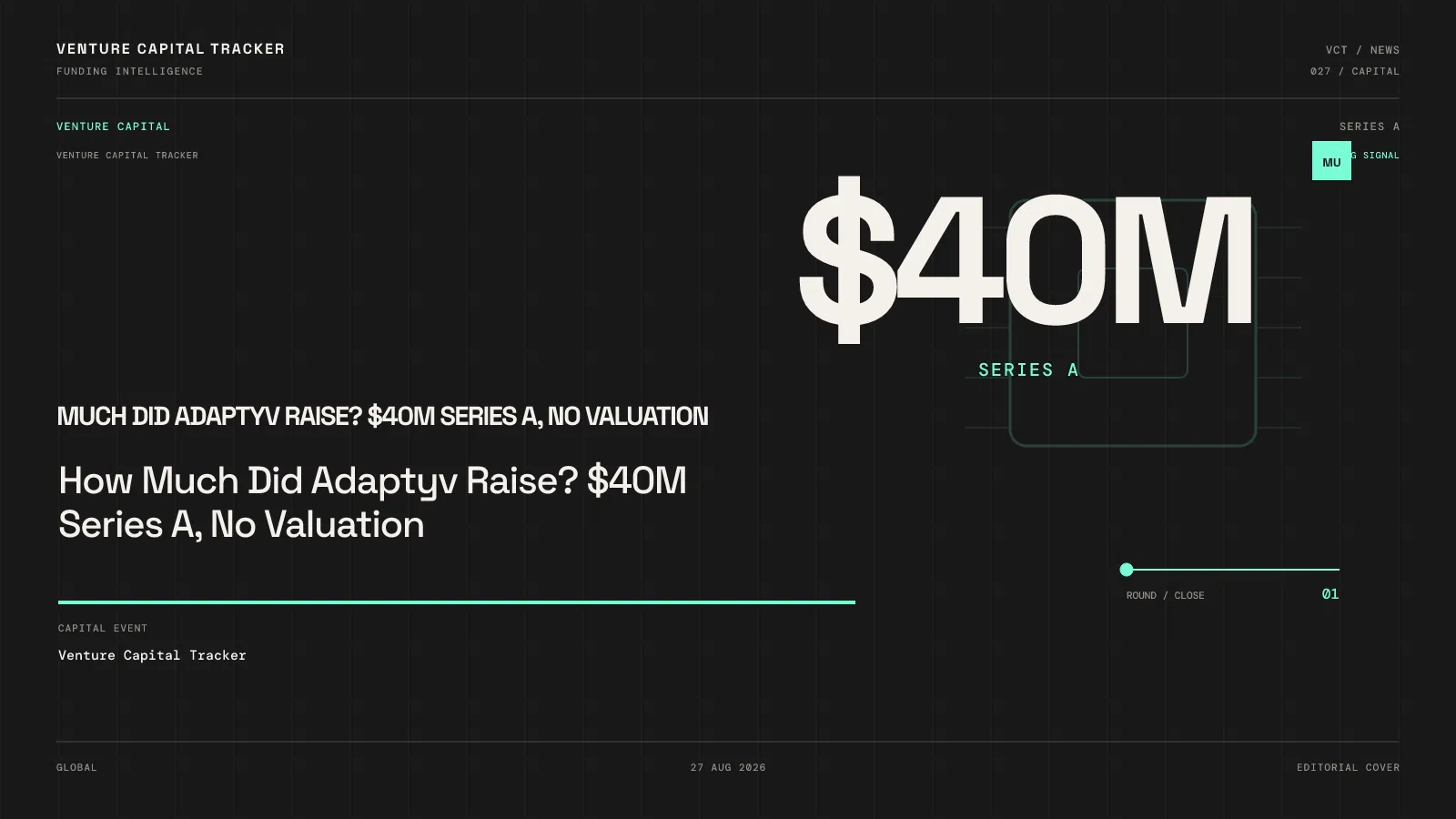 Adaptyv Funding 2026: $40M Series A for Automated Protein…venturecapitaltracker.com · Aug 2026
 Adaptyv Raises €34.35M Series Athesaasnews.com · Aug 2026
▸Research sources · 8
primary sources listed
- Adaptyvadaptyvbio.com · web
8 public sources were cited for this profile; the first-party ones are listed here.
Frequently asked questions
- What does Adaptyv do?
- Adaptyv Bio runs an automated wet lab that experimentally validates AI-designed proteins in under three weeks.
- Who founded Adaptyv?
- Adaptyv was founded by Julian Englert, Daniel Nakhaee-Zadeh Gutierrez, Robert Kaptur, Gerard Antoun, Sam Burns, Daniel Nakhaee-Zadeh in 2021.
- Who are Adaptyv's investors?
- Adaptyv's investors include Founders, HAWKTAIL, Highland Europe, Neer Venture Partners, Rheingau Founders, S2S Ventures, Unruly Capital, Y Combinator and 9 more.
- Where is Adaptyv headquartered?
- Adaptyv is headquartered in Lausanne, CH.