 Fundraising Fox
Sereact
100 employees on LinkedIn · 9 known investors
Find your way into Sereact
Sign up to see every warm intro you have to Sereact
- Paths you didn't know you had: your email and LinkedIn already hold routes to the Sereact team. We find them for you
- 2nd- and 3rd-degree connections: the friend-of-a-friend routes that take hours to manually find through your inbox or LinkedIn
- Answers now, not in days: momentum is everything in a raise. Skip asking around whether someone knows someone
Days of research, done the moment you sign in, with every route ranked by how warm it is.
Sereact builds an AI-powered robotic pick-and-place system for warehouse fulfillment, using a Vision Language Action Model to identify, grasp, and place mixed or unseen items without retraining. The hardware-agnostic system integrates with existing warehouse infrastructure such as AutoStore ports, conveyors, and AMR feeds for continuous production picking.
Also known as Sereact GmbH · Sereact Inc.
Founders & leadership
Investors · 9

How we know: Air Street Capital's portfolio page · a partner's Signal profile · funding news · the VCSheet dataset · research · sereact.ai · open dataset · 5k.vc investor directory · Not right? Tell us

How we know: Creandum's portfolio page · a partner's Signal profile · funding news · research · sereact.ai · open dataset · 5k.vc investor directory · Not right? Tell us

How we know: FELIX CAPITAL's portfolio page · a partner's Signal profile · funding news · research · sereact.ai · open dataset · 5k.vc investor directory · Not right? Tell us

How we know: Headline's portfolio page · funding news · research · sereact.ai · open dataset · 5k.vc investor directory · Not right? Tell us

How we know: Headline Growth Management, LLC's portfolio page · Not right? Tell us

How we know: Point Nine's portfolio page · a partner's Signal profile · funding news · the VCSheet dataset · research · sereact.ai · open dataset · 5k.vc investor directory · Not right? Tell us

How we know: funding news · research · sereact.ai · Not right? Tell us
Also in the syndicate · 2
Funding
SEC filings, press & company announcements$110M disclosed across 1 of 4 rounds · 2025–2026
- Undisclosed amountSeries BJul 2026 · 2 sources
Headline (lead), Air Street Capital, Bullhound Capital, Creandum, Daphni, Felix Capital, Point Nine, Zalando
Source ↗ - $110MraisedApr 2026 · 3 sourcesSource ↗
Source: company announcements and press reports — follow each round's link for the claim.
Company profile
researched Aug 2026Sereact GmbH is a German robotics software company that develops embodied AI for industrial and warehouse robots. Its core product is Cortex, a vision-language-action (VLA) foundation model marketed as a "robotic brain" that interprets natural-language instructions and translates them into physical actions, allowing robots to handle tasks and objects they were not explicitly programmed for. The software is hardware-agnostic and runs on single-arm and dual-arm picking cells, fixed cells, mobile manipulators and humanoid platforms from multiple suppliers.
The product portfolio spans Sereact Pick & Place (autonomous picking and placing across large SKU ranges), Robotic Putwall automation for batch picking and returns sortation, returns inspection and handling, humanoid applications, and Sereact Lens, an in-house optics and AI vision layer for real-time inventory counting, damage and anomaly detection and misplacement tracking. A Sereact Platform layer aggregates robot and Lens data into a unified operational hub with analytics, smart notifications, retrieval-augmented natural-language search over operational history, and agentic chat, and integrates with existing warehouse management systems.
The latest model generation, Cortex 2.0, augments the VLA model with a world model: from the current state it generates candidate future trajectories, evaluates them against a learned model of physics and object behavior, and scores each for stability, risk and efficiency before committing, updating the rollout as the scene changes. Planning takes place in visual latent space, which the company says allows transfer across robot embodiments, and planning compute is tunable per task. Sereact positions this predictive approach against competitors that rely more heavily on end-to-end VLA models.
Founding story
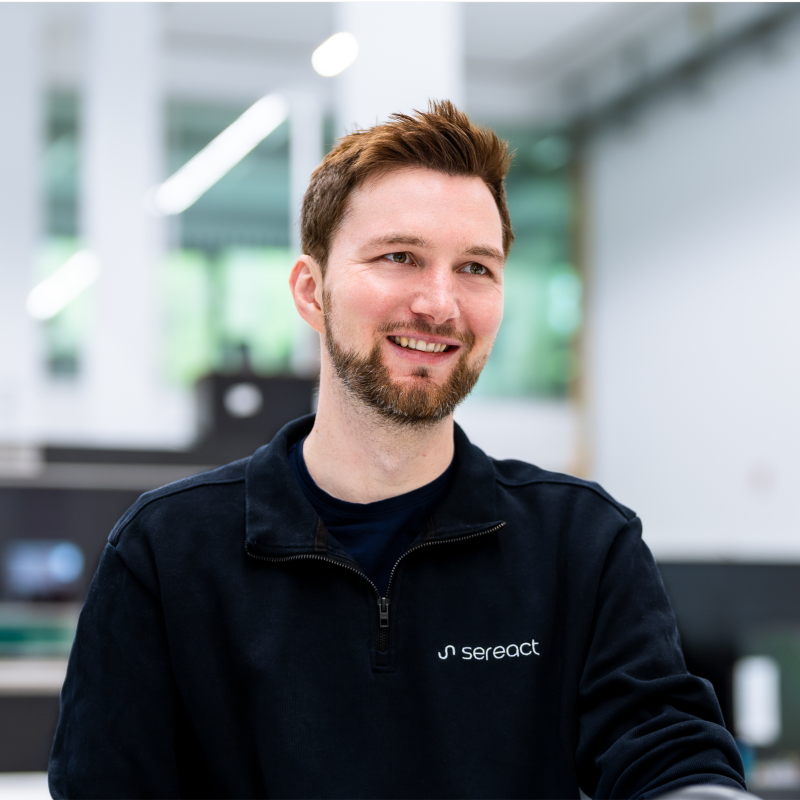
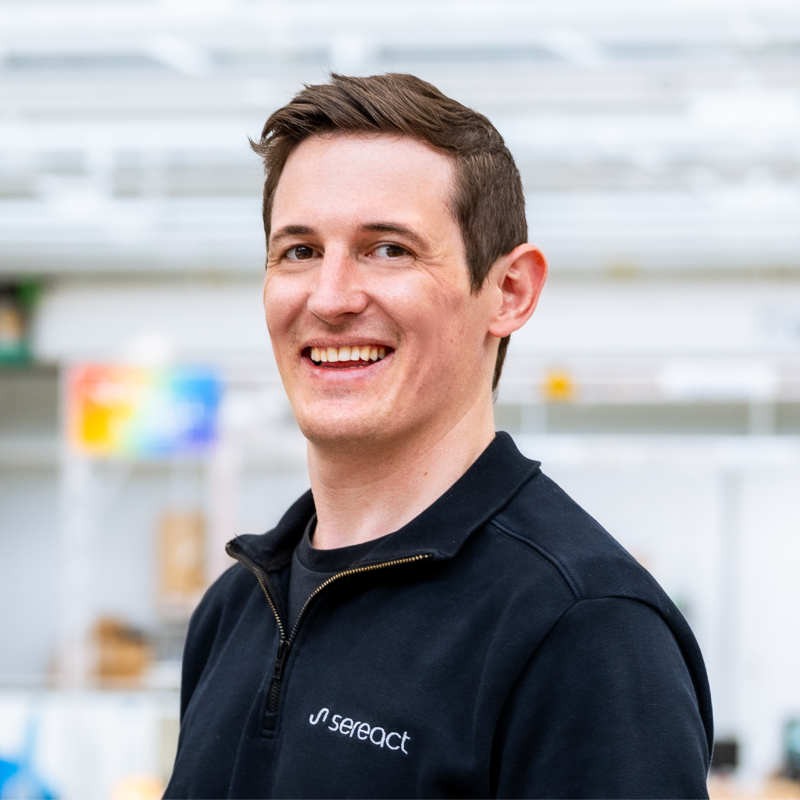
Ralf Gulde and Marc Tuscher, both previously AI researchers at the University of Stuttgart, founded the company in 2021 to close the gap between AI models and physical execution by robots. Gulde serves as CEO and Tuscher as CTO.
Business model
Sereact sells software rather than robots or services: a single model that runs on third-party robot hardware, deployed into customer fulfillment and manufacturing operations and integrated with existing warehouse infrastructure and WMS systems. The company states it ships one product, the model, and describes hardware as commoditizing.
Traction
The company reports more than 200 (site: 300+) live systems, over 1 billion (site: 2B+) real production picks, 50+ deployments across five continents, roughly one remote human intervention per 53,000 picks, pick success above 99% (98% first-attempt accuracy cited elsewhere), typical throughput of 300-450+ units per hour with peaks above 600-650 UPH, and one robot replacing 3 to 4.5 full-time equivalents depending on shift pattern.
Latest developments
In April 2026 Sereact announced a $110 million Series B led by Headline, with Bullhound Capital, Daphni and Felix Capital as new investors and returning backers Air Street Capital, Creandum and Point Nine. The proceeds fund the scaling of Cortex 2.0, which adds a world model for predictive planning, and entry into the US market with a first office in Boston. The company declined to disclose its valuation.
▸Full profile — market position, technology, go-to-market, geography, history
Market position
Sereact describes itself as the most deployed AI picking robot company in the world, citing more than 200 live systems across Europe and over 1 billion production picks at the time of its Series B. Press coverage frames it against Physical Intelligence, Skild AI and Covariant AI, noting that Sereact emphasizes real production data over simulation and lab demonstrations.
Sereact emphasizes production deployment rather than research pilots: a single hardware-agnostic model trained on real warehouse operations instead of synthetic data, zero-shot handling of unseen items without retraining or tuning, predictive planning via a world model rather than purely reactive policies, and a continuously retrained fleet-wide model fed by live deployments.
Technology
A centralized vision-language-action model trained on real production picks, extended in Cortex 2.0 with a world model that simulates and scores candidate trajectories in visual latent space before execution. The company operates a closed data loop in which every pick, failure and recovery is captured with synchronized observations, robot state, gripper force feedback and outcome, then filtered and prioritized by novelty and uncertainty to retrain a single model that is regression-tested and redeployed fleet-wide. Additional technology includes patented gripper hardware supporting two-finger and suction grippers with automatic gripper/product matching and no object teach-in, AutoStore bin-picking integration, and the Lens edge-vision system.
Go-to-market
Direct enterprise sales to logistics, e-commerce, third-party logistics and manufacturing operators, supported by live demonstrations at the company's robotics lab, book-a-demo funnels, and published customer case studies and testimonials. The Series B includes hiring commercial, application and engineering staff in the US.
Warehouse, fulfillment and manufacturing operators in e-commerce, third-party logistics and industry. Named customers include Daimler Truck, BMW, Mercedes-Benz, PepsiCo, Austrian Post, bol., Active Ants, Monta, MS Direct, DeltiLog, Rohlik Group, Material Bank, Ludwig Meister, Sonepar Swiss and OPO Oeschger.
Geography
Headquartered at Sereact GmbH, Schockenriedstrasse 17, 70565 Stuttgart, Germany, with a further Stuttgart location at ARENA2036 e.V. (Pfaffenwaldring 19, 70569). US presence includes Sereact Inc. in Mason, Ohio, and a listed address at MassRobotics in Boston, Massachusetts; the Series B funds the opening of the company's first US office in Boston. Deployments are concentrated in Europe, with the company describing live systems across Europe and the US and customers across five continents.
History
Founded in 2021 by Ralf Gulde and Marc Tuscher, both former AI researchers at the University of Stuttgart. The company says it has spent five years building an infrastructure in which every production robot is also a data source feeding a centralized, continuously retrained model. It raised a $26 million round in January 2025 (a Series A led by Creandum, per the company) and a $110 million Series B in April 2026, taking total funding to more than $140 million.
Compiled by commissioned research from 8 cited public sources — announcements, filings, and press listed under research sources below.
Key figures
latest reportedCompany-reported or press-reported figures, each dated to when it was claimed — not independently audited.
Timeline · 3
launches, deals, and filingsSereact opens its first US office in Boston and hires commercial, application and engineering staff locally as part of its US expansion.
Series B round of $110 million led by Headline with new investors Bullhound Capital, Felix Capital and Daphni, plus returning investors Air Street Capital, Creandum and Point Nine. Proceeds fund Cortex 2.0 development and US market entry. Valuation not disclosed. Total raised stated as more than $140 million.
$110M source ↗
Next generation of Sereact's robotic brain, augmenting its vision-language-action model with a world model that generates and scores candidate future trajectories for stability, risk and efficiency before the robot moves; plans in visual latent space to transfer across robot embodiments.
Dated company events from announcements, filings, and press; legal rows summarize public dockets and regulator releases.
In the news
▸Research sources · 8
primary sources listed
- Sereactsereact.ai · web
8 public sources were cited for this profile; the first-party ones are listed here.
Frequently asked questions
- What does Sereact do?
- German developer of Cortex, a vision-language-action AI model that runs warehouse picking and sorting robots.
- Who founded Sereact?
- Sereact was founded by Ralf Gulde, Marc Tuscher.
- Who are Sereact's investors?
- Sereact's investors include Air Street Capital, Creandum, FELIX CAPITAL, Headline, Headline Growth Management, LLC, Point Nine, Daphni.
- How much funding has Sereact raised?
- Sereact has disclosed $110M raised across 1 of its 4 known rounds.