 Fundraising Fox
Black Forest Labs
Unicorn · $3.3BFreiburg, DE · Founded 2024 · Delaware corporation · 131 employees on LinkedIn · 46 known investors
Find your way into Black Forest Labs
Sign up to see every warm intro you have to Black Forest Labs
- Paths you didn't know you had: your email and LinkedIn already hold routes to the Black Forest Labs team. We find them for you
- 2nd- and 3rd-degree connections: the friend-of-a-friend routes that take hours to manually find through your inbox or LinkedIn
- Answers now, not in days: momentum is everything in a raise. Skip asking around whether someone knows someone
Days of research, done the moment you sign in, with every route ranked by how warm it is.
AI research lab developing visual intelligence technology including image generation and manipulation models. The company builds foundational infrastructure for visual AI applications used by artists and enterprises.
Also known as BFL
Founders & leadership
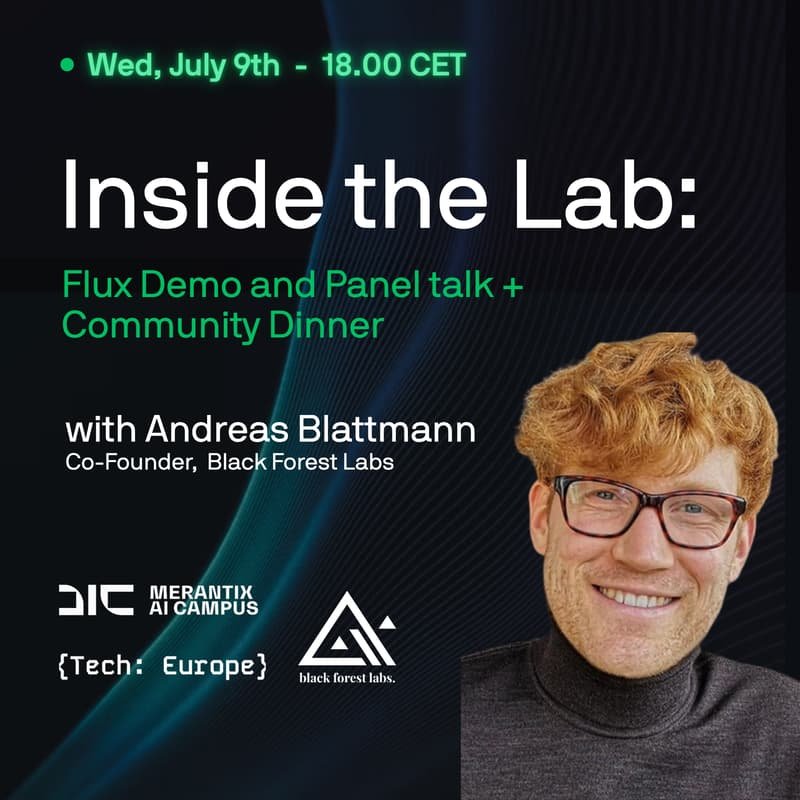
Black Forest Labs was founded in 2024 by Robin Rombach, Andreas Blattmann, Patrick Esser, and Tim Dockhorn.
Board

Investors · 46

How we know: Air Street Capital's portfolio page · research · sacra.com · Not right? Tell us

How we know: a16z's portfolio · a partner's Signal profile · board seat on SEC Form D · funding news · press coverage · research · sacra.com · Not right? Tell us

How we know: research · sacra.com · baincapitalventures.com · Not right? Tell us

How we know: research · sacra.com · Not right? Tell us

How we know: research · sacra.com · Not right? Tell us

How we know: Earlybird Venture Capital's portfolio page · Not right? Tell us

How we know: Headline's portfolio page · research · sacra.com · Not right? Tell us

How we know: Headline Growth Management, LLC's portfolio page · Not right? Tell us

How we know: Mätch VC's portfolio page · techcrunch.com · the VCSheet dataset · Not right? Tell us

How we know: Northzone's portfolio page · research · sacra.com · Not right? Tell us

How we know: Notion Capital's portfolio page · research · sacra.com · Not right? Tell us

How we know: S32's portfolio page · Not right? Tell us

How we know: Salesforce Ventures's portfolio page · research · sacra.com · Not right? Tell us

How we know: SV Angel's portfolio page · research · sacra.com · Not right? Tell us
How we know: Transpose Platform Management's portfolio page · Not right? Tell us

How we know: Visionaries Club's portfolio page · the VCSheet dataset · research · sacra.com · Not right? Tell us


How we know: research · sacra.com · Not right? Tell us
.png)
How we know: funding news · press coverage · research · sacra.com · Not right? Tell us

How we know: techcrunch.com · Not right? Tell us

How we know: research · sacra.com · Not right? Tell us


How we know: research · sacra.com · Not right? Tell us
Also in the syndicate · 15
Reported raises · per SEC filings
Form D private placements$307.6M disclosed across 1 of 6 rounds · 2024–2025
▶$307.6MraisedJun 2026 · 36 investors · Other TechnologyRule 506(b)
- Patrick EsserExecutive Officer, Director
- Andreas BlattmannExecutive Officer, Director
- Anjney MidhaDirector
- Robin RombachExecutive Officer, Director
- Offering amount
- $343.3M
- Amount sold
- $307.6M
- First sale
- Nov 2025
- Incorporated
- Corporation, Delaware, 2024
- Federal exemptions
- 06b
Source: SEC EDGAR Form D. Amounts as filed; amended filings shown once at their latest values.
Valuation · disclosed
Disclosed eventsSource: SEC prospectus filings, and round valuations the company or its investors disclosed — follow each entry's link for the claim.
Company profile
researched Aug 2026Black Forest Labs is an independent AI research company headquartered in Freiburg im Breisgau, Germany, with a second office in San Francisco, that develops foundation models for visual generation and editing. Its FLUX model families span text-to-image generation, in-context image editing (FLUX.1 Kontext), the multi-tier FLUX.2 line, and FLUX 3, a multimodal model announced in July 2026 that jointly learns from images, video and audio in a unified architecture and adds action prediction for robotics.
Models are delivered through three channels: a hosted API for production workloads, downloadable open weights for self-hosted deployment and fine-tuning (distributed via Hugging Face and GitHub), and a browser playground for experimentation. The company also offers enterprise licensing and cites SOC 2 and ISO 27001 on its site. Distribution partners and integration surfaces include Microsoft Azure AI Foundry and Adobe's creative tools, and its models are reported to be used by Adobe, Canva, Meta, Microsoft, Picsart, fal.ai, ElevenLabs, VSCO, Vercel and Snap.
The FLUX.2 family ranges from 4B and 9B [klein] variants optimized for sub-second inference on consumer hardware to a 32B open-weight [dev] model and a [max] tier supporting up to 10 reference images and 4-megapixel output. FLUX 3, built on the company's Self-Flow approach, generates video with native multilingual audio up to 20 seconds in a single generation and supports text-to-video, image-to-video, video-to-video, keyframe-to-video and agentic multi-shot chaining.
Founding story
Founded in 2024 by researchers who had previously developed latent diffusion and Stable Diffusion. Per Startup Intros, the founding group comprised ten co-founders including Robin Rombach (CEO), Andreas Blattmann, Patrick Esser and Dominik Lorenz, who had worked in university research labs at LMU Munich and Heidelberg University before joining Stability AI; they left to form an independent organization dedicated solely to visual intelligence. Their collective papers are cited as having more than 120,000 citations.
Business model
Dual-license model combining open-weight distribution with commercial monetization. Revenue is described as coming from per-generation API usage fees, annual commercial licenses for enterprises self-hosting the models, and large multi-year platform contracts. A self-serve commercial licensing portal offers standardized terms alongside negotiated enterprise agreements. Open [dev] weights serve as an adoption and prototyping funnel into paid licenses and hosted inference, with community contributions described as reducing R&D cost.
API usage priced per image or per megapixel (for example, $0.014-$0.015 per image for FLUX.2 [klein] variants and from $0.03 per megapixel for [pro] and [max]; $40 per 1,000 images for FLUX.1 Kontext [pro] and FLUX1.1 [pro] on Azure AI Foundry), plus enterprise open-weight licenses and multi-year platform contracts such as a reported $140M Meta agreement.
Traction
Sacra estimates roughly $96M in annualized revenue as of August 2025. Reported commercial contracts total about $300M across Meta, Adobe, Canva and Snap, including a $140M Meta agreement. Models are used by Adobe, Canva, Meta, Microsoft, Picsart, fal.ai, ElevenLabs, VSCO, Vercel and, per press reports, xAI's Grok chatbot. Early internal evaluations of FLUX 3 video report preference rates of 93% versus Luma Ray 3.2, 77% versus Runway Gen-4.5, 69% versus Grok Imagine Video and 60% versus Kling v3 Pro, though the company describes these results as preliminary.
Latest developments
In July 2026 the company introduced FLUX 3 in early access, a unified multimodal model for video with native audio (up to 20 seconds per generation), image synthesis and editing, and action prediction, with a staged launch plan covering API and private-weight access and an eventual open-weight FLUX 3 Dev backbone. It co-developed FLUX-mimic with mimic robotics for dexterous manipulation, referencing production testing at Audi. Company announcements also note that Martin Scorsese is an advisor and that the co-founder and CEO publicly urged G7 leaders to support open innovation.
▸Full profile — market position, technology, go-to-market, geography, history, risks & controversies
Market position
Positioned as a specialist frontier lab for visual intelligence rather than a division of a larger platform company. Sacra frames it as a successor to Stability AI in the open-weight diffusion community given the founders' provenance, competing with closed-source big-tech offerings such as OpenAI's DALL-E 3 and Sora, and with other open-weight labs including LAION and Kakao that lack a comparable unified image-and-video roadmap. Its models are described as ranking among the top open-source models on Hugging Face.
Combination of open weights and commercial API/licensing in a single dual-license strategy; a research team with a track record spanning latent diffusion, Stable Diffusion and FLUX; enterprise-first positioning with major platform integrations; and a single multimodal backbone spanning image, video, audio and robotic action prediction.
Technology
Latent-diffusion-derived generative models. FLUX.1 Kontext [dev] is a 12B-parameter open-weight in-context image editing model with day-0 support for ComfyUI, HuggingFace Diffusers and TensorRT; the FLUX.2 family ranges from 4B/9B [klein] models (as little as 13GB VRAM) to a 32B [dev] model, with FP8 quantizations reported to cut VRAM needs and raise performance about 40%. FLUX 3 is a multimodal flow-matching model trained jointly on video, image and audio using the company's Self-Flow method for aligning generation and understanding in one architecture; it also supports action prediction that maps visual observations plus text instructions to predicted physical outcomes and robot control actions.
Go-to-market
B2B2C: direct enterprise sales alongside platform integrators that embed FLUX models in their own products, supplemented by open-weight releases that drive developer awareness. Distribution runs through the company's own API and playground, Microsoft Azure AI Foundry, Adobe creative tools, Hugging Face and GitHub, with an enterprise track for larger organizations.
Enterprises and platform companies embedding image and video generation (e.g. Adobe, Canva, Meta, Microsoft, Picsart, Snap), developers building on the API or open weights, robotics partners such as mimic robotics, and individual artists and creators using the playground.
Geography
Headquartered in Freiburg im Breisgau, Germany, with a second office in San Francisco; the company describes building from labs in both locations.
History
Launched publicly in August 2024 alongside a $31M seed round led by Andreessen Horowitz. A Series A led by Andreessen Horowitz went unannounced until it was disclosed with the December 2025 Series B. The company released FLUX.1 and FLUX.1 Kontext, then FLUX.2 in November 2025, and announced FLUX 3 in early access in July 2026. It raised $300M in Series B funding at a $3.25B post-money valuation announced December 1, 2025, with total funds raised reported to exceed $450M.
Risks & controversies
Press coverage notes the company drew attention after it emerged that Elon Musk's Grok chatbot was using its models for image generation. FLUX 3 benchmark comparisons are self-reported and described by the company as preliminary and subject to change during early access. Source documents disagree on basic facts (total funding of $330M versus over $450M; Series B date given as December 2025 in most sources but February 2026 in one; headcount stated as ~70 by the company versus 10,000+ on an aggregator), indicating uneven data reliability.
Compiled by commissioned research from 11 cited public sources — announcements, filings, and press listed under research sources below.
Key figures
latest reportedCompany-reported or press-reported figures, each dated to when it was claimed — not independently audited.
Founder mafia
2 people who came through Black Forest Labs went on to found or lead other companies.


Related companies · 7





Companies working in the same space as Black Forest Labs.
Timeline · 12
launches, deals, and filingsmimic robotics received early access to FLUX 3 and co-developed FLUX-mimic, combining the FLUX 3 backbone with mimic's robot-learning work on dexterous manipulation; the thesis references testing on production tasks at Audi.
FLUX 3 jointly trains on images, video and audio in a unified flow-matching architecture built on the company's Self-Flow approach, supporting video with native audio up to 20 seconds, image synthesis and editing, and action prediction for robotics. Rollout is staged: FLUX 3 Video, FLUX-mimic/FLUX 3 Action, FLUX 3 Image, then an open-weight FLUX 3 Dev backbone.
Company announcement page references a public appeal by the co-founder and CEO to G7 leaders in support of open innovation.
Company announcement listed on bfl.ai states that Martin Scorsese is an advisor.
Round co-led by Salesforce Ventures and Anjney Midha (AMP), with participation from a16z, NVIDIA, Northzone, Creandum, Earlybird VC, BroadLight Capital, General Catalyst, Temasek, Bain Capital Ventures, Air Street Capital, Visionaries Club, Canva and Figma Ventures. Proceeds earmarked for R&D, compute capacity and scaling teams in Freiburg and San Francisco.
$300M source ↗
Co-led by Salesforce Ventures and Anjney Midha (AMP), with participation from a16z, NVIDIA, Northzone, Creandum, Earlybird VC, BroadLight Capital, General Catalyst, Temasek, Bain Capital Ventures, Air Street Capital, Visionaries Club, Canva Ventures and Figma Ventures; proceeds allocated to R&D, compute infrastructure and team growth in Freiburg and San Francisco.
$300M source ↗
FLUX.2 introduced improved text and image rendering, use of up to 10 reference images for style and tone consistency, and generation at up to 4K resolution; the family spans [dev] (32B open weights), [flex], [pro], [max] and [klein] (4B/9B) variants.
Sacra reports a multi-year agreement with Meta for use of Black Forest Labs' generative image technology, bringing total contract value across partners including Adobe, Canva and Snap to roughly $300M.
$140M source ↗
Signed a multi-year contract with Meta valued at $140 million for use of its generative AI image technology, bringing total contract value across partners including Adobe, Canva and Snap to roughly $300 million.
$140M source ↗
FLUX.2 spans a 32B open-weight [dev] model, [flex], [pro] and [max] tiers and lightweight [klein] variants; features include improved text and image rendering, up to 10 reference images and output up to 4K resolution.
Seed financing with participation from General Catalyst, Mätch.vc and angel investors including Garry Tan, Brendan Iribe, Michael Ovitz and Timo Aila.
$31M source ↗
FLUX.1 launched in summer 2024; its open-weight dev models became widely used on Hugging Face and GitHub.
Dated company events from announcements, filings, and press; legal rows summarize public dockets and regulator releases.
Legal entities · 1
corporate structureIn the news
▸Research sources · 11
primary sources listed
- Black Forest Labsbfl.ai · web
11 public sources were cited for this profile; the first-party ones are listed here.
Frequently asked questions
- What does Black Forest Labs do?
- German frontier AI lab building the FLUX family of open-weight and API-delivered image, video, audio and action models.
- Who founded Black Forest Labs?
- Black Forest Labs was founded by Robin Rombach, Andreas Blattmann, Patrick Esser, Tim Dockhorn in 2024.
- Who are Black Forest Labs's investors?
- Black Forest Labs's investors include Air Street Capital, Andreessen Horowitz, Bain Capital Ventures, BroadLight Capital, Cherry Ventures, Earlybird Venture Capital, Headline, Headline Growth Management, LLC and 23 more.
- How much funding has Black Forest Labs raised?
- Black Forest Labs has disclosed $307.6M raised across 1 of its 6 known rounds.
- Where is Black Forest Labs headquartered?
- Black Forest Labs is headquartered in Freiburg, DE.