 Fundraising Fox
Turbine
Founded 2016 · 116 employees on LinkedIn · 11 known investors
Find your way into Turbine
Sign up to see every warm intro you have to Turbine
- Paths you didn't know you had: your email and LinkedIn already hold routes to the Turbine team. We find them for you
- 2nd- and 3rd-degree connections: the friend-of-a-friend routes that take hours to manually find through your inbox or LinkedIn
- Answers now, not in days: momentum is everything in a raise. Skip asking around whether someone knows someone
Days of research, done the moment you sign in, with every route ranked by how warm it is.
Turbine develops computational simulations of cells to accelerate drug discovery and development in oncology, using in silico predictions validated through wet lab experiments.
Also known as Turbine Simulated Cell · Turbine.ai
Founders & leadership
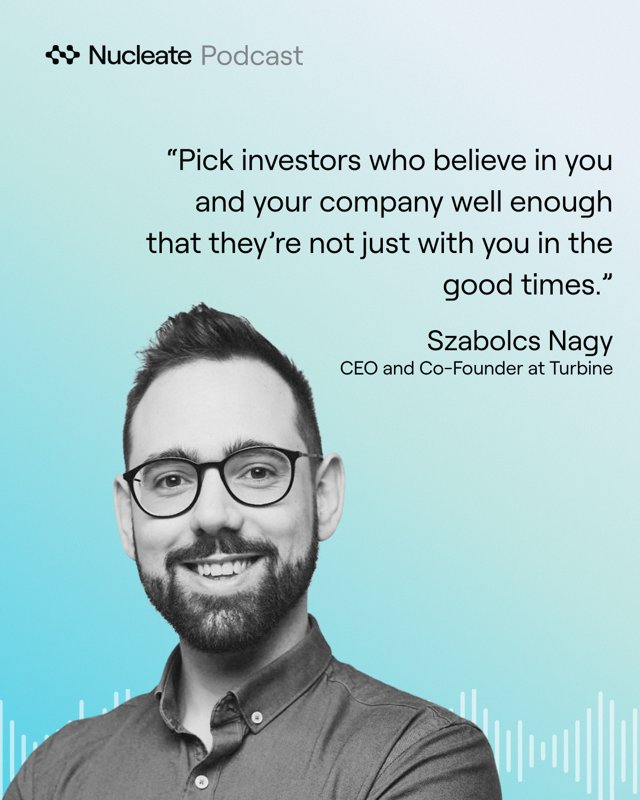
Turbine was founded in 2016 by Szabolcs Nagy.
Investors · 11

How we know: open dataset · 5k.vc investor directory · Not right? Tell us
How we know: Alpha Edison's portfolio page · funding news · fintech.global · Not right? Tell us

How we know: Crane Venture Partners's portfolio page · Not right? Tell us

How we know: Interactive Venture Partners Llc's portfolio page · Not right? Tell us
How we know: Merck Global Health Innovation Fund's portfolio page · Not right? Tell us
How we know: MSD Global Health Innovation Fund's portfolio page · Not right? Tell us
How we know: open dataset · 5k.vc investor directory · Not right? Tell us

How we know: the VCSheet dataset · Not right? Tell us
Also in the syndicate · 1
Funding
SEC filings, press & company announcements- Undisclosed amountSeries AApr 2025
Alpha Edison (lead)
Source ↗
Source: company announcements and press reports — follow each round's link for the claim.
Company profile
researched Aug 2026Turbine develops an AI platform, marketed as Simulated Cell and delivered through a "Virtual Lab", that simulates biological experiments computationally before they are run in a cell, animal or patient. The models learn parameters governing cell signaling from perturbation-response data, drug target profiles and genomic/transcriptomic profiles, with the stated aim of generalizing from cell lines to patient samples and predicting outcomes for experimental conditions the model has not seen. Simulated samples span cell lines, patient-derived organoids, patient-derived xenografts and patient samples, and can be perturbed genetically or pharmacologically at computational scale, producing phenotypic and transcriptomic readouts.
The platform is offered in three tiers. vLab Core provides simulations on public data plus Turbine's proprietary datasets, covering 1,400 oncology cell lines, 1,200 payloads, drugs and drug-like molecules, and knockout alterations across more than 8,500 genes, together with an interpretation toolkit. vLab Custom applies in silico prediction to a partner's proprietary datasets, sample libraries and drugs, with interpretation services. vLab Collaborate extends simulation to virtual endogenous disease models, single or multi-cell samples, and integrates into partner workflows. A wet lab-in-the-loop component validates in silico predictions experimentally and feeds resulting data back into the platform.
Stated application areas include target discovery, combination design, antibody-drug conjugate positioning, biomarker selection, clinical positioning and indication expansion. A translational suite is used to filter millions of simulations into mechanistically explained hypotheses, which are then converted into experimental workplans and validated from in vitro to in vivo.
Founding story
Turbine was established by Hungarian founders; the company's team page states it was established in 2016 and also that CEO Szabolcs Nagy co-founded Turbine in 2015. Nagy studied international business at Corvinus University of Budapest and had previously co-founded a cybersecurity startup that was acquired, later serving as Chief Strategy Officer at The Medical Futurist before refocusing on Turbine. Co-founder and CTO Kristof Szalay, a computer scientist turned biochemist, invented Turbine's original method for simulating human cellular responses to therapeutic perturbations and was named to MIT Technology Review Europe's 35 Innovators under 35 in 2018. Co-founder and Chief Scientific Officer Daniel Veres is a medical doctor specializing in cancer research who translates the platform's computational output into clinical interpretation.
Business model
Turbine sells access to its simulation platform and associated scientific services to biopharma organizations through tiered engagement models: self-serve simulation on Turbine's and public datasets (vLab Core), custom in silico work on a partner's proprietary data with interpretation services (vLab Custom), and deeper collaborative programs across a partner's portfolio (vLab Collaborate). Engagements deliver decision-ready data packages, mechanistic hypotheses and experimental workplans, with optional wet-lab validation.
Revenue is derived from partnerships and platform engagements with pharmaceutical and biotech companies, spanning self-serve virtual lab access, custom in silico prediction and interpretation services, and collaborative R&D programs.
Traction
Turbine reports partnerships with Bayer, AstraZeneca and Merck, and Ono Pharmaceutical states the company has provided multiple targets with first-in-class potential. Platform metrics cited by the company include capacity for 50 million simulations per day, 1.5x higher likelihood of validation from mechanistic hypotheses, and a 2x reduction in time from scientific question to validation, including one case in which 9 million simulations were reduced to actionable recommendations in four weeks. The company also reports that simulation-guided data generation reaches equivalent model performance with 5x fewer data points, corresponding to roughly 80% lower data spend. The team page lists roughly 100 staff across machine learning, computational biology, wet lab, engineering and commercial functions.
Latest developments
The company describes a $25 million Series B as its most recent financing milestone, with an IVP-appointed Series B investor director and a Merck-appointed Series B observer on its board. Its product line-up now includes ADC intelligence, target discovery and de-risking intelligence, and simulation of endogenous diseases within the Virtual Lab.
▸Full profile — market position, technology, go-to-market, geography, history
Market position
Turbine positions itself in AI-driven drug discovery as a mechanistic simulation platform for oncology and other endogenous diseases, benchmarking its predictive performance against published models such as NeST and scGPT, and citing multiple large-pharma partnerships as validation.
Turbine emphasizes mechanistic explainability alongside prediction, aiming to show why an outcome occurs rather than only what will occur, and claims generalization from cell lines to patient-representative samples for conditions never seen in training. Other stated differentiators are benchmark performance against best-in-class published models, a proprietary translational interpretation suite for filtering millions of simulations, and a wet lab-in-the-loop system in which validation data is fed back to improve simulation predictivity.
Technology
The core technology is a mechanistic, AI-based simulation of cell signaling described as the Simulated Cell. Models are trained on genetic and pharmacological perturbation response data, drug target profiles and genomic and transcriptomic profiles, learning signaling parameters that the company says are shared between cell lines and patients so predictions generalize to unseen experiments. The platform supports up to 50 million simulated experiments per day and produces phenotypic and transcriptomic readouts; the company reports its models outperform comparators including NeST and scGPT on predicting cytotoxic drug response (pIC50 correlation) and post-knockout gene expression (top-20 differentially expressed gene correlation) in unseen conditions. A proprietary translational suite filters large simulation sets into mechanistic hypotheses, and an integrated lab-in-the-loop system generates functional genomics, drug modifier screens, direct assays such as apoptosis, and post-treatment transcriptomics data to retrain models.
Go-to-market
The company works through direct partnerships with pharmaceutical companies, supported by a business development team (Chief Business Officer, Head of Business Development and business development directors), and offers a tiered product ladder that ranges from self-serve virtual lab access to integrated, workflow-embedded collaborations. Endorsements from pharma and consulting partners, including Accenture Ventures, are used in its positioning.
Pharmaceutical and biotechnology R&D organizations working in oncology and, via endogenous disease models, other disease areas; named partners and investor-affiliated organizations include Bayer, AstraZeneca, Merck (MSD Global Health Innovation Fund) and Ono Pharmaceutical.
Geography
Founded by Hungarian founders with a team whose named staff are predominantly Hungarian, alongside international leadership, board members and scientific advisors drawn from the UK, US and European biopharma sectors.
History
Founded by Hungarian founders in the mid-2010s, Turbine has progressed through pre-Series A, Series A and Series B financings, reflected in its board composition, which includes a Series B investor director from IVP, a Series A investor director from Mercia, a Series B observer from Merck, a Series A observer from XTX and a pre-Series A observer from Accel. The company reports having worked with large pharmaceutical partners including Bayer, AstraZeneca and Merck, and describes a $25 million Series B as its latest financing milestone.
Compiled by commissioned research from 8 cited public sources — announcements, filings, and press listed under research sources below.
Key figures
latest reportedCompany-reported or press-reported figures, each dated to when it was claimed — not independently audited.
Founder mafia
3 people who came through Turbine went on to found or lead other companies.


Related companies · 1

Companies working in the same space as Turbine.
Timeline · 4
launches, deals, and filingsTurbine's leadership page describes a $25 million Series B as the company's latest financing milestone; the board includes a Series B investor director from IVP and a Series B observer from Merck.
$25M source ↗
The company states its CEO has steered Turbine through multiple top pharma partnerships, including Bayer, AstraZeneca and Merck.
An executive director of Discovery & Research at Ono Pharmaceutical states that Turbine has provided multiple targets with first-in-class potential along with biology-driven validation insights.
CTO and co-founder Kristof Szalay was named one of the 35 Innovators under 35 in 2018 by MIT Technology Review Europe.
Dated company events from announcements, filings, and press; legal rows summarize public dockets and regulator releases.
▸Research sources · 8
primary sources listed
- Turbineturbine.ai · web
8 public sources were cited for this profile; the first-party ones are listed here.
Frequently asked questions
- What does Turbine do?
- Turbine builds AI-driven virtual cell simulations that let biopharma teams run oncology experiments in silico before the wet lab.
- Who founded Turbine?
- Turbine was founded by Szabolcs Nagy in 2016.
- Who are Turbine's investors?
- Turbine's investors include Accel, Alpha Edison, Atlantic, Beiersdorf Innovation Fund, Crane Venture Partners, Interactive Venture Partners Llc, Merck Global Health Innovation Fund, MSD Global Health Innovation Fund and 2 more.