 Fundraising Fox
PopSQL
AcquiredYC S19San Francisco, US · Founded 2017 · Delaware corporation · 15 employees · 9 known investors
Find your way into PopSQL
Sign up to see every warm intro you have to PopSQL
- Paths you didn't know you had: your email and LinkedIn already hold routes to the PopSQL team. We find them for you
- 2nd- and 3rd-degree connections: the friend-of-a-friend routes that take hours to manually find through your inbox or LinkedIn
- Answers now, not in days: momentum is everything in a raise. Skip asking around whether someone knows someone
Days of research, done the moment you sign in, with every route ranked by how warm it is.
Acquired by Timescale April 2024 · terms undisclosed — Collaborative browser/desktop SQL editor, query/dashboard workspace and team acquired; product later placed in limited support and planned retirement postponed.
PopSQL is a SQL editor and data collaboration platform that enables teams to write, visualize, and share SQL queries and data results. The product serves data teams at companies like DoorDash, Shipt, and Redfin.
Also known as PopSQL
Founders & leadership· Y Combinator alumni (S19)
PopSQL was founded in 2017 by Rahil Sondhi.

Investors · 9

How we know: FundersClub's portfolio page · a partner's Signal profile · offering press articles · prnewswire.com · Y Combinator's founder network · Not right? Tell us
How we know: Gradient Ventures's portfolio page · a partner's Signal profile · funding news · prnewswire.com · the VCSheet dataset · open dataset · 5k.vc investor directory · Y Combinator's founder network · Not right? Tell us

How we know: Y Combinator's founder network · somacap.com · Not right? Tell us

How we know: the Y Combinator directory · offering press articles · prnewswire.com · open dataset · 5k.vc investor directory · Not right? Tell us

How we know: a partner's Signal profile · Y Combinator's founder network · Not right? Tell us
How we know: funding news · Not right? Tell us
How we know: Y Combinator's founder network · Not right? Tell us

How we know: funding news · offering press articles · company funding news (hacker news) · press coverage · research · finsmes.com · Y Combinator's founder network · Not right? Tell us

How we know: Y Combinator's founder network · Not right? Tell us
Funding
SEC filings, press & company announcements$20.8M disclosed across 2 of 5 rounds · 2019–2022
- $3.4MSeedSep 2020 · 3 sources
Gradient Ventures (lead), FundersClub, Y Combinator
Source ↗
▶$17.4MraisedFeb 2022 · 39 investors · OtherRule 506(b)
- Rahil SondhiExecutive Officer, Director
- Offering amount
- $17.4M
- Amount sold
- $17.4M
- First sale
- Dec 2021
- Incorporated
- Corporation, Delaware, 2017
- Federal exemptions
- 06b
Source: SEC EDGAR Form D. Amounts as filed; amended filings shown once at their latest values.
Company profile
researched Aug 2026PopSQL is a collaborative SQL editor and workspace for data teams. The product lets users write and run queries, browse database schemas, build charts and lightweight dashboards, and share results, combining an IDE-style editing experience with collaboration features more typical of document tools.
Core capabilities include folders and search across queries, dashboards, tables and columns; a data catalog with definitions, tags, usage statistics, common joins and top users; a schema browser; intelligent autocomplete; real-time multi-user editing with live presence; inline comments; Markdown descriptions; version history with diffs and revert; and shared database connections so team members do not have to manage credentials individually. Query variables allow less technical stakeholders to customize reports (for example by date range or user ID) without writing SQL. Results can be pushed to Slack, managed via API endpoints for query management and scheduling, and tracked in Git for change review. Additional features described at the time of the Series A include SQL notebooks (beta) supporting cross-database joins by referencing prior query results, and a dbt integration (beta).
PopSQL connects to major databases and warehouses including Amazon Athena, Azure Synapse, BigQuery, ClickHouse, MySQL, PostgreSQL, Presto, Amazon Redshift, Snowflake, SQL Server, TigerData and Trino. It is offered both as a web application (app.popsql.com) and as a downloadable desktop app for macOS (Intel and Apple Silicon builds), the latter aimed at teams that prefer to connect directly from their own machines. Connectivity options for private networks include a bridge connector, SSH tunnels, static IPs, and the desktop app.
Founding story
According to the company's Series A blog post, founder and CEO Rahil Sondhi conceived of PopSQL in 2017 while working at Instacart, where he relied heavily on SQL to answer stakeholder questions. He found that existing SQL editors ran queries but did not help with sharing, organizing, collaborating or aligning as a cross-functional team, leading to duplicated work, static SQL files shared over Slack, exports into spreadsheets for charts, and institutional knowledge lost when employees departed.
Business model
PopSQL sells a software product (SaaS with an optional desktop application) to data teams inside companies. Users can get started for free, and the product is positioned for team-wide adoption, with enterprise-oriented capabilities such as SSO/SCIM provisioning, granular connection permissions, audit logs, approval workflows, and deployment within a customer's own VPC. Sources do not disclose pricing tiers or contract structures, though one customer cites the tool as comparatively pricing-friendly.
Sources indicate a software subscription model with a free entry point ("get started for free") and paid team/enterprise usage; the company reported 5x revenue growth between its September 2020 seed announcement and February 2022. No pricing details are disclosed in the sources.
Traction
Company materials report 2,000+ customer data teams, 60,000 queries run per day and 1 million schedules run per week, and claim analysts save an average of 10 hours per week using the product. At the February 2022 Series A, the company reported 5x revenue growth and a more than doubled team since September 2020, with 12 employees at that time.
Latest developments
The most recent dated developments in the sources are the February 2022 Series A and the accompanying feature announcements (data catalog, SQL notebooks beta, dbt integration beta, enterprise security/VPC deployment). Current site material references a TigerData integration and 2,000+ customer data teams, and the about page cites $17.4M total funding, 60K queries run per day and 1M schedules run per week. Documentation was last updated approximately 11 months prior to retrieval.
▸Full profile — market position, technology, go-to-market, geography, history
Market position
PopSQL describes itself as serving modern data teams and states that over 2,000 companies use the product, including DoorDash, Shipt, Redfin, Optimizely, Vroom, Udacity, Ramp and doodle. It frames itself as complementary to existing BI tools and other SQL editors rather than strictly replacing them, enabling collaboration between SQL power users, junior analysts and less technical stakeholders. Company materials cite Gartner's projection that through 2023 data scientists and analysts would lose 60–70% of productive time to finding, preparing, integrating and sharing datasets as the market problem being addressed.
PopSQL positions itself against legacy SQL editors, which it characterizes as supporting query execution but not the downstream workflow of sharing, organizing, collaborating and aligning on findings, and against workflows that rely on passing .sql files and screenshots through Slack or exporting results into spreadsheets. Its stated differentiators are real-time collaboration and shared connections, a central searchable repository of queries and dashboards, version history, and a data catalog — analogized in company materials to what Figma, Notion and GitHub provide for designers, project managers and engineers. Customers quoted on the site cite an approachable UI for non-technical users, flexibility relative to predefined BI semantics, and price.
Technology
A collaborative SQL IDE delivered as a web application and an Electron-style desktop client, with real-time collaborative editing, autocomplete driven by schema and usage metadata, version history and diffs, in-app charting and dashboards, parameterized query variables, and scheduling. It connects to major relational databases and cloud warehouses (Athena, Azure Synapse, BigQuery, ClickHouse, MySQL, PostgreSQL, Presto, Redshift, Snowflake, SQL Server, TigerData, Trino) and supports private-network connectivity via a bridge connector, SSH tunnels, static IPs or the desktop app. Integrations include Slack, Git, dbt (beta), and REST APIs for query management and scheduling. The company states SOC 2 and GDPR compliance and supports SSO/SCIM with Okta, AzureAD and Google.
Go-to-market
Go-to-market is product-led: free self-service sign-up on the web or via the desktop app, documentation and quick-start connection guides, and published customer case studies (FactoryFix, Udacity, Branch, Darwin, Jobandtalent). The company also markets through partner-oriented content, such as a joint pitch with TigerData on running fast PostgreSQL queries over large datasets. Enterprise features (SOC 2 and GDPR compliance, SSO/SCIM, access controls, VPC deployment) support expansion into larger organizations.
Data teams and analytics organizations, including SQL power users, junior analysts, data scientists, engineers and less technical business stakeholders who consume reports. Named users and customers include DoorDash, Shipt, Redfin, Optimizely, Vroom, Udacity, Ramp, doodle, Instacart, theScore, Scruff, FactoryFix, Branch, Darwin, Jobandtalent and Drop.
Geography
The company describes a distributed team spread throughout the Americas with flexible hours; press coverage identifies PopSQL as San Francisco, California-based. Customers are described as global, spanning over 2,000 companies.
History
The company traces its origin to 2017, when founder Rahil Sondhi encountered SQL collaboration problems while working at Instacart. PopSQL appeared in Y Combinator's Summer 2019 batch and, per press listed on its site, raised $1 million before the S19 Demo Day. Seed funding of $3.4M was announced in September 2020. In February 2022 the company raised a $14M Series A led by Tiger Global, at which point it reported having more than doubled its team and grown revenue 5x since the seed announcement, with a headcount of 12 and over 2,000 customer companies. Its about page cites $17.4M in total funding.
Compiled by commissioned research from 8 cited public sources — announcements, filings, and press listed under research sources below.
Key figures
latest reportedCompany-reported or press-reported figures, each dated to when it was claimed — not independently audited.
Founder mafia
3 people who came through PopSQL went on to found or lead other companies.


Related companies · 10








Companies working in the same space as PopSQL.
Timeline · 5
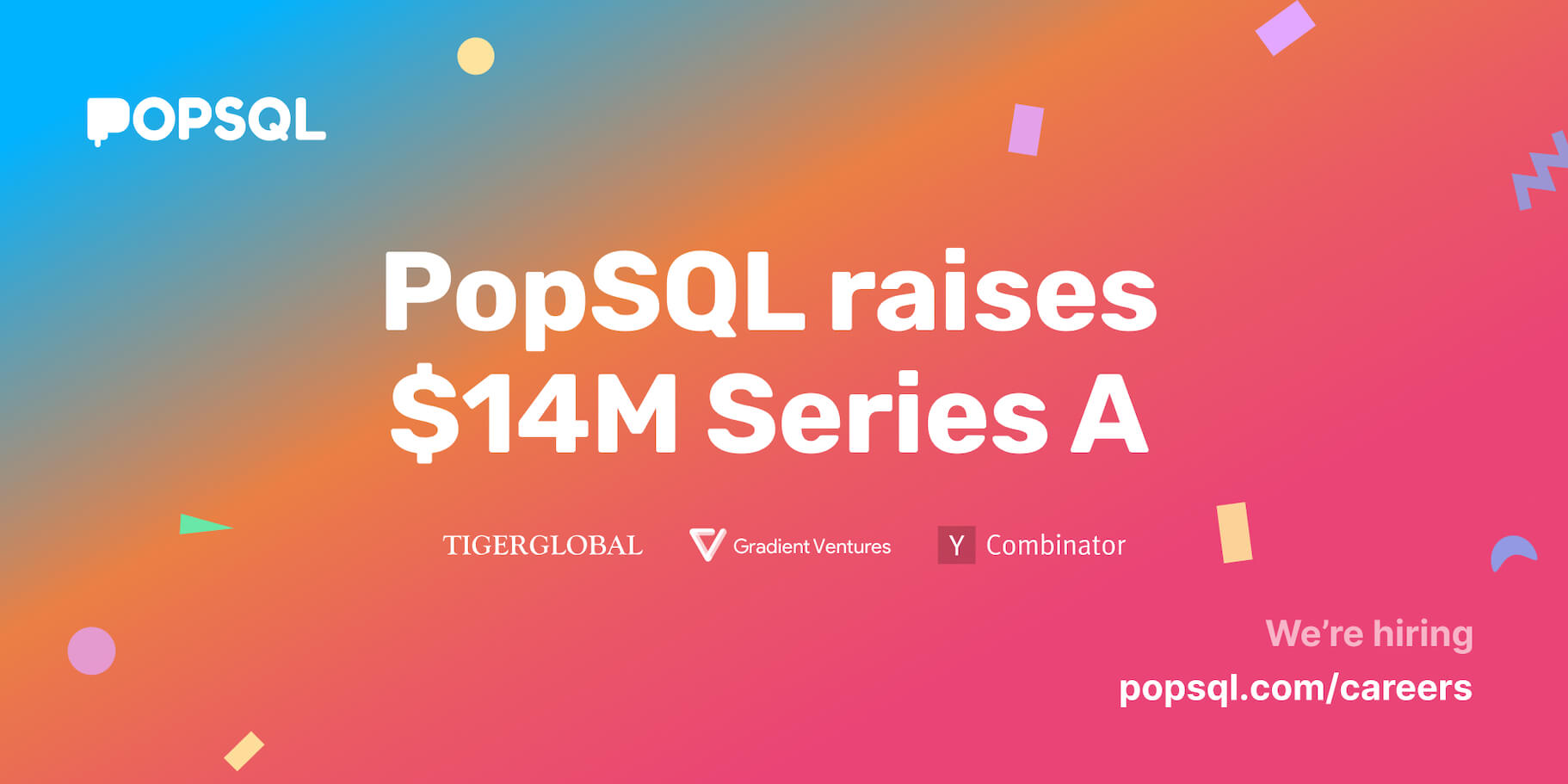
launches, deals, and filingsPopSQL announced a $14M Series A round led by Tiger Global with participation from Gradient Ventures, Y Combinator, and FundersClub, to be used to expand operations and business reach.
$14M source ↗
Alongside the Series A announcement, PopSQL described recently added capabilities: a data catalog, SQL notebooks in beta, a dbt integration in beta, and enterprise-grade security including VPC deployment, granular access controls, SSO, audit logs, and approval workflows.
Press listing on the company's about page references a September 2020 article reporting a $3.4M raise for PopSQL's collaborative SQL editor; the company blog notes seed funding was announced in September 2020.
$3.4M source ↗
Press coverage listed on the company's about page reports PopSQL raised $1 million before Y Combinator's S19 Demo Day.
$1M source ↗
PopSQL is listed among the 84 startups from Y Combinator's S19 Demo Day; Y Combinator later participated in the Series A.
Dated company events from announcements, filings, and press; legal rows summarize public dockets and regulator releases.
Legal entities · 2
corporate structureIn the news
▸Research sources · 8
primary sources listed
- PopSQLpopsql.com · web
8 public sources were cited for this profile; the first-party ones are listed here.
Frequently asked questions
- What does PopSQL do?
- Collaborative SQL editor and data workspace letting teams write, version, visualize and share queries across major databases.
- Who founded PopSQL?
- PopSQL was founded by Rahil Sondhi in 2017.
- Who are PopSQL's investors?
- PopSQL's investors include FundersClub, Gradient Ventures, Soma Capital, Y Combinator, BACKGROUND CAPITAL, FCVC, Ravikant Capital, Tiger Global Management and 1 more.
- How much funding has PopSQL raised?
- PopSQL has disclosed $20.8M raised across 2 of its 5 known rounds.
- Where is PopSQL headquartered?
- PopSQL is headquartered in San Francisco, US.