 Fundraising Fox
Orbital Matter
Entrepreneur First '22Berlin, DE · Founded 2022 · 10 known investors
Find your way into Orbital Matter
Sign up to see every warm intro you have to Orbital Matter
- Paths you didn't know you had: your email and LinkedIn already hold routes to the Orbital Matter team. We find them for you
- 2nd- and 3rd-degree connections: the friend-of-a-friend routes that take hours to manually find through your inbox or LinkedIn
- Answers now, not in days: momentum is everything in a raise. Skip asking around whether someone knows someone
Days of research, done the moment you sign in, with every route ranked by how warm it is.
Orbital Matter designs and builds large rigid structures directly in orbit as an alternative to mechanical folding/deployable systems, targeting large-area elements such as solar arrays, radiators and antennas for satellite constellations, space data centers and multi-module space stations. Its approach constructs continuous monolithic booms in space rather than launching pre-folded hardware.
Also known as Orbital Matter Sp. z o.o. · PADS (Printer Assisted Deployment System)
Founders & leadership
Orbital Matter was founded in 2022 by Jakub Stojek and Robert Ihnatisin.

Investors · 10

How we know: Early Game Ventures's portfolio page · a partner's Signal profile · research · startupintros.com · open dataset · 5k.vc investor directory · Not right? Tell us

How we know: the Entrepreneur First portfolio · open dataset · 5k.vc investor directory · Not right? Tell us

How we know: StartX's portfolio page · Not right? Tell us

How we know: Sunfish Partners's portfolio page · the VCSheet dataset · Not right? Tell us


Also in the syndicate · 3
Company profile
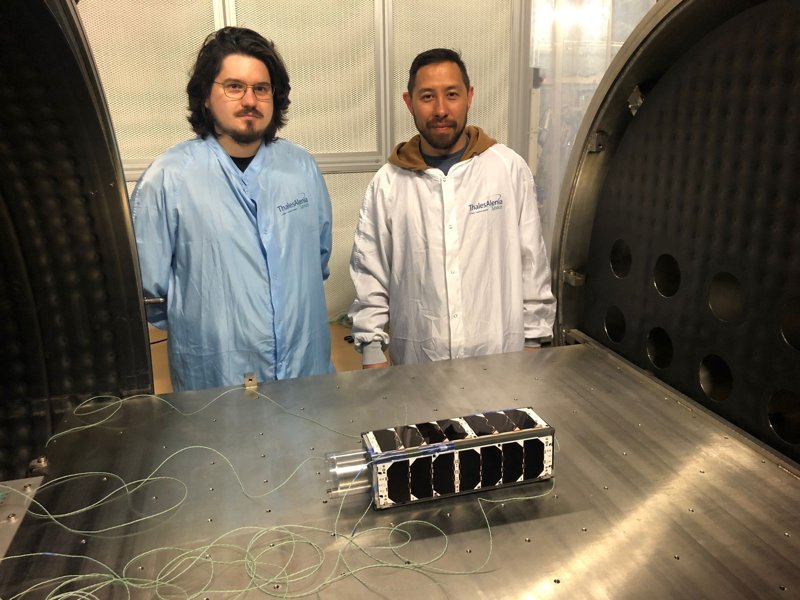
researched Aug 2026Orbital Matter is a space technology company developing hardware that manufactures large structures directly in orbit rather than launching them pre-folded. Its core product is PADS (Printer Assisted Deployment System), a compact, self-contained module that integrates with most satellite platforms and extrudes a continuous hollow structural boom on-orbit. Booms range from 10 meters to over 100 meters in length with an adjustable cross-section of 38–90 mm, produced without joints, hinges, latches, motors or tensioning systems. The company positions these booms as the structural backbone for large-area elements — solar arrays, radiators and antennas — needed by power-hungry satellite constellations, space data centers and multi-module space stations [0][3].
The process stores raw material as a liquid photopolymer resin inside the printer module, feeds it through a precision extrusion head, and rapidly hardens it with a tuned UV light source in vacuum. The company brands the material SPACECRETE, drawing an analogy to concrete, which is placed as a liquid and cures on site. Stated advantages of UV curing over melt-based additive manufacturing include lower thermal complexity and a peak power draw of 20 W; the print mechanism uses a single motor to limit failure modes. Structure size is said to be limited only by the volume of raw material carried, so cost per meter falls as structures grow [0][3].
Orbital Matter follows a flight-driven development model, launching demonstrators frequently and iterating in orbit. Its published sequence runs from Replicator technology demonstrator missions (2024–26) through joint PADS missions with customer apertures (2026–28) to construction missions around 2030 for space data centers and space stations with kilometer-scale solar arrays and radiators. A product roadmap sets PADS structural booms in 2027, kilometer-scale solar arrays and radiators in 2028, and a refillable universal 3D printer for arbitrary geometries — including lunar infrastructure — from 2030 [0][3]."]
Founding story
The company was founded in 2022 by Jakub Stojek (co-founder and CEO) and Robert Ihnatisin (co-founder and CTO), who met at Entrepreneur First in Berlin. According to the company, they concluded that as satellites grow in number and size, Earth-based manufacturing and launch constraints become a structural limit, which creates a market for in-space manufacturing [5]. A third-party profile describes Stojek as a manufacturing entrepreneur and Ihnatisin as a 3D printing specialist who previously worked at Formlabs, and states the core technology principles were proven before and during incubation at ESA BIC Poland, where prototypes were built and tested in simulated space conditions and IP was filed [7].
Business model
Orbital Matter sells and flies in-space manufacturing hardware. PADS is presented as a plug-and-play manufacturing and deployment module that integrates with most satellite platforms and provides a standardized deployment interface for customer payloads such as solar arrays, radiators and antennas. Engagement models referenced include joint missions with customers and partners and integration evaluations for specific missions [0][3]. Public funding sources include venture capital and non-dilutive grant support such as the EIC Pre-Accelerator [4][6].
Sources indicate revenue from hardware modules integrated onto customer satellites and from joint/pilot missions; a third-party profile references a paid pilot with Thales Alenia Space and a stated intent to deliver a first client order [3][7]. Sources do not disclose pricing or revenue figures.
Traction
PADS is stated to be at TRL 8, having passed all flight qualification tests, with launches on multiple missions in 2026 with ESA and Thales Alenia Space [3]. In July 2026 Replicator 2 launched aboard SpaceX Transporter-17 to demonstrate solar array deployment via in-space 3D printing, and a joint mission was announced to test a VHF antenna prototype on an in-space manufactured support boom. In August 2026 the company reported the first 3D printing in the open vacuum of space, with one of four onboard printers extruding and UV-curing resin in low Earth orbit, filmed by the printer's own camera [4]. Reported non-dilutive support includes €500k from the European Innovation Council in July 2026 [4]. A third-party profile cites ESA BIC Poland incubation and a Thales Alenia Space MoU and paid pilot [7].
Latest developments
In July 2026 Orbital Matter launched Replicator 2 aboard SpaceX Transporter-17 to demonstrate solar array deployment through in-space 3D printing, announced a joint mission to test a VHF antenna prototype deployed with an in-space manufactured support boom, and received €500k from the European Innovation Council Pre-Accelerator for product development and commercialization. On 12 August 2026 it reported being the first company to 3D print in the open vacuum of space [4]. Its technology page states PADS has reached TRL 8 and is launching on multiple missions in 2026 with ESA and Thales Alenia Space [3].
▸Full profile — market position, technology, go-to-market, geography, history, risks & controversies
Market position
The company presents itself as an alternative to conventional mechanical deployables (hinges, latches, motors, tensioning systems) for large satellite appendages, and claims to be the first company to 3D print in the open vacuum of space [0][4]. A third-party profile places it within the in-space manufacturing segment alongside companies such as ThinkOrbital and Orbital Express, and notes European space-independence tailwinds and ESA-linked programs [7].
Stated differentiators are UV-cured, heat-free printing that avoids the thermal complexity and power draw of melt-based additive manufacturing (20 W peak, described as less than a light bulb); a single-motor mechanism to minimize failure modes; joint-free monolithic booms whose cost per meter falls with length; constant power, footprint and process across boom sizes from 10 m to 100 m+, with raw material volume as the only variable; zero debris release; electrical passthrough; and optional retraction [0][3]. A third-party profile adds claims of patented technology, up to 70% lower launch mass and roughly 10x lower launch volume [6][7].
Technology
The system extrudes liquid photopolymer resin through a precision extrusion head and cures it with a tuned UV source in vacuum, producing a continuous, dimensionally stable, joint-free hollow boom. The company markets the feedstock as SPACECRETE and states the baseline is an aerospace-rated photopolymer optimized for vacuum performance, low outgassing and radiation resistance; the extrusion architecture is described as material-agnostic and has also been validated with thermoplastic feedstock. Published PADS specifications: TRL 8 (flight qualified), boom length 10–100 m, boom diameter adjustable 38–90 mm, stowed size 96 × 96 × 300–3000 mm, mass 2–20 kg, peak power 20 W, deploy force 10 N, deploy speed 1 m/h, first mode frequency 2 Hz deployed and 960 Hz stowed, zero debris release, end-to-end electrical passthrough during deployment, and optional payload retraction for reentry or repositioning. A single motor drives the print mechanism [0][3]. A third-party profile characterizes the process as heat-free and patented, claiming up to 70% launch mass reduction and roughly tenfold launch volume reduction [6][7].
Go-to-market
Orbital Matter markets PADS directly to satellite platform operators and primes as an integratable module, offering a downloadable technical datasheet with interface diagrams and integration guidelines and inviting mission-specific evaluation discussions. It pursues joint missions with institutional and industrial partners — PADS units are stated to be launching on multiple missions in 2026 with ESA and Thales Alenia Space — and publicizes flight demonstrations through a newsroom and mailing list [0][3][4].
Satellite constellation operators with high power needs, developers of space data centers, multi-module commercial space stations, and high-power communication systems; more broadly any platform requiring solar arrays, radiators or antennas too large to fold into a launch fairing. A third-party profile also lists space agencies and infrastructure developers, and mentions future lunar infrastructure [0][3][7].
Geography
The company describes itself as founded in 2022 and based in Warsaw, Poland, with a tagline of "Designed in Germany · Made in Poland · Built in Orbit" [0][5]. Third-party sources variously describe it as Warsaw-based Polish space tech and as Berlin-based, and note the founders met at Entrepreneur First Berlin [5][6][7]. Investors and partners referenced span Poland, Romania (Early Game Ventures, Bucharest) and European institutions such as ESA and the European Innovation Council [4][6].
History
Founded in 2022, the company was incubated at ESA BIC Poland, where it built prototypes, tested in simulated space conditions and filed intellectual property, according to a third-party profile that also cites an early Thales Alenia Space MoU and paid pilot and an ESA-supported demonstration flight opportunity [7]. Funding reported publicly includes a $1.0M seed round dated December 2023 with Sunfish Partners as lead (third-party aggregator) and a €1 million seed round led by Early Game Ventures reported in August 2025 [6][7]. In 2026 the company reported flight activity: Replicator 2 launched aboard SpaceX Transporter-17 in July 2026, a joint mission to test a VHF antenna deployed on an in-space manufactured boom was announced in July 2026, and in August 2026 the company reported the first 3D printing in the open vacuum of space, with one of four onboard printers extruding and UV-curing resin into solid structure in low Earth orbit [4]. Also in July 2026 it received €500k from the European Innovation Council Pre-Accelerator [4].
Risks & controversies
Most performance and readiness claims — TRL 8, "first to 3D print in the open vacuum of space," 70% launch mass and 10x volume reductions, and 20x material efficiency — originate from the company itself or aggregator write-ups rather than independent verification [0][3][4][6][7]. Source data is also inconsistent: headquarters is given as Warsaw in company material but described as Berlin-based in one aggregator profile; funding is reported both as a $1.0M seed in December 2023 led by Sunfish Partners and as a €1M seed led by Early Game Ventures in August 2025, and as €1.1M pre-seed in 2023 in the same aggregator narrative; the same aggregator lists an implausible 201-500 employee band for a company of this stage [6][7]. Roadmap dates have also shifted across sources (e.g., a 2025 in-orbit demo referenced in one profile versus 2026 flight activity in the newsroom) [4][7]. The business depends on unproven long-duration on-orbit manufacturing, launch availability, and a small number of institutional partners.
Compiled by commissioned research from 8 cited public sources — announcements, filings, and press listed under research sources below.
Key figures
latest reportedCompany-reported or press-reported figures, each dated to when it was claimed — not independently audited.
Timeline · 7
launches, deals, and filingsOne of four onboard printers extruded and UV-cured resin into solid structure in low Earth orbit, filmed by the printer's own camera; company states it is the first to do so.
Joint mission to test a VHF antenna prototype deployed with an in-space manufactured support boom.
EIC Pre-Accelerator funding to support development and commercialization of in-space-built solar arrays for megawatt-class satellites, following an in-orbit technology demonstration earlier that week.
Mission to demonstrate solar array deployment through in-space 3D printing, described as a first step toward megawatt-class arrays for orbital data centers.
Company states the PADS manufacturing unit has passed all flight qualification tests and is launching on multiple missions in 2026 with ESA and Thales Alenia Space.
Vestbee reported a €1 million seed round led by Bucharest-based Early Game Ventures with participation from several business angels, to be used to advance the 3D printing technology from TRL 5 to TRL 8 ahead of the next launch and first client order.
Aggregator profile lists a $1.0M seed round announced 1 December 2023, led by Sunfish Partners with Antler, Seraphim Space, Anna Alex and Early Game Ventures participating.
$1M source ↗
Dated company events from announcements, filings, and press; legal rows summarize public dockets and regulator releases.
▸Research sources · 8
primary sources listed
- Orbital Matterorbitalmatter.com · web
8 public sources were cited for this profile; the first-party ones are listed here.
Frequently asked questions
- What does Orbital Matter do?
- Orbital Matter builds continuous rigid structural booms directly in orbit via UV-cured resin 3D printing, replacing mechanical deployables.
- Who founded Orbital Matter?
- Orbital Matter was founded by Jakub Stojek, Robert Ihnatisin in 2022.
- Who are Orbital Matter's investors?
- Orbital Matter's investors include Early Game Ventures, Entrepreneur First, StartX, Sunfish Partners, Antler, Seraphim Space, Sunfish Partners.
- Where is Orbital Matter headquartered?
- Orbital Matter is headquartered in Berlin, DE.