 Fundraising Fox
Micrographia Bio
Entrepreneur First '20London, GB · Founded 2020 · 16 employees on LinkedIn · 4 known investors
Find your way into Micrographia Bio
Sign up to see every warm intro you have to Micrographia Bio
- Paths you didn't know you had: your email and LinkedIn already hold routes to the Micrographia Bio team. We find them for you
- 2nd- and 3rd-degree connections: the friend-of-a-friend routes that take hours to manually find through your inbox or LinkedIn
- Answers now, not in days: momentum is everything in a raise. Skip asking around whether someone knows someone
Days of research, done the moment you sign in, with every route ranked by how warm it is.
Micrographia Bio pairs imaging mass spectrometry with AI analysis to map how proteins are distributed across tissue samples at cellular resolution. Drug developers use the resulting spatial proteomics data to identify potential therapeutic targets and study mechanisms of action.
Also known as Micrographia Bio
Founders & leadership
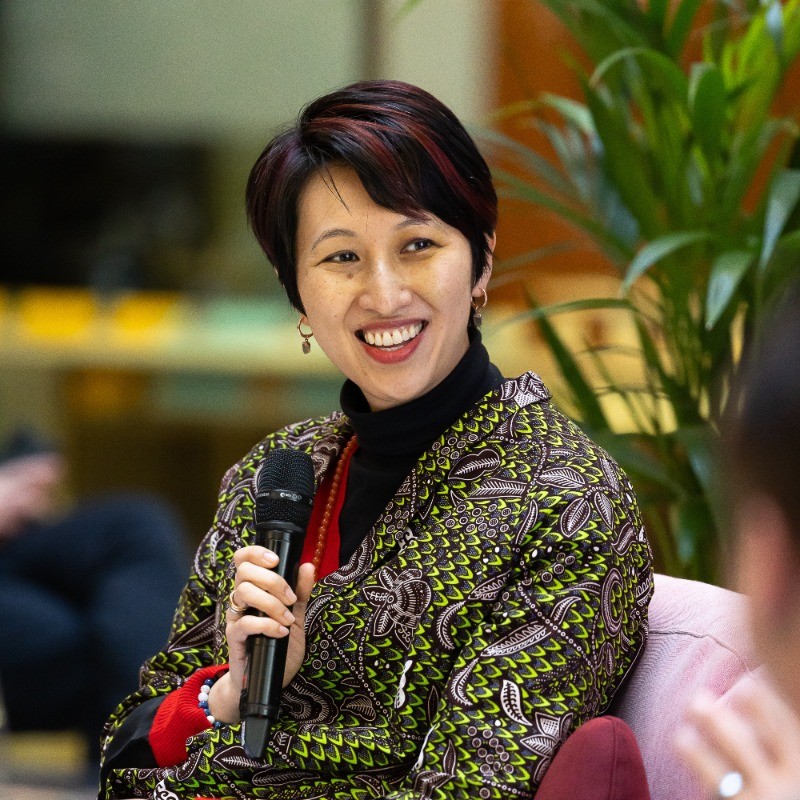
Micrographia Bio was founded in 2020 by Julia Li and Chris Thompson.

Investors · 4

How we know: the VCSheet dataset · open dataset · 5k.vc investor directory · Not right? Tell us

How we know: the Entrepreneur First portfolio · Not right? Tell us
How we know: Samos Investments's portfolio page · Not right? Tell us
.jpeg)
How we know: the VCSheet dataset · open dataset · 5k.vc investor directory · Not right? Tell us
Company profile
researched Aug 2026Micrographia Bio is a London-based life sciences company developing an AI-enabled spatial proteomics platform that directly visualizes protein-protein interactions and protein behaviour at nanoscale resolution. The company positions its approach as an alternative to genomics- and transcriptomics-led drug discovery, arguing that understanding protein-protein networks inside cells determines the mechanism of action of medicines and that protein proximity informs mechanism.
The platform combines advanced imaging chemistry with machine learning to deliver quantitative, spatially informed endpoints. Stated capabilities include detection of proteins at single-molecule resolution, multiplexed detection of nanoscale protein interactions (described as 2-12plex or greater), and visual inspection and quantification of individual protein complexes, supporting mechanistic characterization of therapeutic compounds. Application areas listed by the company include endogenous protein-protein interactions, homodimerization and heterodimerization, and protein signalling complex formation, in contexts where spatial context matters.
Alongside platform work, the company states it is advancing internal pipeline therapeutic candidates focused on fundamental cellular pathways. The company name references Robert Hooke's 1665 publication "Micrographia: or Some Physiological Descriptions of Minute Bodies made by Magnifying Glasses."
Founding story
The company states it was founded on the belief that the future of drug discovery will be driven by spatial proteomics — understanding protein-protein networks inside cells to determine mechanisms of action — and with the inspiration that all diseases deserve a cure. Its name draws on Robert Hooke's 1665 work Micrographia, in reference to how early microscopy revealed a previously hidden world.
Business model
The website indicates a dual approach: an AI-enabled spatial proteomics platform offered in the context of partnerships and collaborations with drug developers, alongside internally advanced therapeutic candidates focused on fundamental cellular pathways. The sources do not describe pricing, contract structures or revenue arrangements.
Not disclosed in the available sources.
Traction
No customers, revenue, funded partnerships or study results are quantified in the sources. The company references illustrative platform applications and collaborations without naming counterparties, and states it is advancing internal therapeutic candidates. It has assembled a scientific advisory board including Annalisa Jenkins (Non-Executive Director, Genomics England; former Head of R&D at Merck Serono), Kate Haviland (former CEO, Blueprint Medicines), Professor Ed Tate (GSK Chair in Chemical Biology, Imperial College London), Alexander Moscho (former Chief Strategy Officer, UCB), Deborah Dunsire (former CEO of Lundbeck, Millennium and FORUM Pharmaceuticals) and Professor Ralf Jungmann (Ludwig Maximilian University; DNA-PAINT super-resolution microscopy).
Latest developments
No dated news, financing or product announcements appear in the available sources. The company website carries a 2026 copyright notice and maintains active contact, team, technology and careers sections.
▸Full profile — market position, technology, go-to-market, geography, history, risks & controversies
Market position
Described by the company as an applied AI-first life sciences company in spatial proteomics, contrasting its approach with genomics and transcriptomics methods it characterizes as having failed at cost-effective drug discovery. The sources contain no third-party market share, ranking or competitive benchmarking data.
The company distinguishes its platform by direct visualisation and quantification of endogenous protein-protein interactions at nanoscale, in spatial context, rather than relying on genomic or transcriptomic readouts or conventional assays, with the stated aim of increasing mechanistic clarity at the earliest stages of discovery.
Technology
An AI-enabled spatial proteomics platform combining advanced imaging chemistry, microscopy, machine vision and machine learning to observe and quantify protein interactions at nanometer scale. Stated technical capabilities: single-molecule resolution protein detection; multiplexed (2-12plex+) detection of nanoscale protein interactions; and visual inspection and quantification of individual protein complexes, yielding quantitative, spatially informed endpoints. The company describes its team as spanning molecular biology, chemistry, physics, optics and machine learning.
Go-to-market
The website directs prospective partners to contact the company by email and offers a mailing list for news and partnering opportunities, and refers to illustrative platform applications and collaborations, indicating a partnership- and collaboration-led approach with drug developers. No sales channels, customers or distribution details are disclosed in the sources.
Drug discovery organizations and researchers seeking mechanistic characterization of therapeutic compounds and quantitative endpoints for protein interactions at early discovery stages.
Geography
Single stated location: Micrographia Bio (122L), Translation & Innovation Hub, 84 Wood Lane, London W12 0BZ, United Kingdom. Entrepreneurs First lists the company under its London portfolio context.
History
Entrepreneurs First lists Micrographia Bio in its company portfolio, indicating an association with the EF talent investor programme. The website describes the company as founder-led and co-founded by Julia Fan Li (CEO) and Chris Thompson (CTO). Sources do not provide a dated history of financing or milestone events.
Risks & controversies
No controversies, litigation or negative coverage of Micrographia Bio appear in the available sources. Two retrieved documents concerning startup shutdowns and biotech closures do not mention the company. Publicly available information is limited largely to the company's own website, and no funding, revenue, headcount or validation data is disclosed.
Compiled by commissioned research from 6 cited public sources — announcements, filings, and press listed under research sources below.
Key figures
latest reportedCompany-reported or press-reported figures, each dated to when it was claimed — not independently audited.
Companies House · registry record
View on Companies House ↗- Registered name
- MICROGRAPHIA BIO LIMITED
- Company number
- 12329276
- Status
- Active
- Company type
- Private limited company
- Incorporated
- 22 Nov 2019
- Registered office
- Dawes Road Hub, 20 Dawes Road, London, SW6 7EN
- Nature of business (SIC)
- 72190 — Other research and experimental development on natural sciences and engineering
- Accounts
- last made up to 30 Nov 2025 · next due 31 Aug 2027
- Confirmation statement
- last made up to 30 Dec 2025 · next due 13 Jan 2027
Current officers · 2
- Julia Li — director, appointed 22 Nov 2019
- Christopher Thompson — director, appointed 22 Nov 2019
Source: Companies House public register · retrieved 13 Sept 2026. Contains public sector information licensed under the Open Government Licence v3.0.
▸Research sources · 6
primary sources listed
- Micrographia Bio | Discovery in a blinkmicrographiabio.com · web
6 public sources were cited for this profile; the first-party ones are listed here.
Frequently asked questions
- What does Micrographia Bio do?
- London spatial proteomics company using AI-enabled nanoscale imaging to visualize protein-protein interactions for drug discovery.
- Who founded Micrographia Bio?
- Micrographia Bio was founded by Julia Li, Chris Thompson in 2020.
- Who are Micrographia Bio's investors?
- Micrographia Bio's investors include DCVC (Data Collective), Entrepreneur First, Samos Investments, Ada Ventures.
- Where is Micrographia Bio headquartered?
- Micrographia Bio is headquartered in London, GB.