 Fundraising Fox
Craitor
Techstars '23San Diego, US · Founded 2019 · Delaware corporation · 7 employees on LinkedIn · 1 known investors
Find your way into Craitor
Sign up to see every warm intro you have to Craitor
- Paths you didn't know you had: your email and LinkedIn already hold routes to the Craitor team. We find them for you
- 2nd- and 3rd-degree connections: the friend-of-a-friend routes that take hours to manually find through your inbox or LinkedIn
- Answers now, not in days: momentum is everything in a raise. Skip asking around whether someone knows someone
Days of research, done the moment you sign in, with every route ranked by how warm it is.
FieldFab produces ruggedized, portable 3D printers designed to manufacture mission-critical parts in harsh and austere environments. The system operates across extreme temperature ranges and demanding field conditions, serving tactical and defense applications requiring on-site manufacturing capabilities.
Also known as Craitor, Inc.
Founders & leadership
Craitor was founded in 2019 by Eric Shnell.
Investors · 1

How we know: the Techstars portfolio · open dataset · Top 3000 Accelerator Startups (no YC) 2026-08 · Not right? Tell us
Reported raises · per SEC filings
Form D private placements$10K disclosed across 1 round · 2024
▶$10KraisedJun 2024 · 1 investors · Other TechnologyRule 506(b)
- Eric ShnellExecutive Officer, Director
- Meher Akhil BirlangiExecutive Officer, Director
- Offering amount
- $500K
- Amount sold
- $10K
- First sale
- Apr 2024
- Incorporated
- Corporation, Delaware
- Federal exemptions
- 06b
Source: SEC EDGAR Form D. Amounts as filed; amended filings shown once at their latest values.
Company profile
researched Sep 2026Craitor is a San Diego, California-based machinery company that develops and manufactures rugged, portable 3D printers for military and other extreme operating environments. Its system, FieldFab, is designed to print mission-critical components where conventional supply chains are unreliable or unavailable, and is built to resist dust, water, humidity, temperature cycling, vibration and rough handling during transport. The company describes its aim as building a production layer for critical hardware deployed at the point of need, so that readiness does not depend on an external supply chain or factory.
FieldFab is stated to meet MIL-STD-810H requirements, to print in temperatures from -40°F to 120°F across all humidity conditions, and to be qualified for tactical transportation by air, land and sea. It is compatible with polymer-based filaments, including advanced high-temperature plastics, composites and flexible materials, and is used for vehicle and transportation systems, communications infrastructure, medical equipment, robotics, and power generation and distribution parts. Automation reduces operator training from an industry norm of several days to roughly 15 minutes, which the company likens to operating a parts vending machine.
Beyond FieldFab, Craitor says it is building a broader ecosystem of manufacturing hardware, software and certified digital data intended to link design authority, manufacturing and end users into a single digital supply chain, with multiple tiers planned for announcement in 2026 and a further platform described on its website as coming in 2027.
Founding story
Eric Shnell began 3D printing as a hobbyist in the early 2010s and, while studying mechanical engineering at UC San Diego, trained and supervised students in campus maker studios. That work led to a role as a strategic technical advisor supporting advanced manufacturing for the U.S. Marine Corps, where he observed that Marines spent more time working around the limitations of existing 3D printers than vendors spent adapting to Marine requirements. He founded Craitor to address that gap in Marine Corps maintenance and supply-chain modernization; the name is a play on the words "crate" and "creator." Shnell has credited UC San Diego programs including the Basement, the Institute for the Global Entrepreneur and the Office of Innovation and Commercialization for mentorship and connections.
Business model
Craitor sells rugged additive manufacturing hardware and associated software and services primarily to government and defense customers, a business model characterized as B2G. Revenue sources identified include government contracts, hardware sales, and services and consulting. The company works with OEM partners so that certified parts can be produced on demand at the point of need, positioning the offering as a digital supply chain rather than a standalone printer sale.
Revenue is derived from government contracts, hardware sales, and services and consulting, sold principally on a business-to-government basis.
Traction
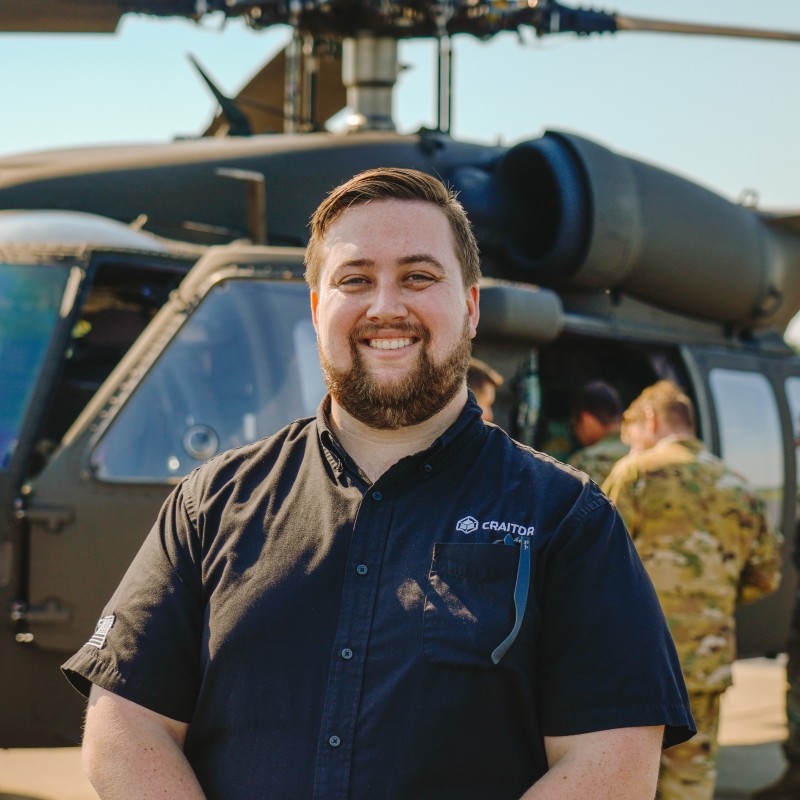
Craitor works with the U.S. Marine Corps, Army and Navy, and its FieldFab system has been deployed in dozens of field exercises both inside and outside the continental United States with the U.S. Department of Defense, allied nations and commercial partners. A notable deployment was in-flight printing of UAV components aboard a UH-60 Black Hawk in October 2025. As of 2023 the company was running an initial pilot run of production-level systems. Caplight records approximately seven employees and $3.42 million in total funding raised as of January 2026.
Latest developments
In October 2025, FieldFab was integrated into a UH-60 Black Hawk helicopter together with Sentient Industries' METEOR power system and used to print UAV components designed by 2nd Order Effects while the aircraft flew combat maneuvers. In a January 2026 interview, the CEO said the company planned to formally announce multiple tiers of a broader manufacturing and digital supply chain ecosystem during 2026. The company's website states that a next platform is in development, coming in 2027.
▸Full profile — market position, technology, go-to-market, geography, history
Market position
Craitor operates in defense technology and additive manufacturing, with verticals spanning 3D printing, defense tech and smart manufacturing. Companies identified as comparable include SPEE3D, Markforged and Firestorm. The company describes itself as having built a defense hardware business before defense startups became a popular investment category.
Craitor positions its systems against conventional 3D printers that were not designed for field use. Stated points of difference include certification to MIL-STD-810H, operation from -40°F to 120°F and in all humidity conditions, resistance to dust, water, shock and vibration, qualification for tactical air, land and sea transport, a heated chamber for regulated printing, and integrated models and machine learning that allow parts to be printed consistently without an expert operator, cutting operator training to about 15 minutes.
Technology
FieldFab is a portable fused-filament 3D printing platform engineered for austere conditions. It has a heated chamber that maintains steady temperature for regulated printing, and hardware, software and machine-learning models that work together so parts drawn from a database can be printed consistently without an expert operator. It is certified to MIL-STD-810H, prints from -40°F to 120°F in all humidity conditions, and is qualified for tactical transport by air, land and sea. The platform supports polymer-based filaments including advanced high-temperature plastics, composites and flexibles, and the company states it can produce direct metal replacements, biocompatible parts, flexible parts and standard parts.
Go-to-market
The company entered the market through direct collaboration with military units, beginning as technical advisors to the Marine Corps Digital Manufacturing unit and developing its system under a Cooperative Research and Development Agreement with the U.S. Marine Corps. It has expanded through field exercises and deployments with the Department of Defense, allied nations and commercial partners, and works with OEM partners to enable certified on-demand part production. It has also participated in accelerator programs including SCALE Aerospace Ventures, run by UCLA and Starburst Aerospace, and has stated intentions to move into commercial markets.
Primary customers are military and government organizations, including the U.S. Marine Corps, Army and Navy, the wider U.S. Department of Defense and allied nations. The company has also identified commercial and industrial markets such as gas and wind energy companies and farms, as well as disaster relief and medical response organizations, and has expressed longer-term interest in space applications.
Geography
Craitor is headquartered in San Diego, California, and originated at UC San Diego. Early development work took place with the U.S. Marine Corps at Camp Pendleton and Twentynine Palms and with the Navy at Naval Base San Diego. FieldFab has been deployed in dozens of field exercises both CONUS and OCONUS with the U.S. Department of Defense, allied nations and commercial partners.
History
Eric Shnell began the work that became Craitor as an undergraduate mechanical engineering student at UC San Diego in 2018, initially leading a team of undergraduates serving as strategic technical advisors to the Marine Corps' Digital Manufacturing unit. The founding of the company is dated to 2019 in a January 2026 interview with Shnell, while a UC San Diego article dates the start of his startup journey to 2018. The company took part in a Blackstone LaunchPad accelerator activity dated April 2020 and joined the inaugural SCALE Aerospace Ventures accelerator cohort, run by UCLA and Starburst Aerospace, in May 2021. Shnell has described carrying the company through the pandemic and bootstrapping its growth while he was a full-time student. By 2023 the company was running an initial pilot production run of its systems with the Marines, Army and Navy while beginning to explore commercial markets, and in October 2025 its FieldFab system was operated in flight aboard a UH-60 Black Hawk.
Compiled by commissioned research from 7 cited public sources — announcements, filings, and press listed under research sources below.
Key figures
latest reportedCompany-reported or press-reported figures, each dated to when it was claimed — not independently audited.
Timeline · 3
launches, deals, and filingsU.S. troops used Craitor's FieldFab system to 3D print UAV components inside a UH-60 Black Hawk helicopter while the aircraft flew combat maneuvers. The system was integrated alongside Sentient Industries' METEOR power system, and the printed drone parts were designed by 2nd Order Effects.
Craitor was named one of eight aerospace startups in the 2021 inaugural cohort of SCALE Aerospace Ventures, a 13-week virtual accelerator run jointly by UCLA and Starburst Aerospace for pre-seed and seed stage companies.
Craitor's system was developed under a CRADA with the U.S. Marine Corps, with the team working directly with the 9th Communication Battalion at Camp Pendleton. The company later also worked with the Navy through Naval Base San Diego and with units at Twentynine Palms.
Dated company events from announcements, filings, and press; legal rows summarize public dockets and regulator releases.
Legal entities · 1
corporate structure▸Research sources · 7
primary sources listed
- Craitorcraitor.com · web
7 public sources were cited for this profile; the first-party ones are listed here.
Frequently asked questions
- What does Craitor do?
- Craitor builds FieldFab, a rugged portable 3D printer for producing mission-critical parts in extreme field environments.
- Who founded Craitor?
- Craitor was founded by Eric Shnell in 2019.
- Who are Craitor's investors?
- Craitor's investors include Techstars.
- How much funding has Craitor raised?
- Craitor has disclosed $10K raised across 1 round.
- Where is Craitor headquartered?
- Craitor is headquartered in San Diego, US.