 Fundraising Fox
Airbility
500 Global '2413 employees on LinkedIn · 5 known investors
Find your way into Airbility
Sign up to see every warm intro you have to Airbility
- Paths you didn't know you had: your email and LinkedIn already hold routes to the Airbility team. We find them for you
- 2nd- and 3rd-degree connections: the friend-of-a-friend routes that take hours to manually find through your inbox or LinkedIn
- Answers now, not in days: momentum is everything in a raise. Skip asking around whether someone knows someone
Days of research, done the moment you sign in, with every route ranked by how warm it is.
Airbility is a South Korean aircraft developer working on high-speed electric vertical take-off and landing vehicles. Its designs use distributed fanjet propulsion and modular hybrid power systems intended for quieter medium- to long-range flight.
Also known as Airbility Inc. · 에어빌리티
Founders & leadership


Investors · 5

How we know: open dataset · Top 3000 Accelerator Startups (no YC) 2026-08 · open dataset · 500 Global portfolio 2026-08 · Not right? Tell us

How we know: a partner's Signal profile · Not right? Tell us
How we know: prnewswire.com · funding news · Not right? Tell us
Funding
SEC filings, press & company announcements$4.7M disclosed across 1 of 2 rounds · 2026
- $4.7MSeries ASep 2026 · 6 sources
Sazze Partners (lead), Industrial Bank of Korea, Stonebridge Ventures
Source ↗
Source: company announcements and press reports — follow each round's link for the claim.
Company profile
researched Sep 2026Airbility Inc. is a South Korean aerospace and defense company that develops high-speed electric vertical take-off and landing (eVTOL) aircraft and integrated counter-unmanned aircraft system (counter-UAS) capabilities. The name is derived from a combination of "air" with "mobility" and "ability." Its aircraft combine eVTOL airframe geometries and flight systems with distributed electric fanjet propulsion, variable-inlet technology and modular hybrid-energy propulsion, paired with onboard autonomy and links to external sensing assets.
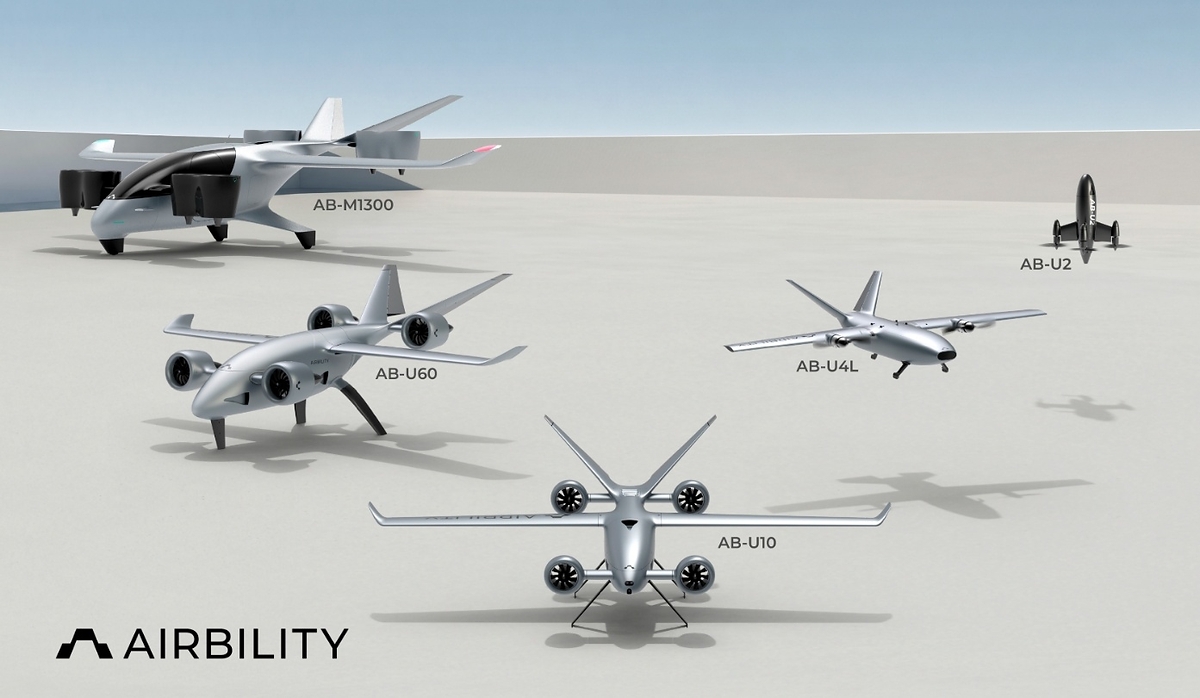
The company's product line spans an airborne mothership platform, capture and kinetic interceptors, and heavy-lift cargo aircraft built on a shared autonomy and command architecture. Disclosed platforms include the AB-U10, a 10 kg-class vectored-thrust eVTOL with a 1.8 m wingspan, 2 kg payload, range over 10 km and speeds of roughly 160-180 km/h, equipped with an integrated net gun for counter-drone missions; the AB-U60, a 60 kg-class surveillance and emergency-logistics eVTOL with fanjet electric propulsion and a hybrid energy source reaching up to 200 km/h, also used as a mothership; the AB-U2, a compact kinetic interceptor deployed from the mothership; the AB-U4L, a fixed-wing launcher-deployed interceptor designed for approximately 300 km/h; the 4 kg-class AB-U4, which entered commercialization in 2025; and the AB-M1300, a 1.3-ton-class crewed-uncrewed hybrid eVTOL with a 10 m wingspan, two occupants, 250 kg payload, 400 km/h top speed and two hours of endurance, targeted at Light Sport Aircraft certification and commercialization in 2028 for mid-mile logistics, leisure and pilot training.
Airbility positions its air-to-air interception approach against the cost asymmetry of drone defense, citing roughly USD 35,000 for a Shahed-type one-way attack drone versus about USD 4 million for a Patriot interceptor, and estimating engagement costs of approximately USD 50 to USD 3,000 depending on configuration, with AB-series pricing at roughly one-tenth of comparable overseas systems.
Founding story
Airbility was founded in November 2023 with the stated aim of providing solutions through future air mobility. It was co-founded by researchers who worked on Korea's KT-1, T-50 and KF-21 aircraft programs at the Agency for Defense Development, together with professionals from Hyundai Motor, the MIT Media Lab, LG Electronics and Genesis Design. Three senior technical leaders each spent between 25 and 31 years at the Agency for Defense Development.
Business model
Airbility designs, engineers and manufactures its own aircraft in-house, using 3D printing, composite airframe machining, battery packs and flight-control software, and sells mission-specific unmanned platforms. Management has stated an intent to broaden the model from selling airframes to selling integrated counter-drone systems. Internationally, it also pursues OEM manufacturing and distribution partnerships, such as an arrangement under which Vietnam's CT UAV would produce 5,000 UAVs including the AB-U60 and handle distribution, sales, support and maintenance.
Revenue is derived from sales of unmanned aircraft and, going forward, integrated counter-drone systems, supplemented by government R&D support programs. Management has targeted KRW 50 billion in cumulative revenue by 2028.
Traction
In December 2025, two years after founding, Airbility completed transition-flight demonstrations across three prototype aircraft. The 4 kg-class AB-U4 entered commercialization in 2025, with the AB-U10 planned for commercialization by the end of 2026 and the AB-U2 and AB-U4L in the first half of 2027; the AB-U60 is targeted for launch in 2027. The company had 26 employees, approximately 80 percent of them in R&D, and was hiring across hardware, AI and software roles. It secured USD 2.2 million (KRW 3 billion) in R&D support via the Korea AeroSpace Administration's 2026 Scale-Up TIPS program and was pursuing projects with the ROK Marine Corps and the Defense Acquisition Program Administration.
Latest developments
In September 2026 Airbility announced a KRW 6.5 billion (USD 4.7 million) Series A led by Sazze Partners with participation from Stonebridge Ventures and Industrial Bank of Korea, bringing total funding to KRW 10.5 billion (USD 7.6 million). It subsequently opened the Giheung Campus, integrating R&D and production, and began large-scale hiring as a government-designated employer under Korea's military service exemption program for research and industrial technical personnel, aiming to deliver its first counter-drone aircraft within the year. It also debuted its integrated counter-UAS interceptor lineup at MSPO 2026, signed an MOU with the ROK Army Air Defense School, and won a Red Dot Design Award.
▸Full profile — market position, technology, go-to-market, geography, history, risks & controversies
Market position
Airbility describes itself as a deep-tech aerospace and defense company addressing the cost imbalance created by low-cost attack drones, and has been characterized in coverage as aspiring to be "Korea's Anduril." It claims Korea's first counter-drone (C-UAS) interceptor, recognized with a Red Dot Design Award. Its Series A was cited as Sazze Partners' first defense-sector investment.
Airbility emphasizes in-house design, engineering and rapid prototyping in a single continuous process from airframe design and 3D printing through composite machining, assembly, onboard AI integration and flight testing, enabling design changes to feed directly into prototypes. Its aircraft pair vertical take-off with high-speed, low-noise fanjet propulsion and hybrid energy for longer endurance, and its air-to-air hard-kill approach is presented as offering a far lower cost per engagement than conventional interceptors, with domestically developed systems priced well below comparable overseas offerings and fewer origin-related export restrictions.
Technology
Airbility's platforms use distributed electric fanjet propulsion, variable-inlet technology and modular hybrid-energy propulsion to combine vertical take-off with high-speed cruise and extended endurance, with low-noise characteristics cited for urban and suburban operation. Capabilities span AI-powered detection and tracking, AI-driven kill-chain command and control, high-speed interception and AI-enabled mothership operations, with onboard AI intended to allow independent mission execution in communications-limited environments and integration with radar, electro-optical and infrared sensors so that detection, interception and post-engagement assessment operate as one system. Engineering work includes reinforcement learning and autonomous decision-making, ground-system AI with multi-target fusion, onboard AI on Jetson Orin NX with ROS2, and simulation using PIL, HIL, Isaac Sim and Unreal. The company is also developing domestically produced electric ducted fans, targeting an 80 kW-class EDF for a 1.3-ton eVTOL with a 15 kW scaled prototype for ground and flight testing.
Go-to-market
The company sells directly to defense and government customers in Korea while building references through military and procurement-agency projects, and expands abroad through memoranda of understanding, joint ventures and OEM/distribution partners. It was in commercial discussions with counterparties in more than nine countries across the Middle East, Southeast Asia and Latin America, with four MOUs and two joint ventures in progress, and exhibited its integrated counter-UAS interceptor lineup in Europe at MSPO 2026.
Defense and security customers, including the Republic of Korea Marine Corps, the Defense Acquisition Program Administration and the ROK Army Air Defense School, as well as operators protecting critical infrastructure such as airports, power plants and cities. Civil and commercial applications include mid-mile logistics, wildfire monitoring, disaster response, ship resupply, medical and express logistics, security services, leisure use and pilot training.
Geography
Headquartered in Seocho-gu, Seoul, with research and manufacturing in South Korea. Operations formerly spanned a corporate research center in Yangjae, Seoul and a plant in Seongnam, Gyeonggi Province, which were consolidated into the Giheung Campus in Yongin, Gyeonggi Province. Commercial activity extends to Vietnam and Southeast Asia, the Middle East, Latin America and Europe.
History
Founded in November 2023 and based in Seoul's Seocho-gu district, Airbility initially framed itself as an advanced air mobility (AAM) company before moving toward counter-UAS defense applications. In 2025 it began an anti-drone technology series on its blog, launched an electric ducted fan localization R&D project with E-Powertrain Korea, Sejong University and the Korea Light Aircraft Research Association under a COMPA program, and signed an MoU with Vietnam's CT Group in August 2025. The 4 kg-class AB-U4 entered commercialization in 2025. In December 2025 the company completed transition-flight demonstrations across three prototype aircraft, validating core design, flight-control logic and system integration. In September 2026 it closed a Series A led by Sazze Partners, and it subsequently consolidated its Yangjae corporate research center and Seongnam plant into a combined Giheung Campus in Yongin, Gyeonggi Province.
Risks & controversies
Commercialization timelines for the AB-U10, AB-U2, AB-U4L, AB-U60 and AB-M1300 remain forward-looking, and the revenue target of KRW 50 billion by 2028 is a company projection. Much of the international pipeline consists of memoranda of understanding and joint-venture initiatives rather than executed contracts, and export activity in defense markets is subject to procurement and origin restrictions.
Compiled by commissioned research from 8 cited public sources — announcements, filings, and press listed under research sources below.
Key figures
latest reportedCompany-reported or press-reported figures, each dated to when it was claimed — not independently audited.
Timeline · 11
launches, deals, and filingsAirbility announced a USD 4.7 million (KRW 6.5 billion) Series A led by Silicon Valley firm Sazze Partners, with follow-on from existing investor Stonebridge Ventures and Industrial Bank of Korea as a new shareholder, bringing total funding to USD 7.6 million (KRW 10.5 billion). Valuation was not disclosed. Proceeds are for end-to-end counter-UAS development, production infrastructure and onboard AI. Other existing investors include Samho Green Investment, Mashup Ventures, BASS Ventures and 500 Global.
$4.7M source ↗
Airbility won a Red Dot Design Award for what it describes as Korea's first counter-drone (C-UAS) interceptor.
Airbility consolidated its Yangjae corporate research center in Seoul and its Seongnam plant into the Giheung Campus in Yongin, Gyeonggi Province, creating a one-stop process spanning airframe design, 3D printing, composite machining, assembly, onboard AI integration and flight test, and launched large-scale hiring across hardware, AI and software roles.
Airbility presented its integrated counter-UAS interceptor lineup in Europe at the MSPO 2026 defense exhibition.
Airbility secured USD 2.2 million (KRW 3 billion) in R&D support after selection for the Korea AeroSpace Administration's 2026 Scale-Up TIPS program; company materials describe up to KRW 3 billion in R&D support over three years.
$2.2M source ↗
Airbility signed a memorandum of understanding with the Republic of Korea Army Air Defense School on advancing counter-drone weapon systems.
Airbility signed a strategic memorandum of understanding with German company Schübeler covering electric ducted fan propulsion technology for eVTOL platforms.
Airbility completed transition-flight demonstrations on three prototype aircraft, validating core design, flight-control logic and system integration for its high-speed eVTOL platform.
Airbility signed a strategic MoU with Vietnamese conglomerate CT Group at the Korea Chamber of Commerce and Industry in Seoul during the Korea-Vietnam High-Level Industrial Cooperation MoU Signing Ceremony. The partnership covers co-development and commercialization of high-speed eVTOL-based UAV platforms, AAM technology demonstrations, exclusive distribution in Vietnam and Southeast Asia, and joint training programs. CT Group subsidiary CT UAV is to produce 5,000 UAVs including the AB-U60 under an OEM model. Facilitated by KILSA Global.
Airbility launched a follow-up R&D project, "Development of Design Technology for Electric Ducted Fans for Next-Generation Lightweight eVTOL Aircraft," through COMPA's Public Technology Discovery and Matching Program, with E-Powertrain Korea and Sejong University participating and the Korea Light Aircraft Research Association as lead organization. The team targets an 80 kW-class EDF for a 1.3-ton VTOL aircraft plus a 15 kW scaled prototype.
The 4-kilogram-class AB-U4 entered commercialization in 2025.
Dated company events from announcements, filings, and press; legal rows summarize public dockets and regulator releases.
In the news
▸Research sources · 8
primary sources listed
- Airbilityairbility.co.kr · web
8 public sources were cited for this profile; the first-party ones are listed here.
Frequently asked questions
- What does Airbility do?
- South Korean deep-tech aerospace firm building high-speed eVTOL aircraft and air-to-air counter-drone interceptor systems.
- Who founded Airbility?
- Airbility was founded by Jinmo Lee, Minyoung Ahn.
- Who are Airbility's investors?
- Airbility's investors include 500 Global, Industrial Bank of Korea, Primer Sazze Partners, Sazze, Stonebridge Ventures.
- How much funding has Airbility raised?
- Airbility has disclosed $4.7M raised across 1 of its 2 known rounds.